
Part of the regional summaries: Chagos Archipelago - Egmont / Danger Island / Cauvin Bank and Chagos Archipelago
More info
Chagos (NOAA CRW virtual station)BIEG06, at Egmont, shows coral stress in three forms at once - widespread pale, washed-out Acropora plains, individual colonies with bone-white branch tips, and standing dead branching framework already colonized by algae - but also new coral recruits settling directly on that dead substrate, capturing mortality and recovery side by side. Fish life here includes the largest trevally and snapper schools reviewed in the whole Chagos set, plus the only nudibranch found in the archipelago's photographed frames. Published cover is 44%. Surveyed on the Living Oceans Foundation's Global Reef Expedition.
Nine independent survey stations shown with the program’s logo — click one to see how far it is from this site.
Three other CRD dive sites within 5 km shown in orange — click a marker to open its page.
🗺 Detailed map of the Global Reef Expedition dive sites, Egmont Atoll, Chagos (Khaled bin Sultan Living Oceans Foundation; opens in a new window)
Site description
Setting
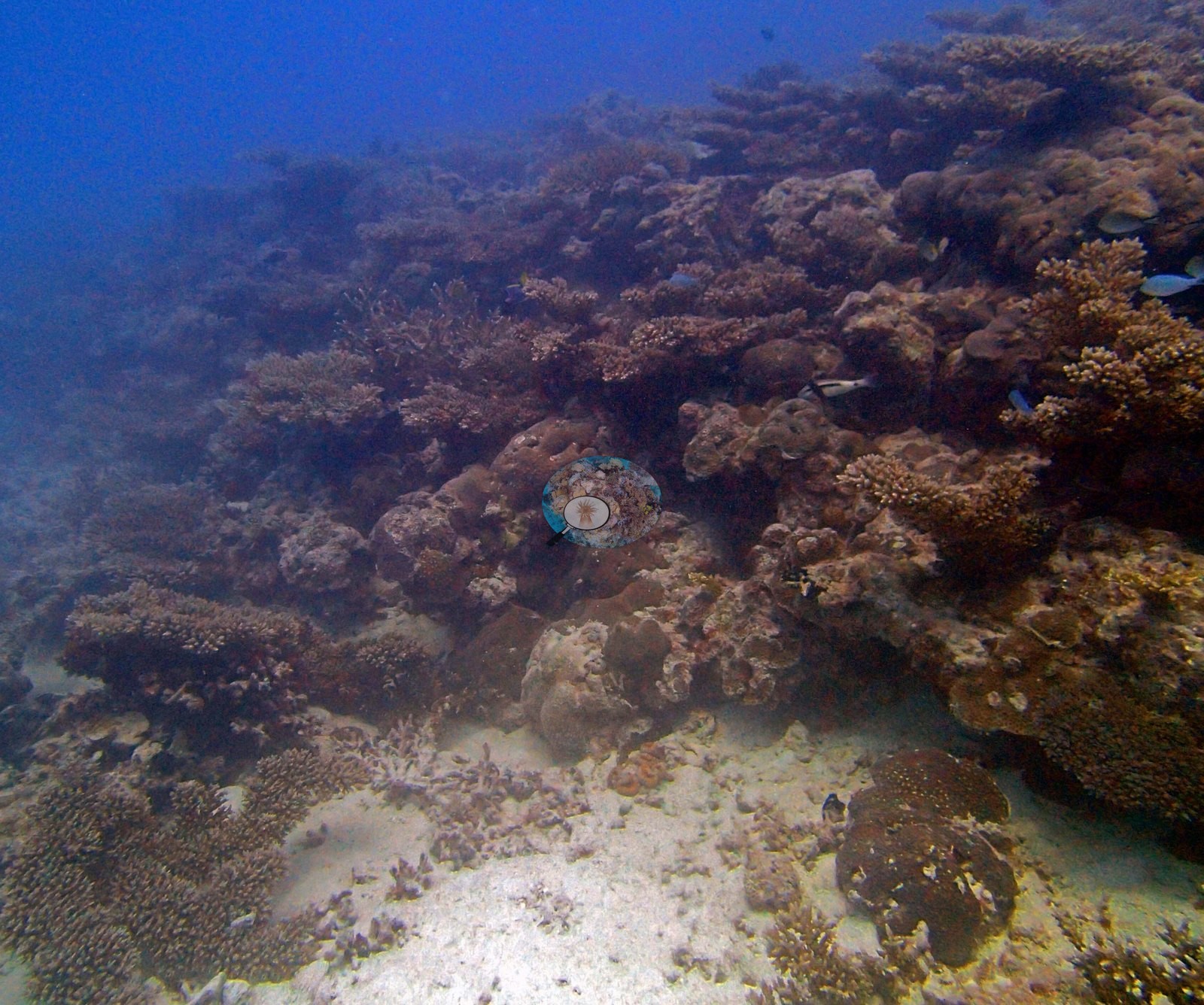
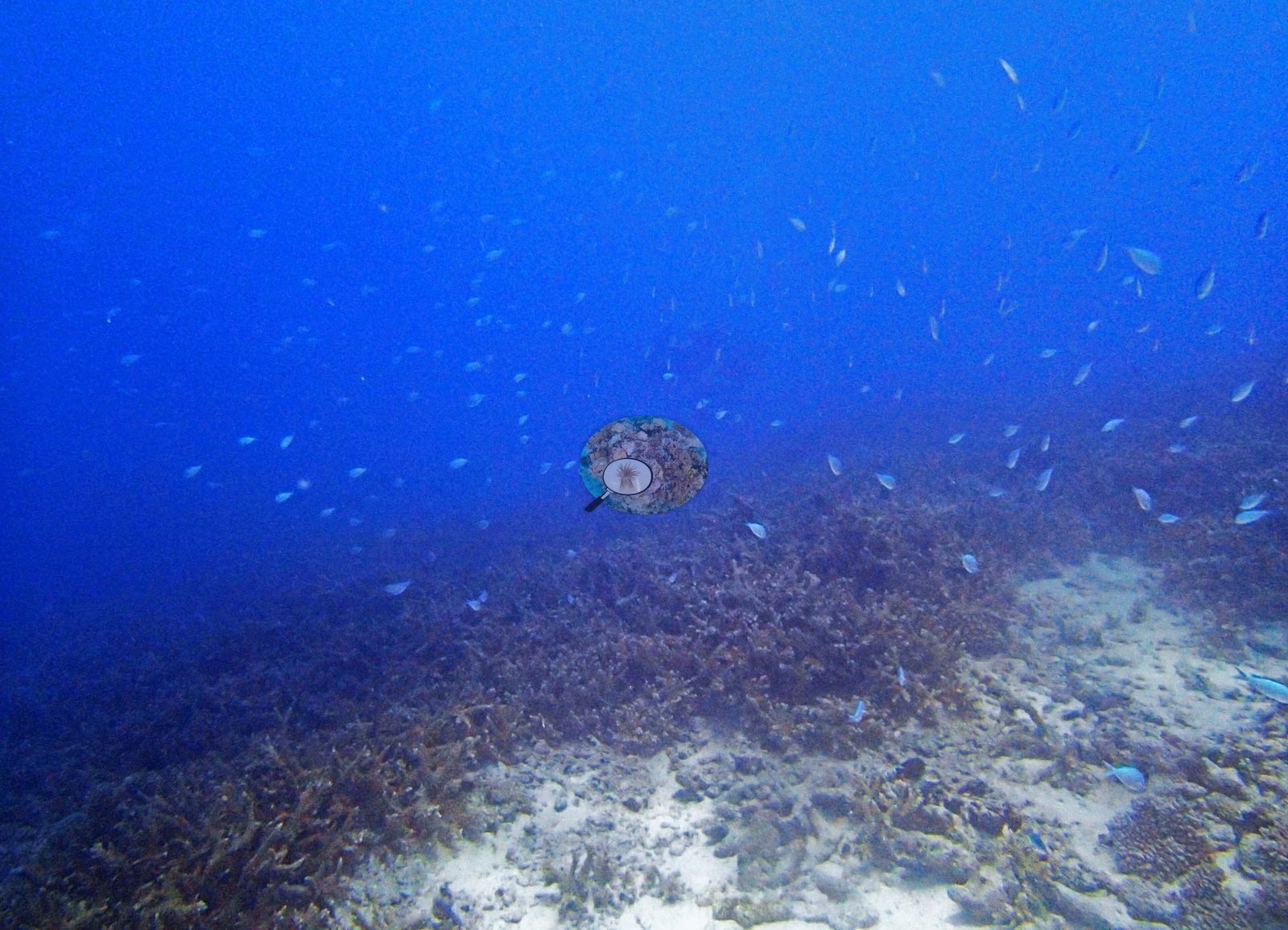
Visibility is fair to hazy and several frames (P3110530, P3110533, P3110534, P3110536, P3110539, P3110553, P3110561) are soft or backscattered.
General benthic features
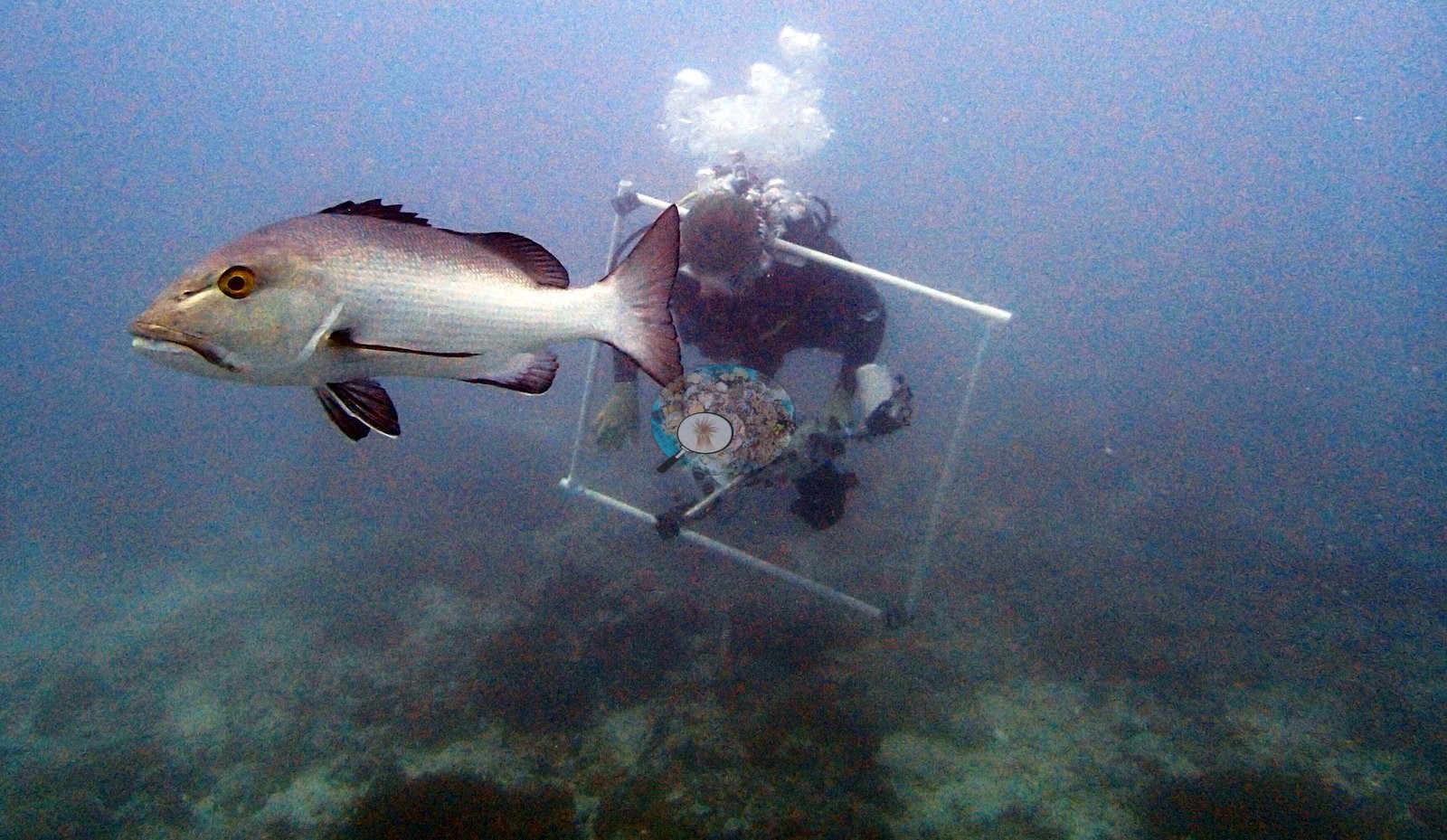
Quadrat apparatus is visible in one frame; no scale bar appears anywhere.
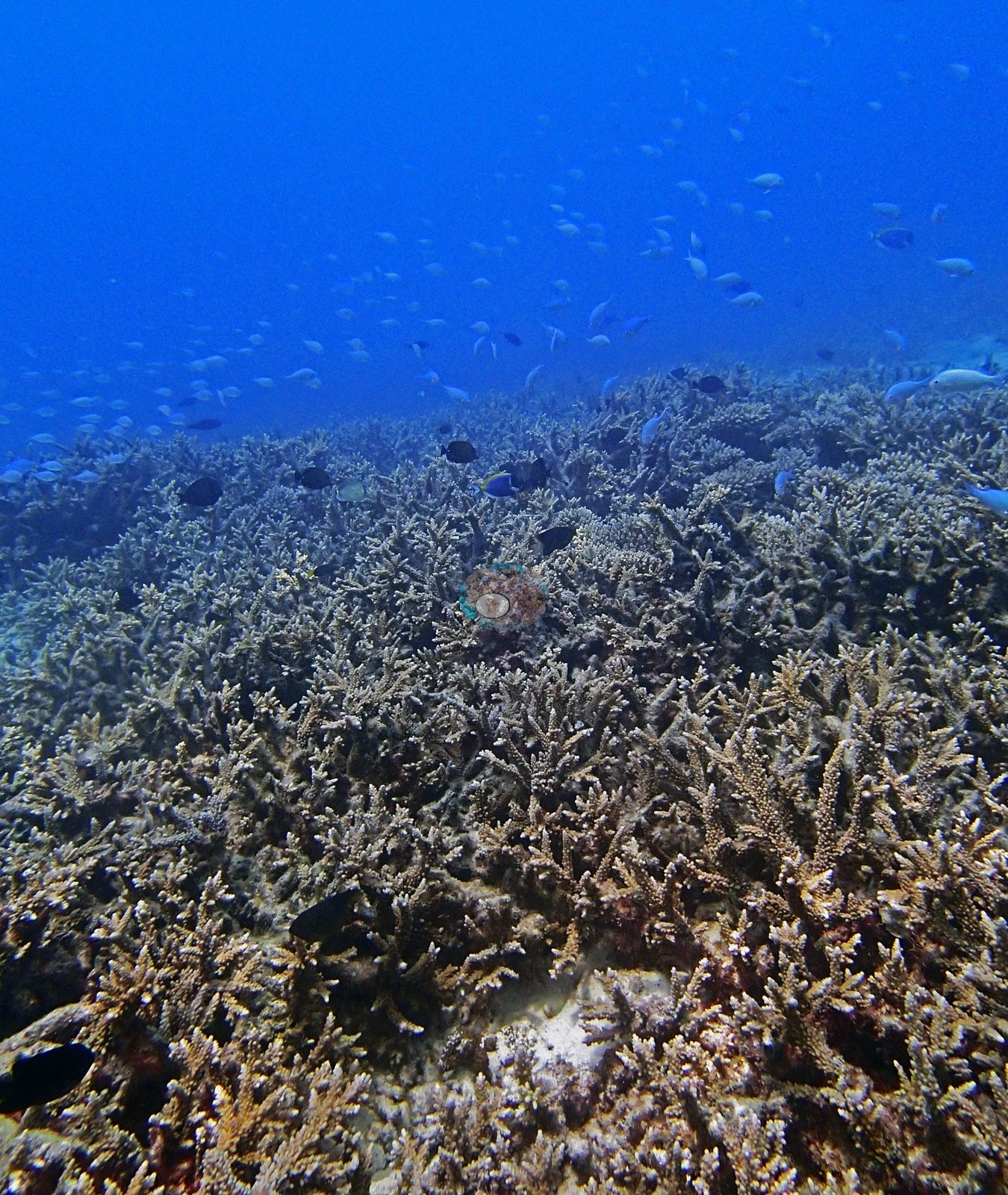
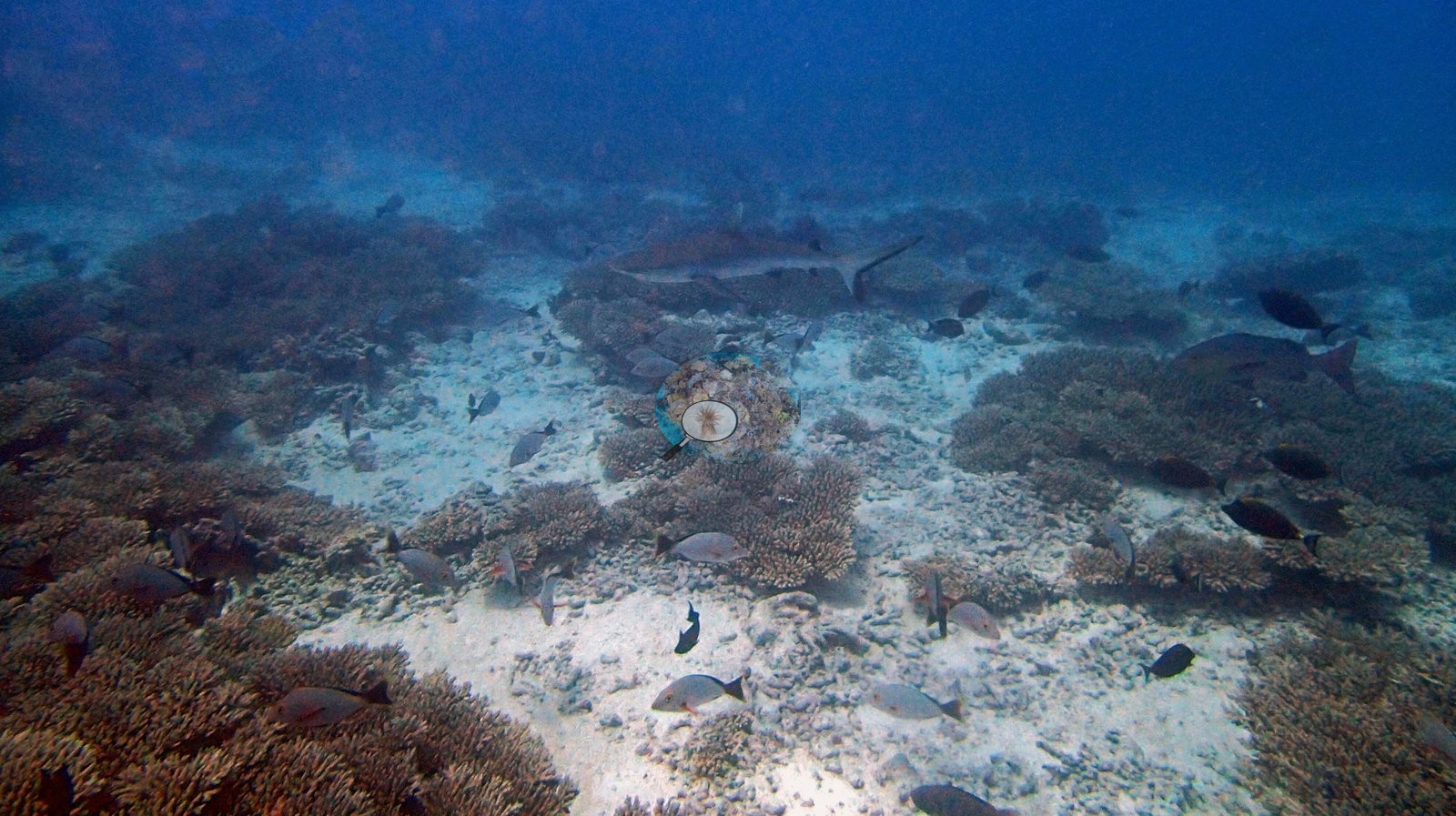
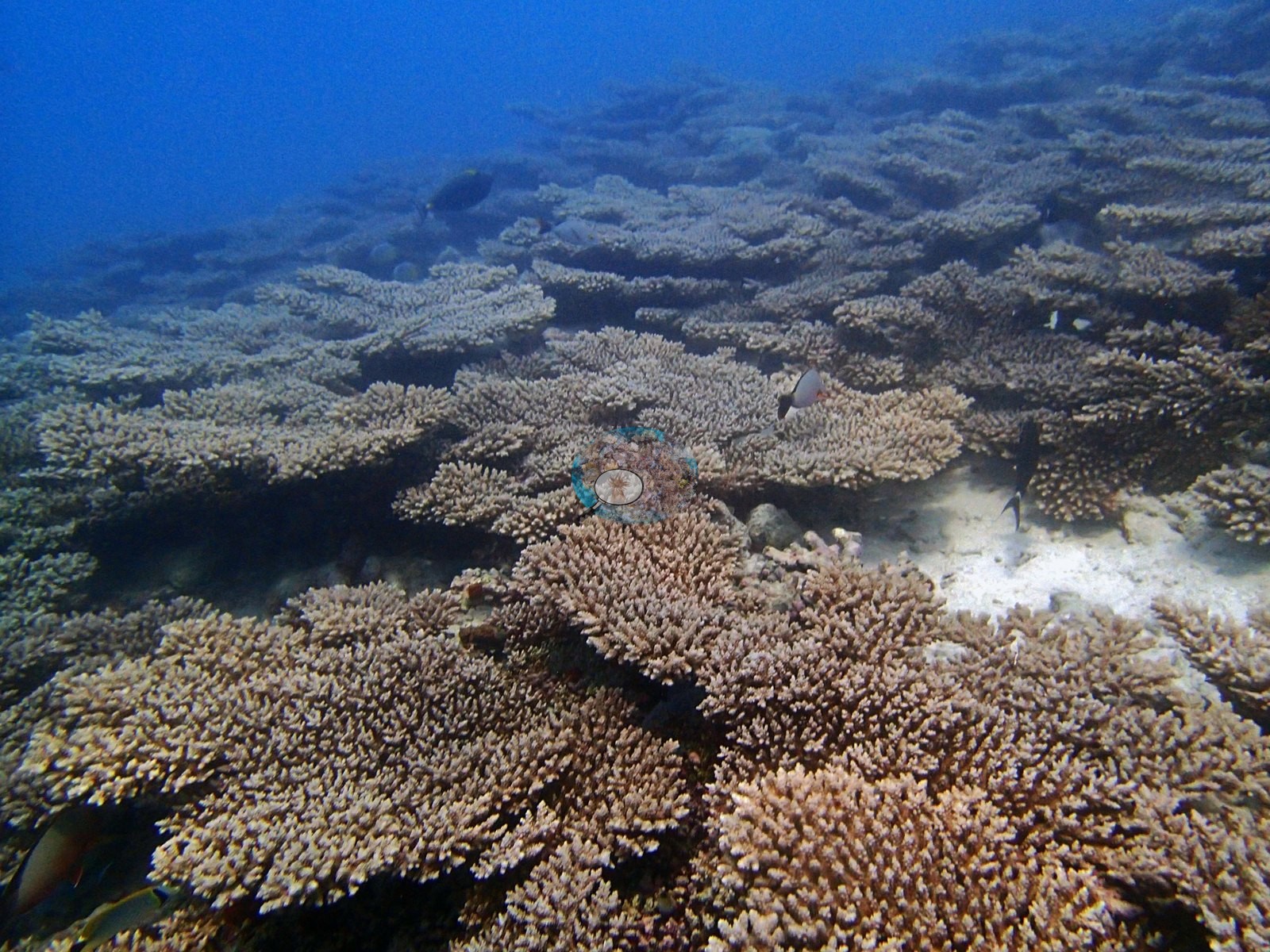
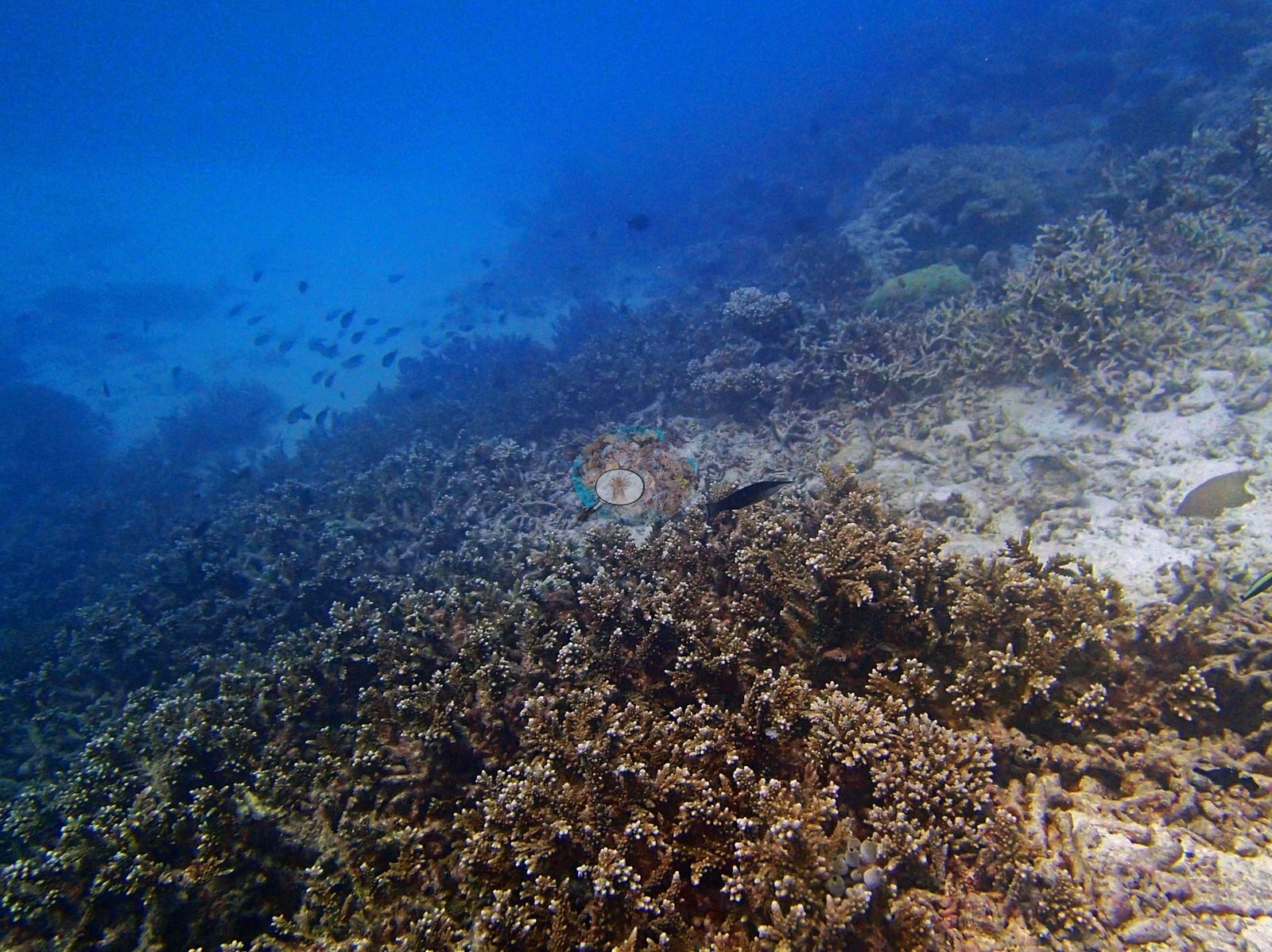
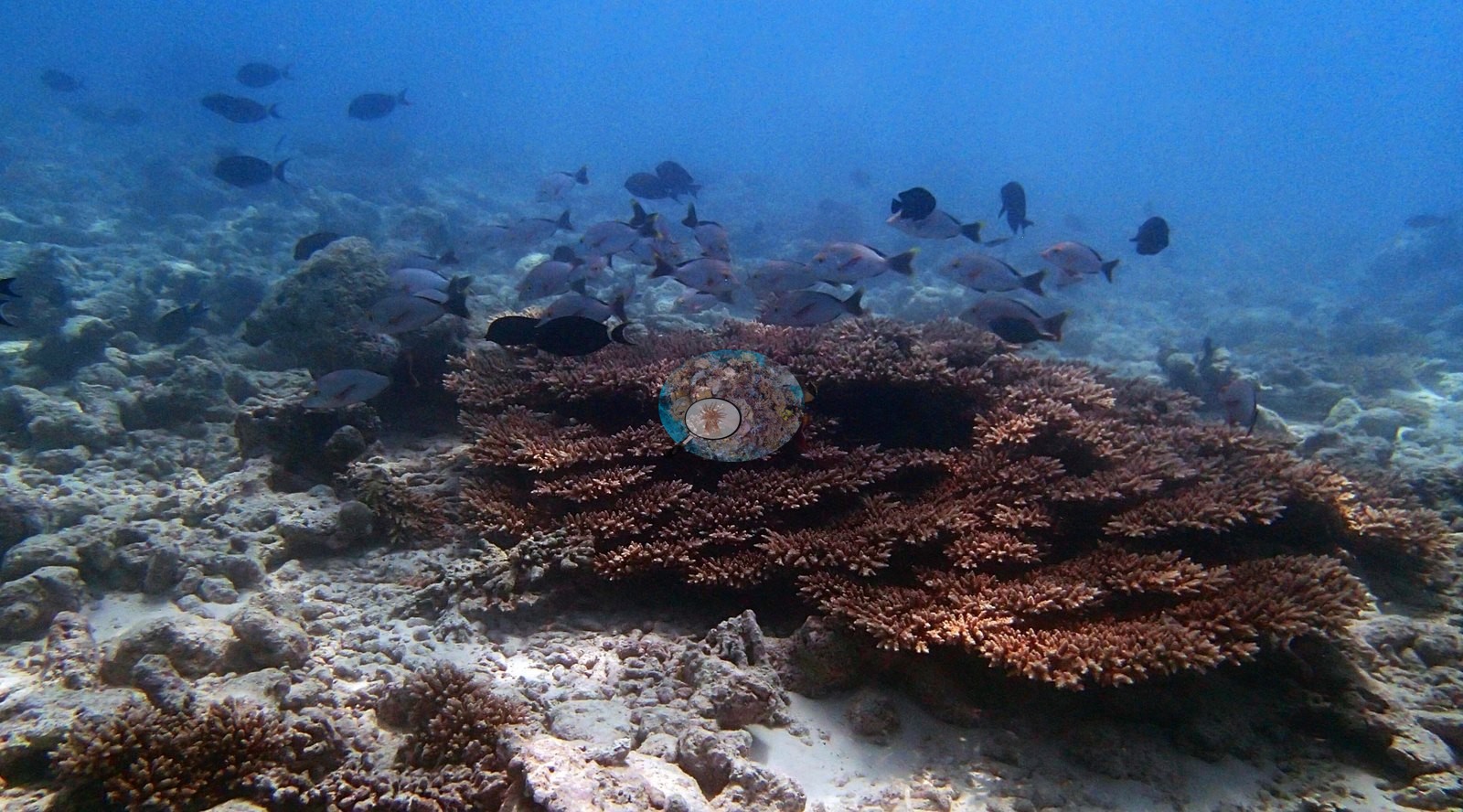
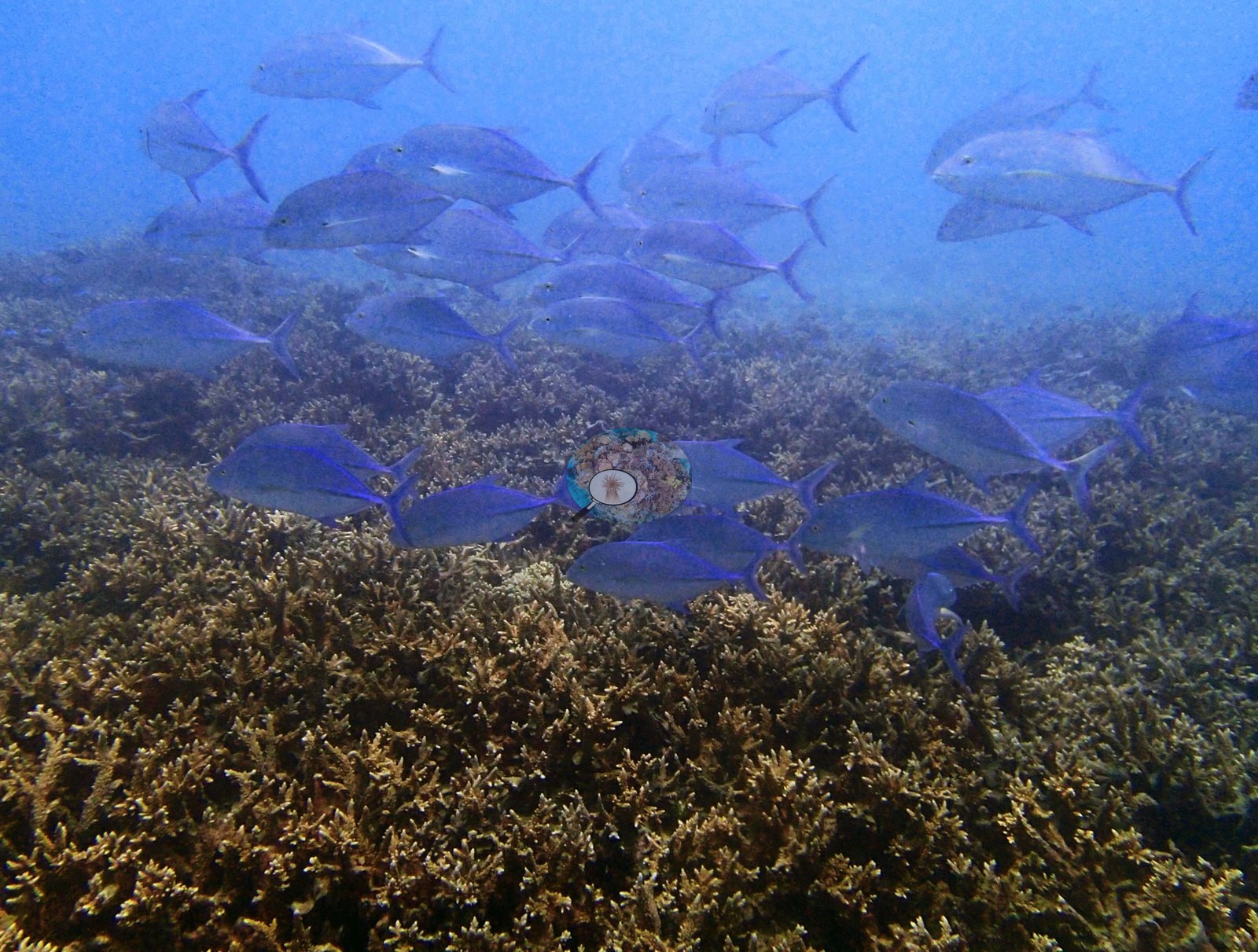
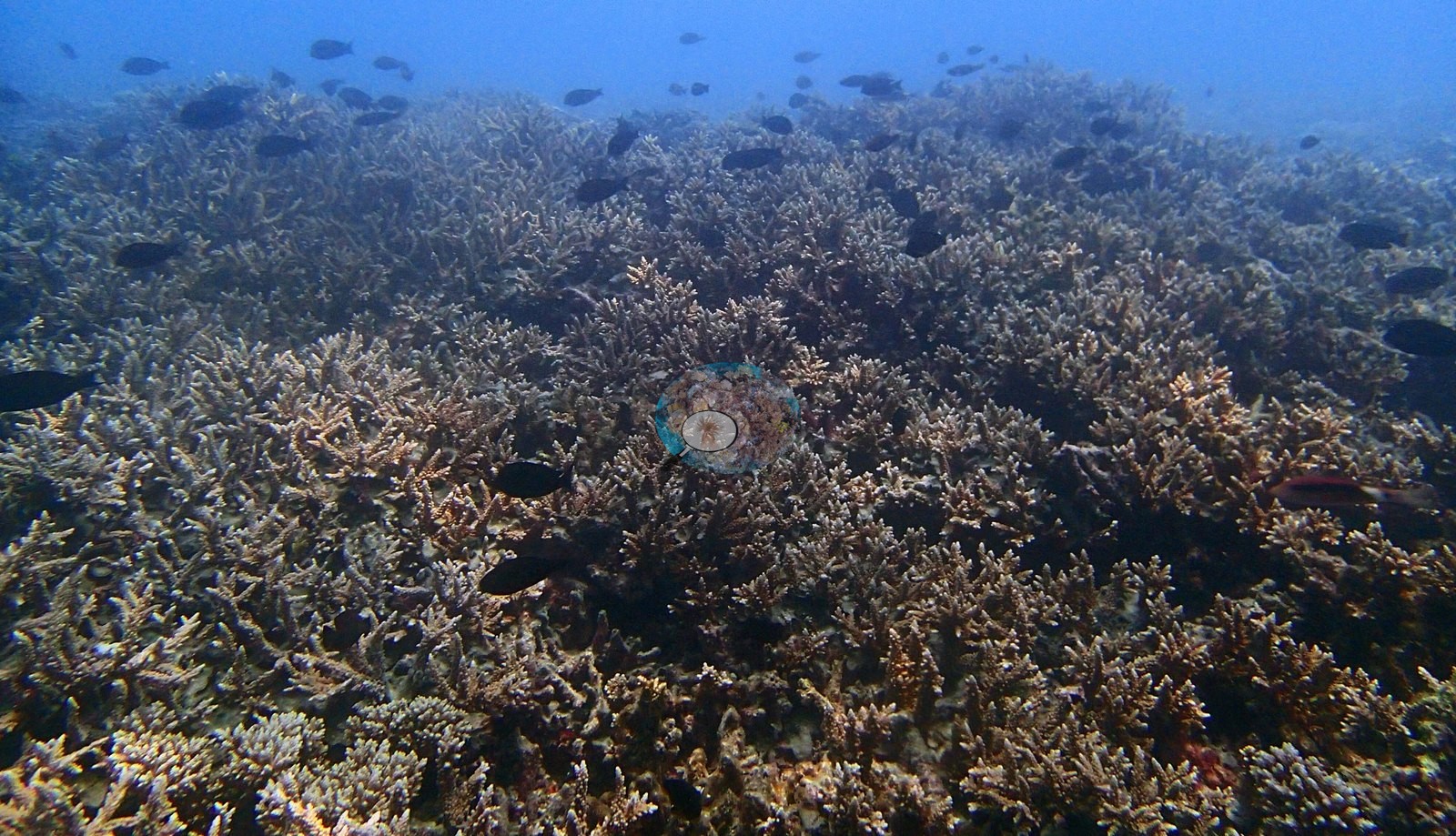
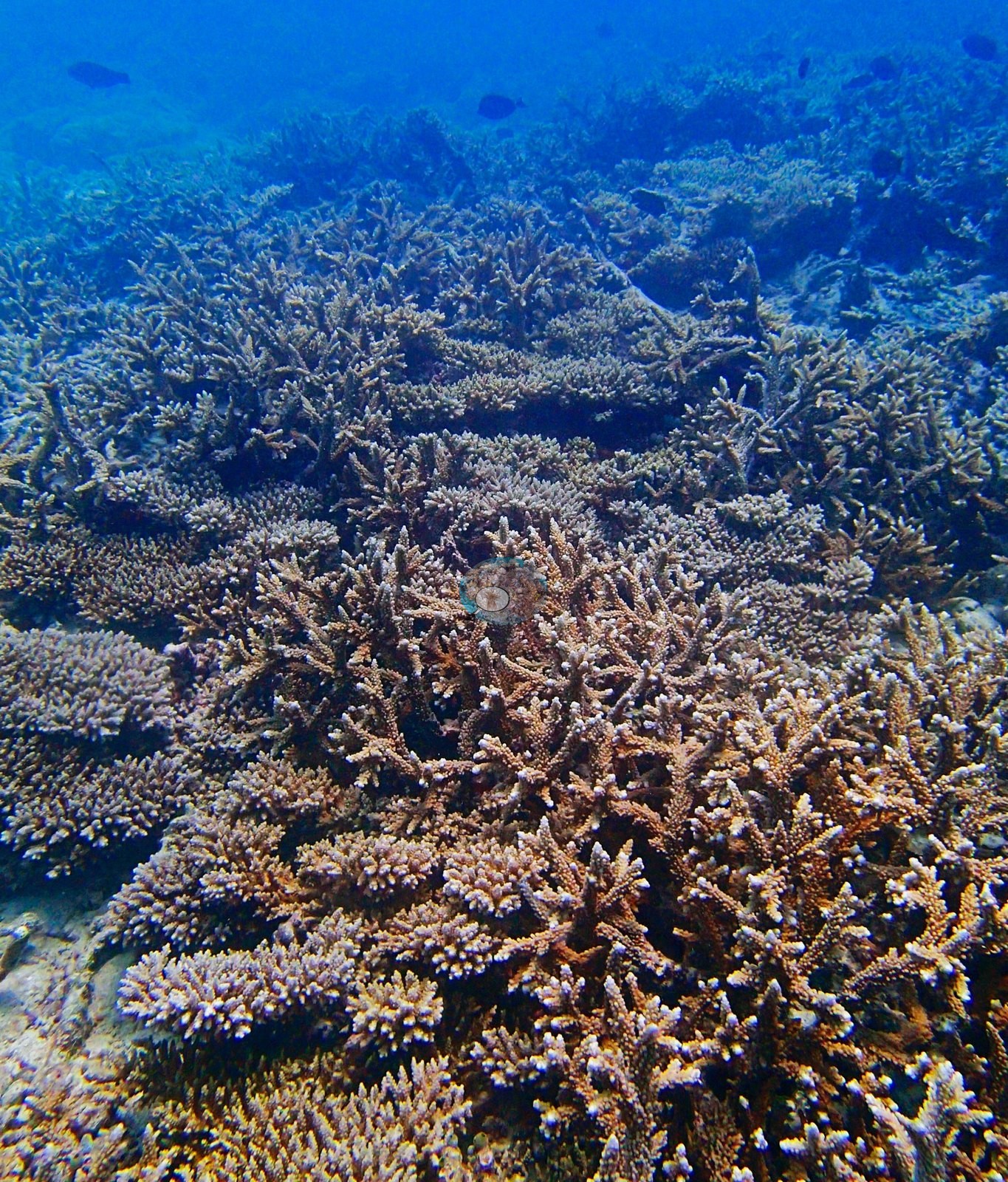
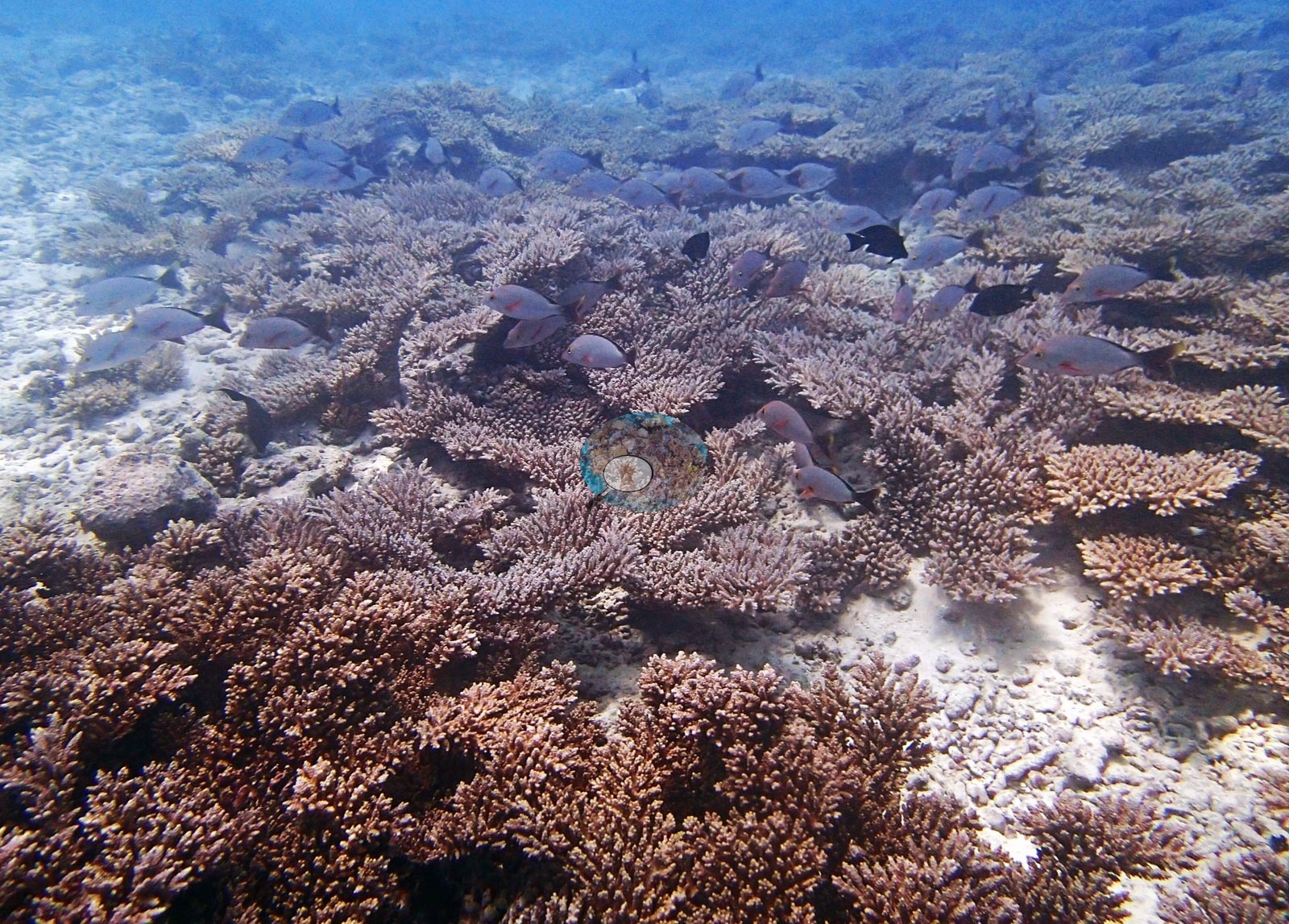
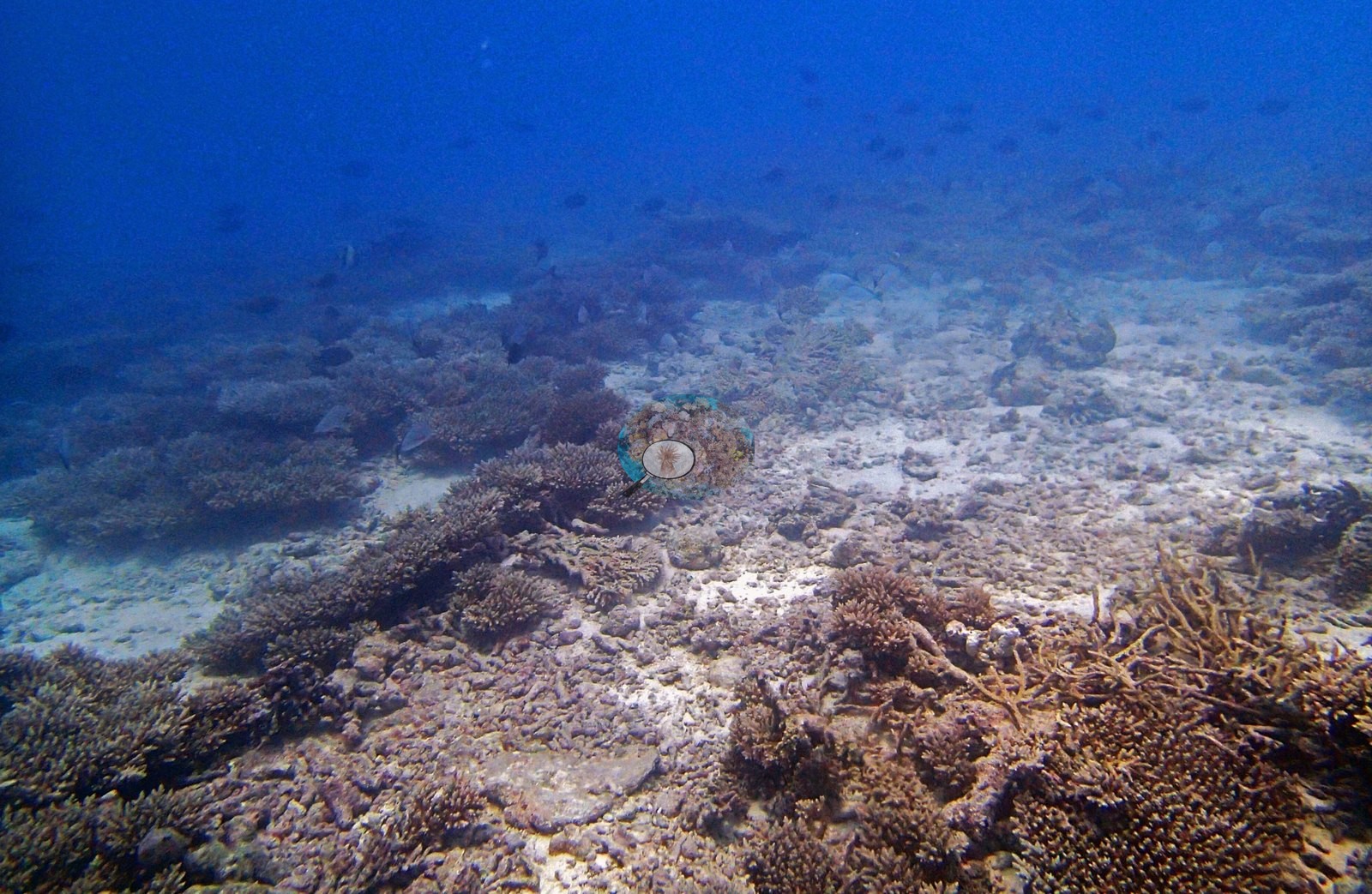
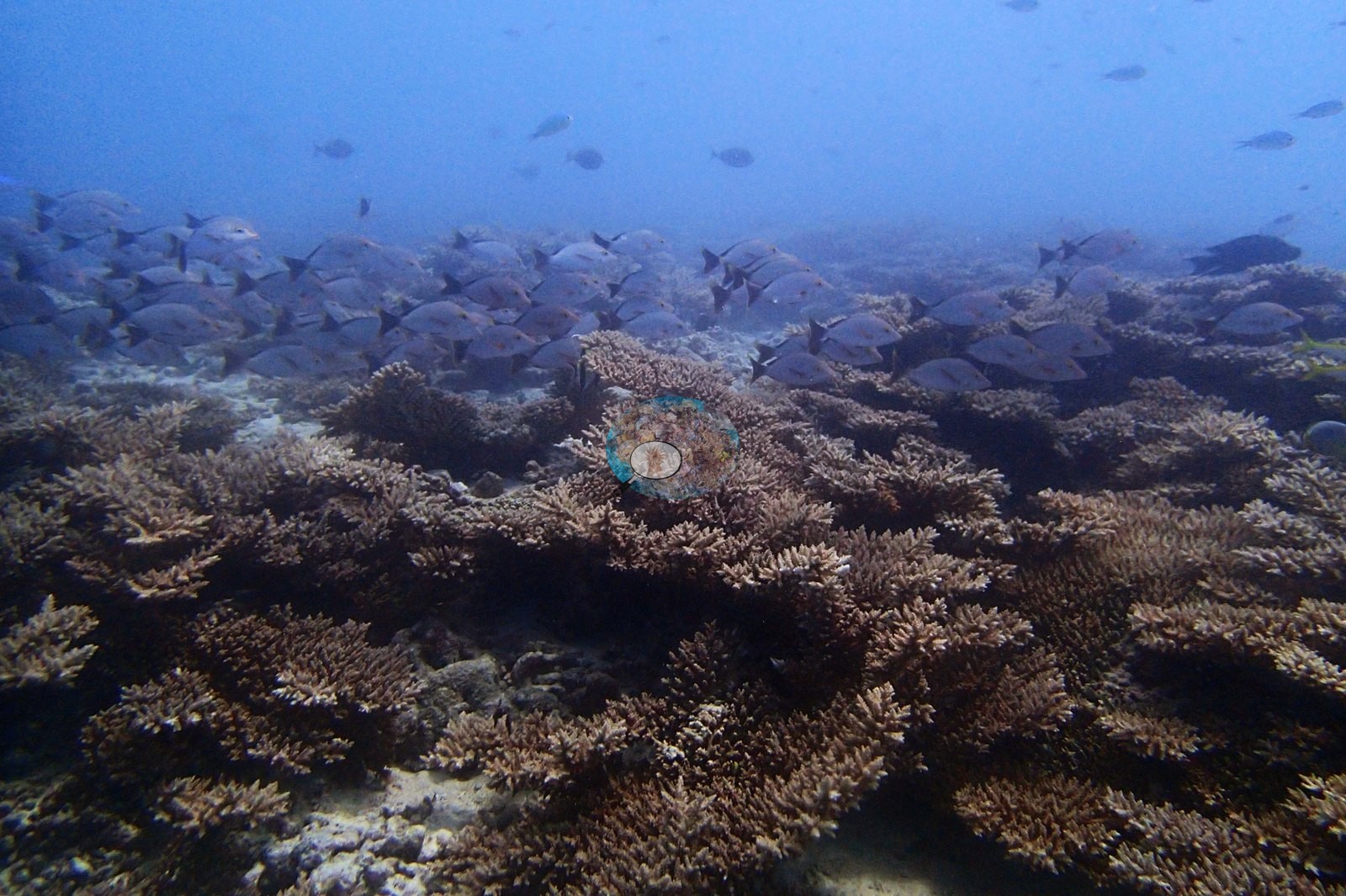
This is a branching-Acropora reef, and the frames say so unambiguously. P3110488, P3110490, P3110537, P3110538, P3110541, P3110542, P3110553, P3110560, and P3110561 are wide views over near-continuous plains of fine-branched staghorn, digitate and corymbose Acropora running away from the camera to the limit of visibility. P3110541 and P3110488 are the richest — dense gold-brown thickets with almost no bare substrate in frame — while P3110487 and P3110489 show the same thicket broken by white sand channels, loose dead branch rubble and pale pavement. P3110491 adds mixed brown and mauve branching colonies with mustard encrusting sheets over a sandy floor.
Coral cover
Coral cover: 44%. Live hard coral measured on the in situ benthic transects of the LOF BIOT-1 expedition (Mayfield & Dempsey 2026, Oceans, supplemental S1), against algal cover of 42.2% of the benthos. The transect is this site's measurement — the authoritative record of cover and community at BIEG06 (Egmont Atoll, dived 11 March 2015) — and no image-derived product overrides it. It is the highest transect cover of this Chagos batch, and the near-continuous branching thickets in the wide frames are exactly what a reef measured at 43.5% looks like. This pin carries no depth-stratified (D1–D4) transect breakdown, so the site mean and the paired algal figure are the whole of the transect record here. No cover value is read off any photograph below.
Method comparison — CoralNet points vs Coralscapes masks. Across methods the same reef reads: transects 43.5% · CoralNet points 30.1% · Coralscapes masks 23.3% (33 frames). The 7 pp gap between the two image products is the widest of the Egmont sites and is consistent with what the frames show: extensive fine-branched staghorn thickets, which point-counts capture readily but which a mask-based model tends to under-segment where branches interleave with shadow and dead skeleton. The 10.3 pp spread across all three methods reflects how far both image products sit below the transect here — a diver's transect integrates the whole swim across a continuous thicket, while both image products are computed frame by frame over a set in which sand channels, standing dead framework, water column, and shadow take a large share of the field of view, and in which six frames are effectively fish portraits. These products have different sampling footprints and denominators, they are compared to the transect and not against it, and they should not be averaged. All of the above is a qualitative account of what is visible in the frames. Anderson's published per-site % bleached for BIEG06 (10.4%) is the authoritative statement of this site's bleaching status; nothing in this photographic account is converted into a percentage, and nothing here is offered as a corroboration or a test of it.
Also on record for this site: Coral cover: 44%. Live hard coral measured on the in situ benthic transects of the LOF BIOT-1 expedition (Mayfield & Dempsey 2026, Oceans, supplemental S1), against algal cover of 42.2% of the benthos. The transect figure is this site's authoritative cover value; no image-derived product overrides it. Across methods the same reef reads: transects 43.5% · CoralNet points 30.1% · Coralscapes masks 23.3% (33 frames). These products have different sampling footprints and denominators and should not be averaged.
Stressors
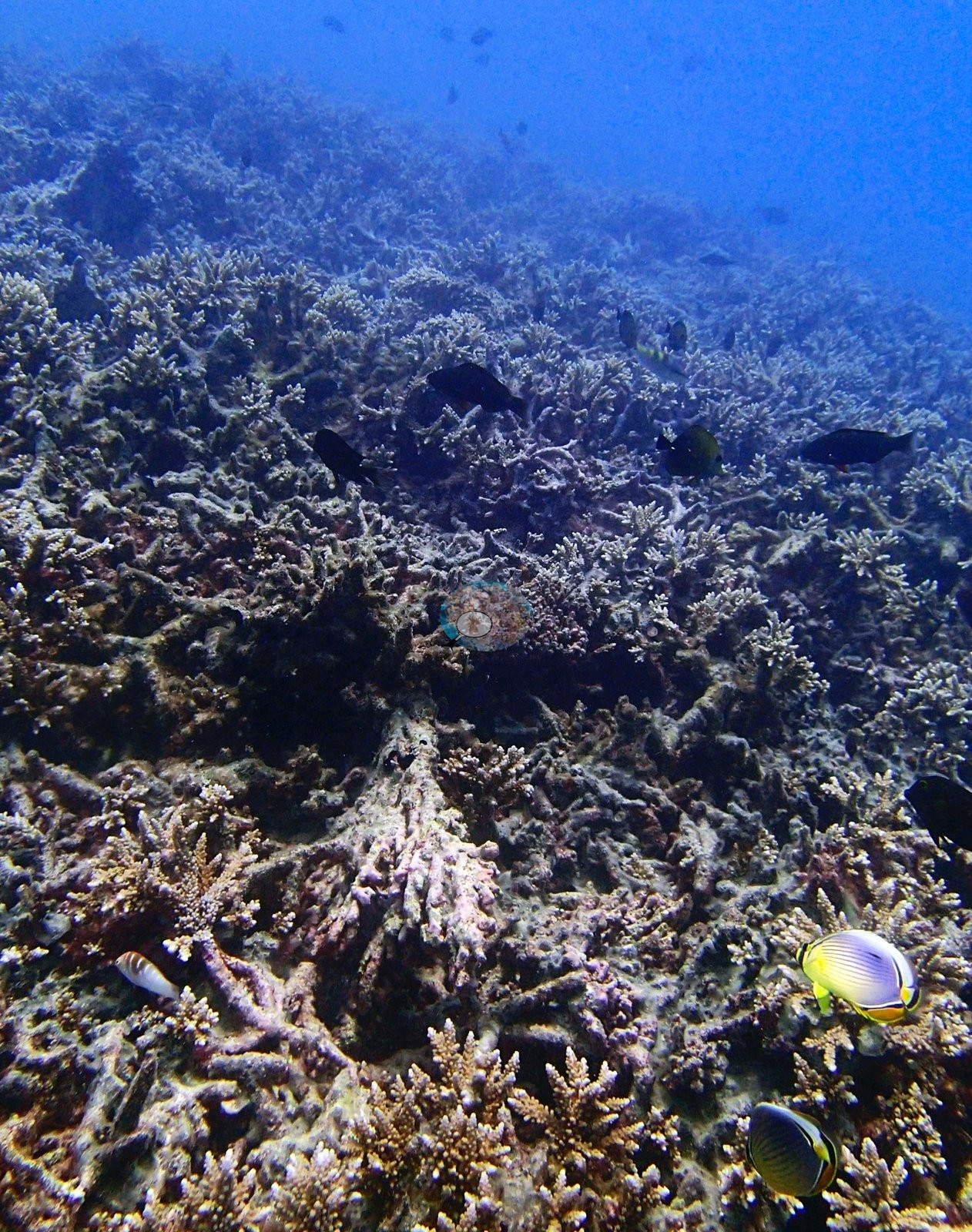
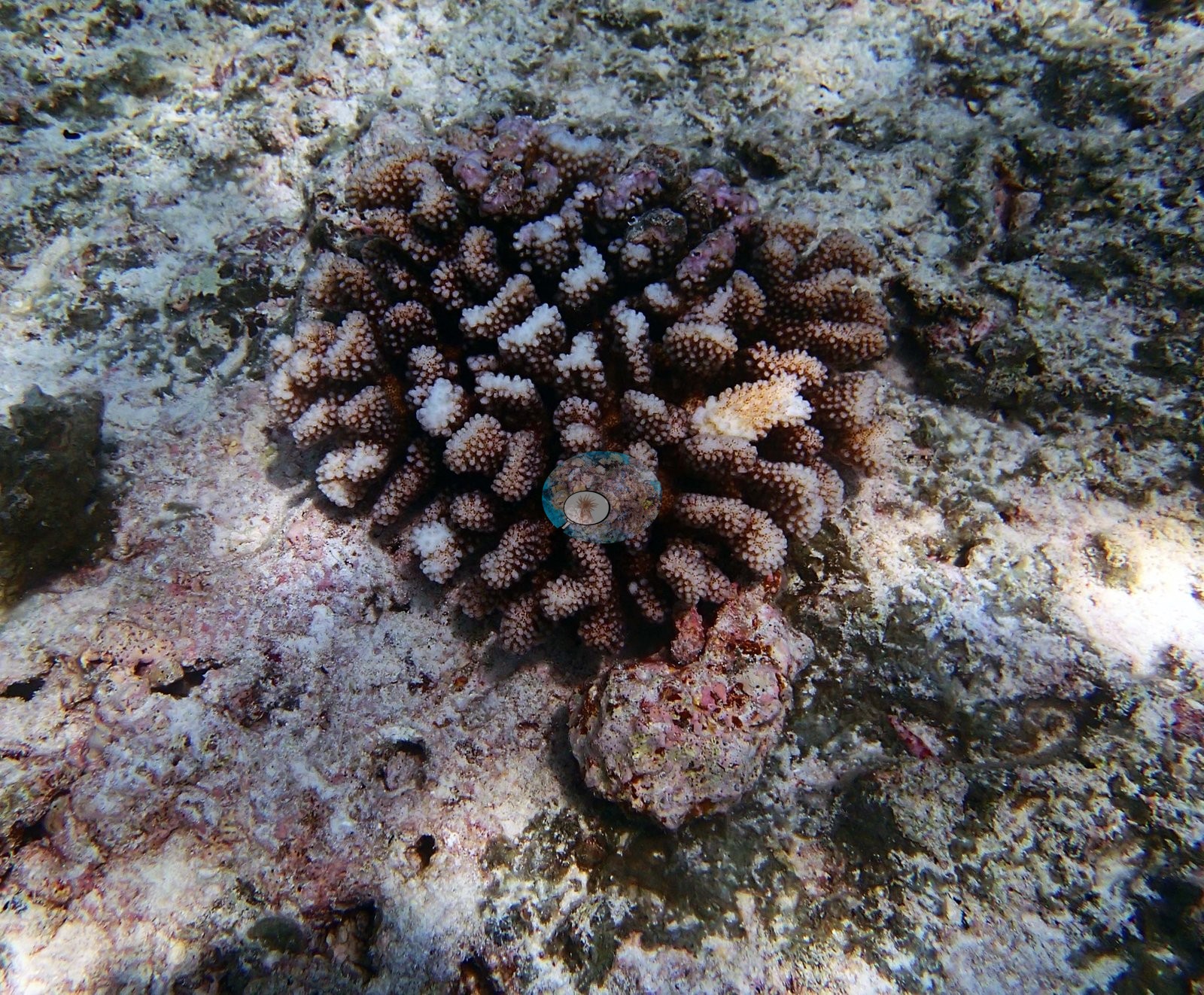
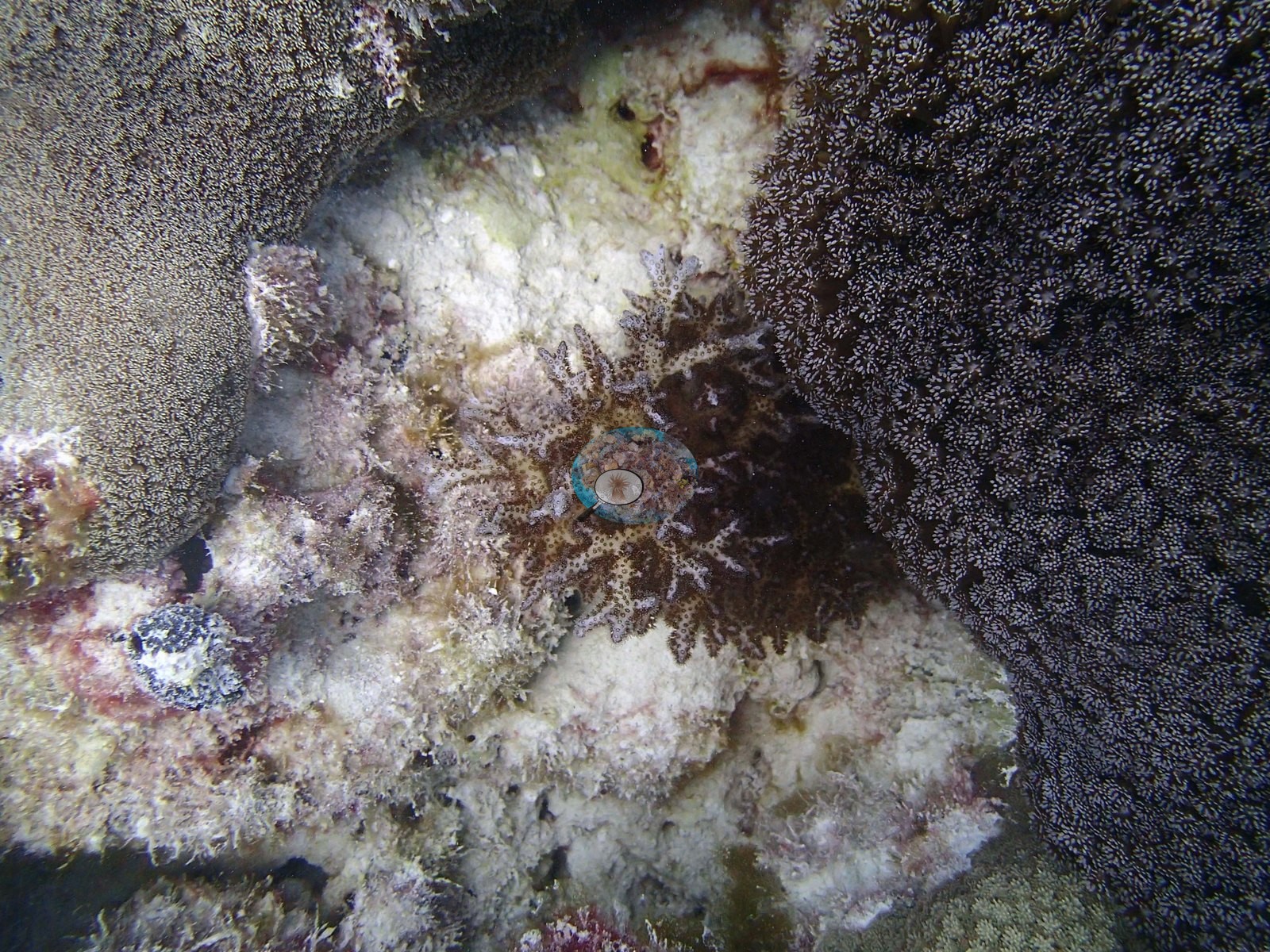
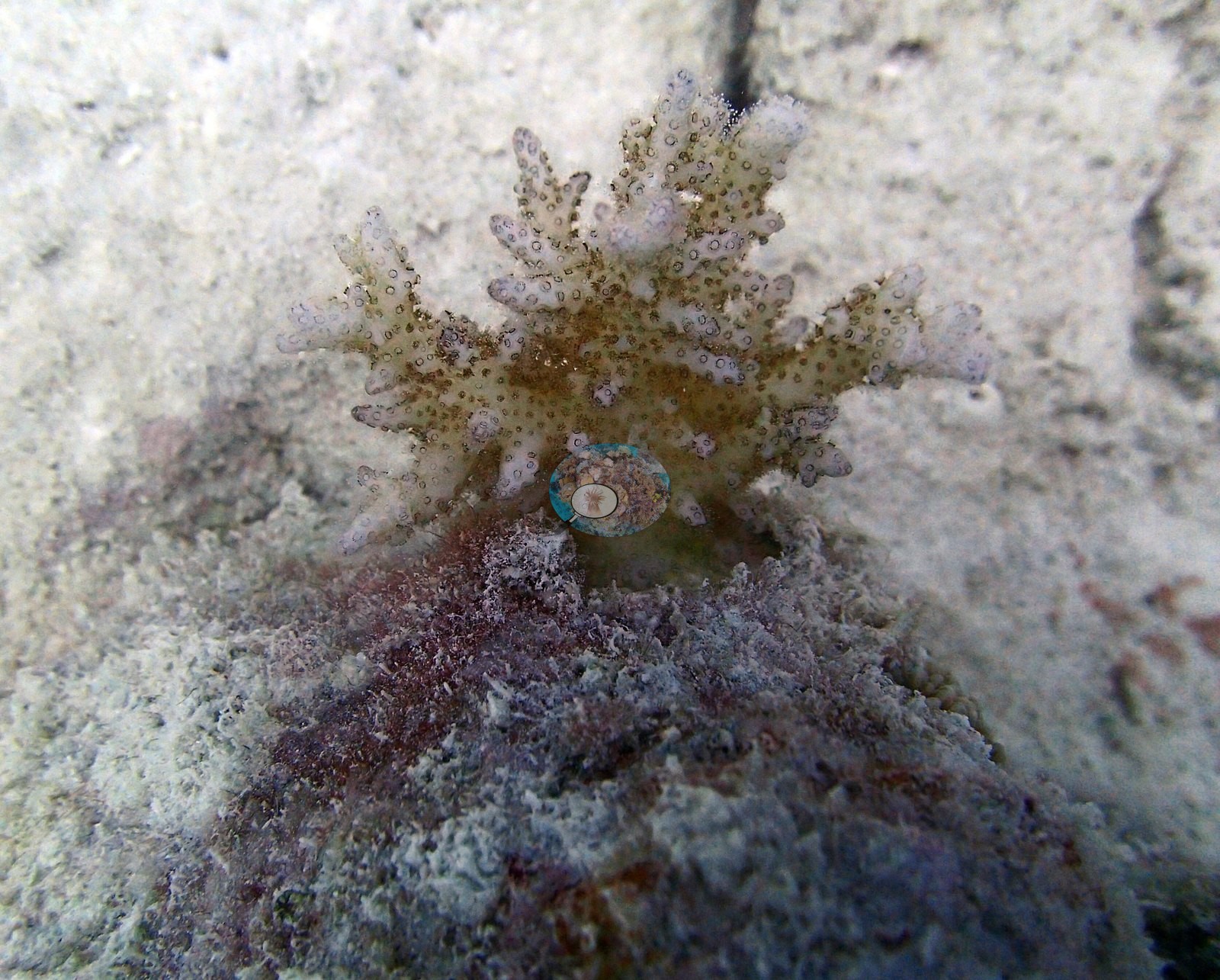
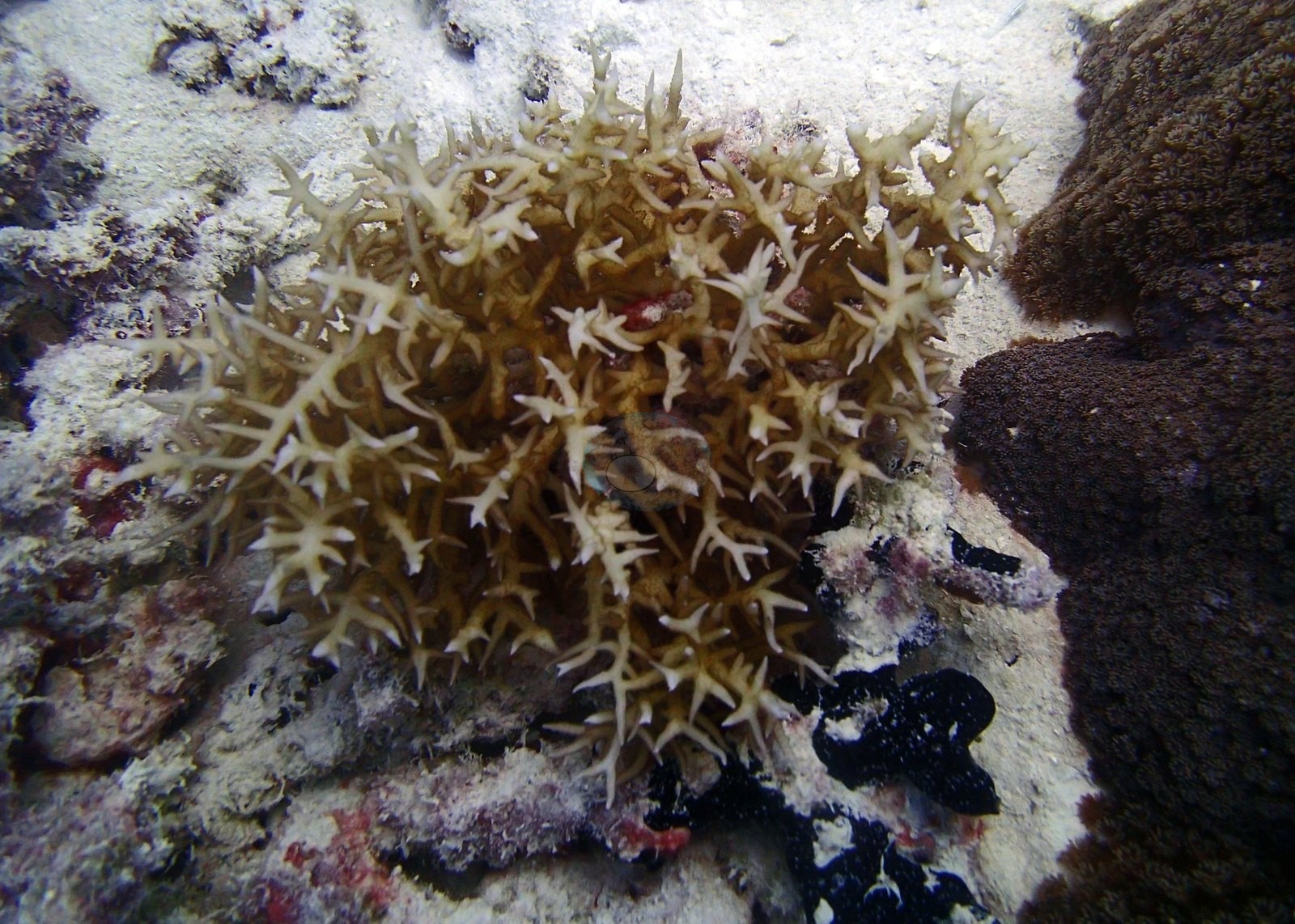
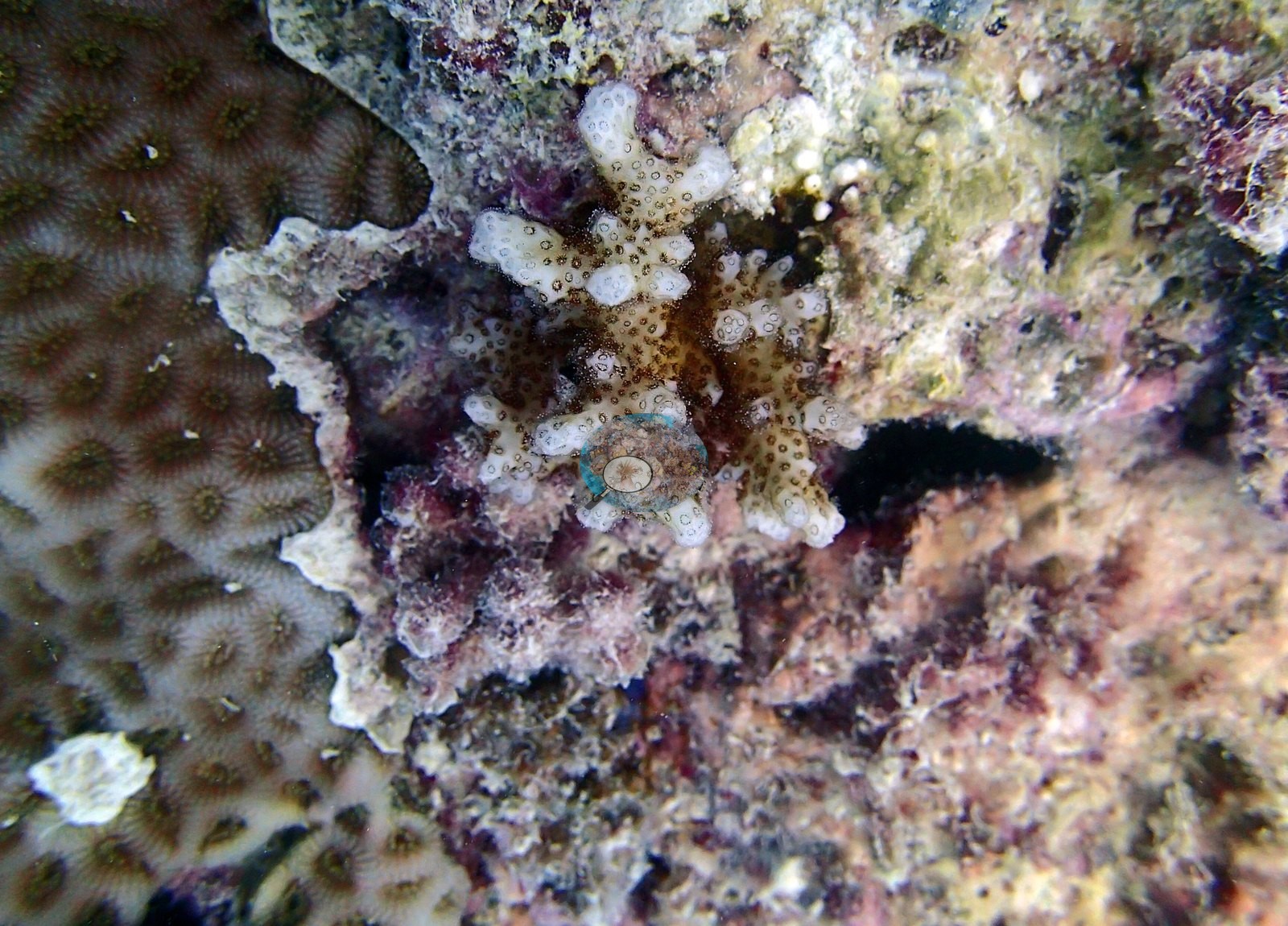
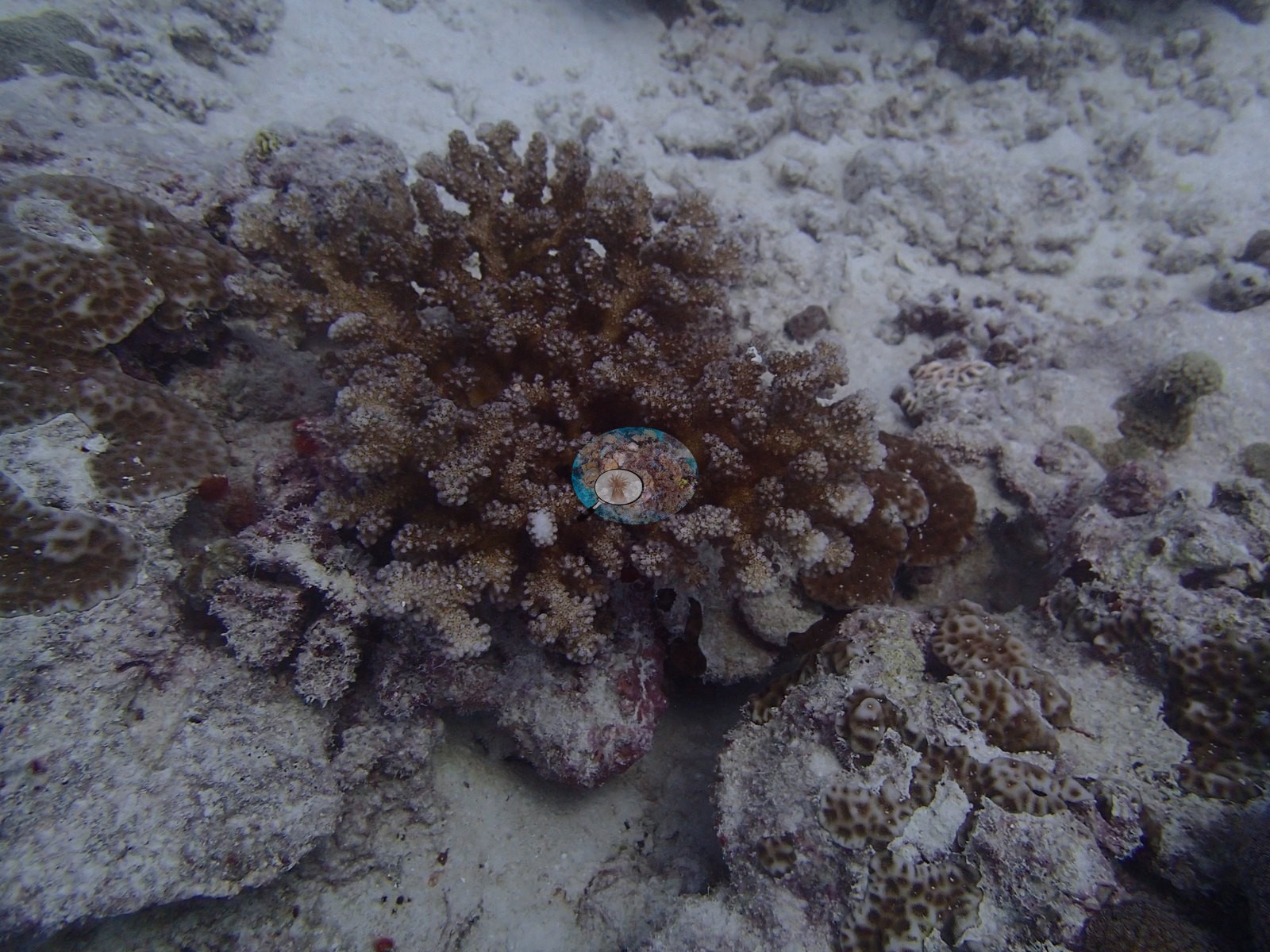
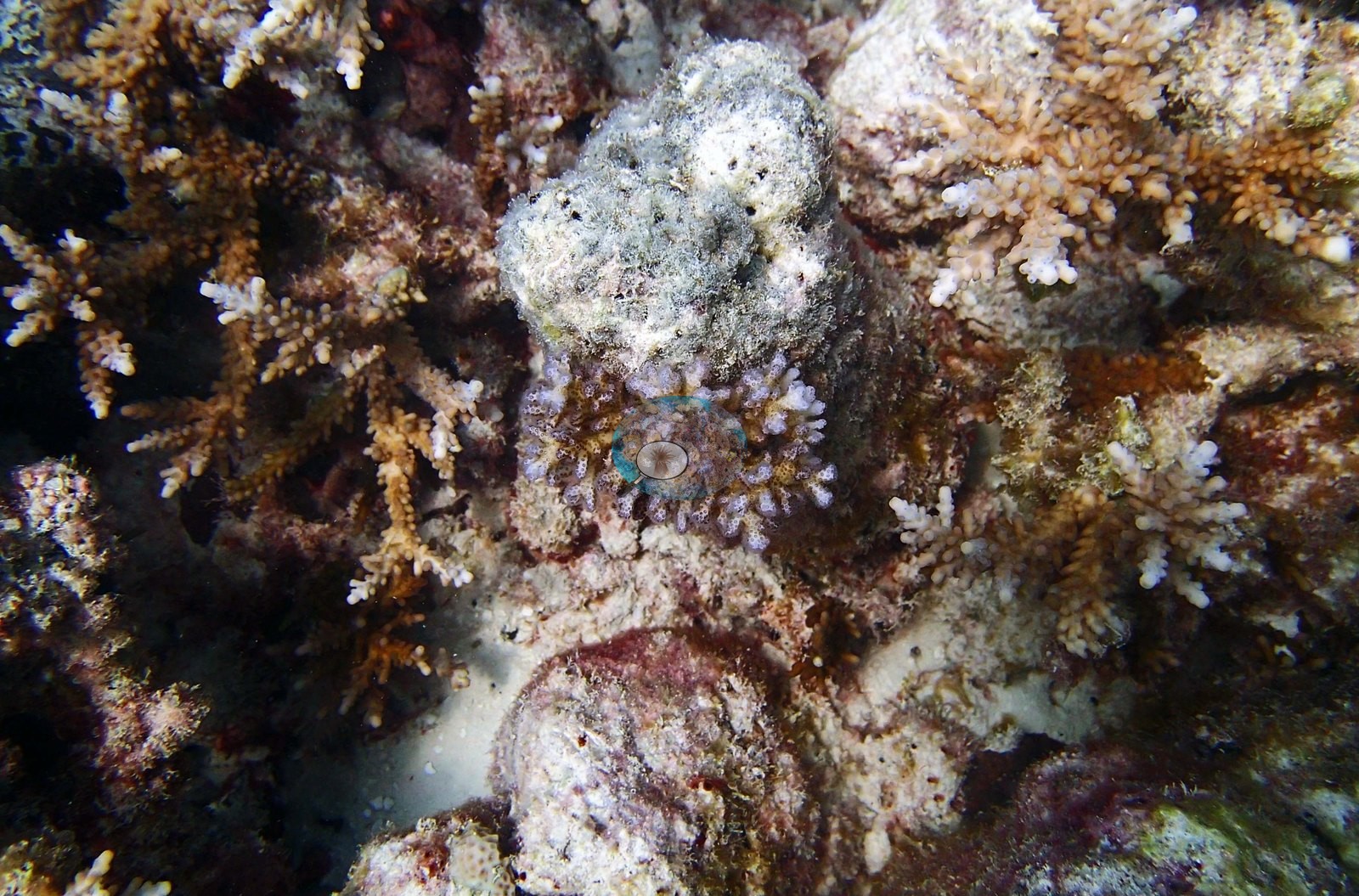
Condition. The stress signal here is the site's most important photographic content, and it takes three distinct forms which should not be pooled. First, widespread paling: P3110553 and P3110537 show entire Acropora plains in a washed-out gray-white rather than the golden brown of a healthy stand, and P3110560 shows the same over a broad area beneath an emperor school — the contrast with the gold-brown thickets of P3110541 and P3110488 alongside them is the strongest condition signal in the set, though those frames are hazy enough that light and water-column effects cannot be fully separated from tissue paling. Second, partial-colony bleaching on individual colonies: P3110562 is a clean macro of a Pocillopora with numerous bone-white branch tips against pigmented bases, P3110515 shows a branching Acropora with extensively whitened tips, and P3110514 records a small cream-white colony that appears wholly bleached. Third — and most striking — standing dead framework: P3110542 shows a large expanse of intact branching coral skeleton, gray-brown and algal-fuzzed with no live tissue, still standing in growth position among live colonies, with two butterflyfish working over it, and P3110489 shows piles of dead branch rubble across open pavement. Set against this, three frames (P3110506, P3110527, P3110543) document the opposite process — small pale Acropora recruits settled directly on dead, CCA-crusted substrate, including one ring of recruits surrounding an algal-covered dead mass. A single dive therefore records mortality and recruitment on the same reef.
Fish and other fauna
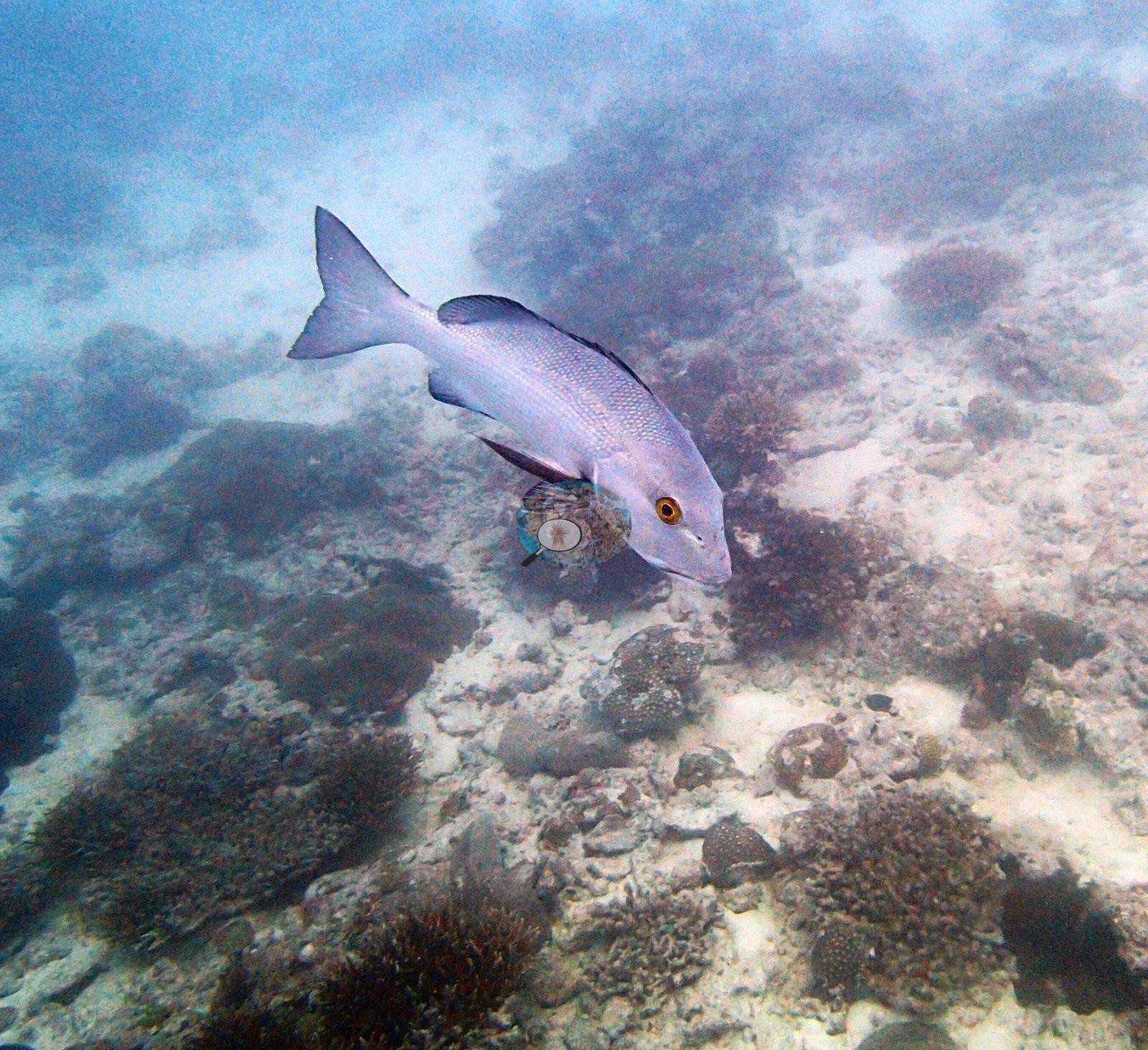
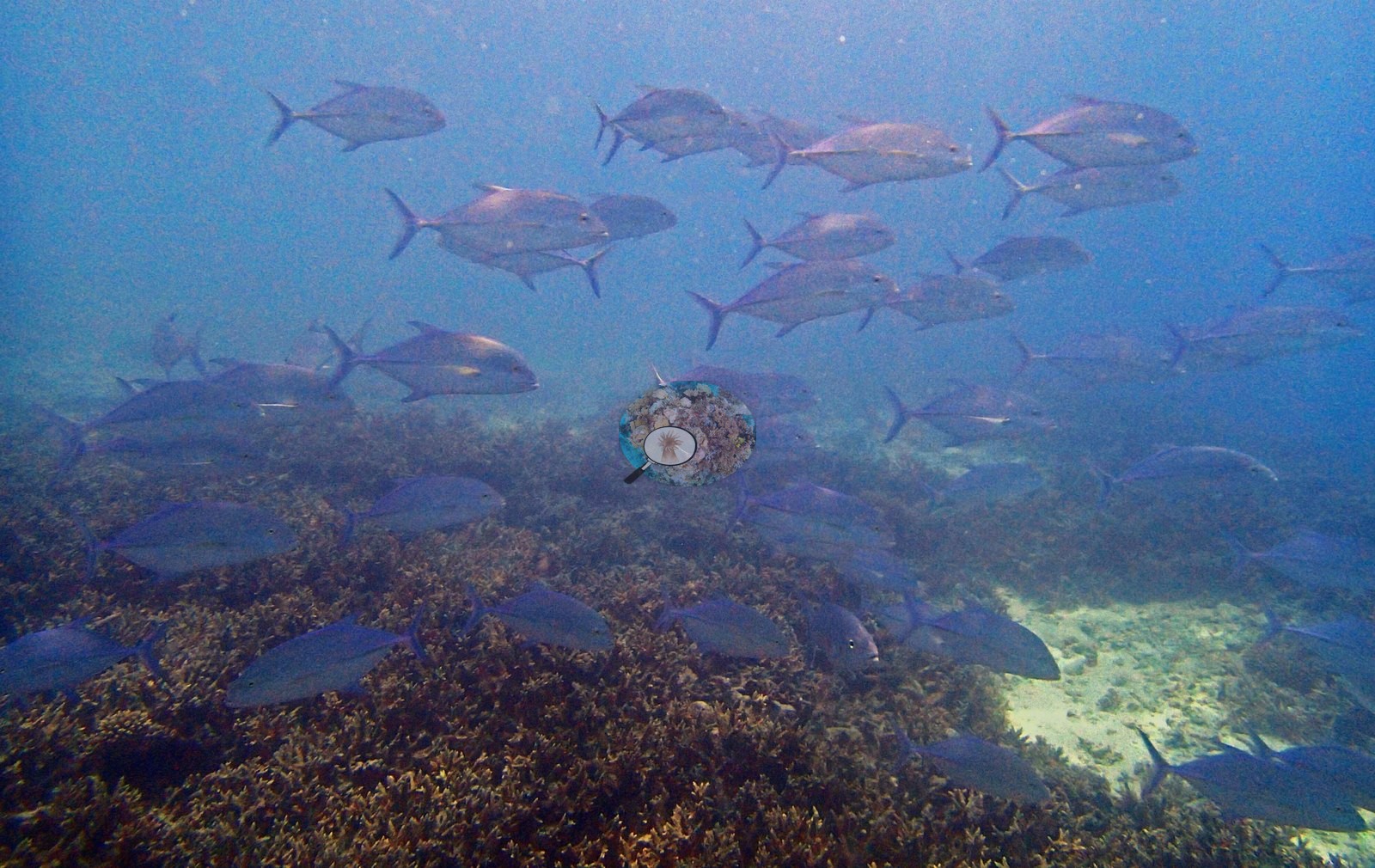
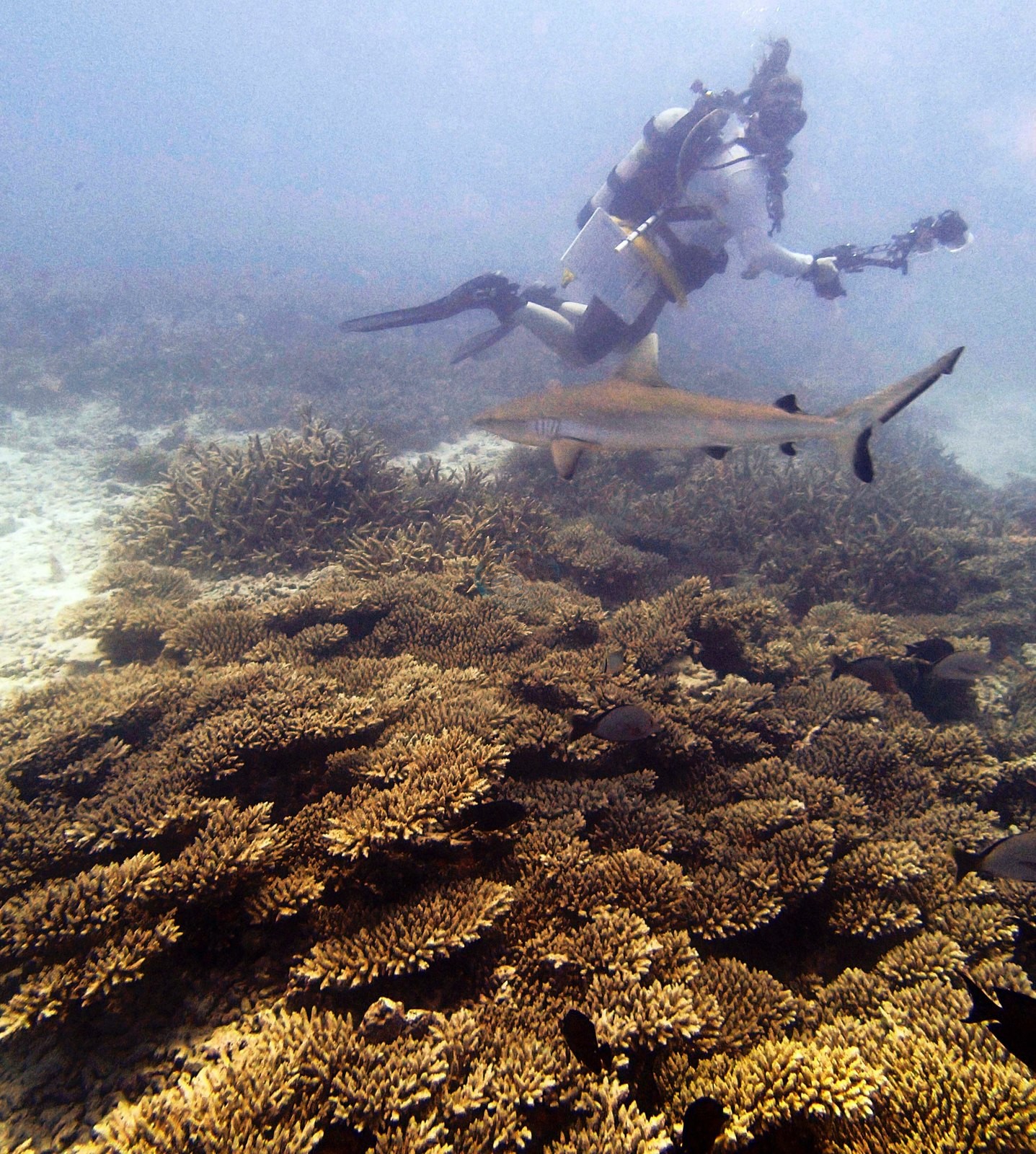
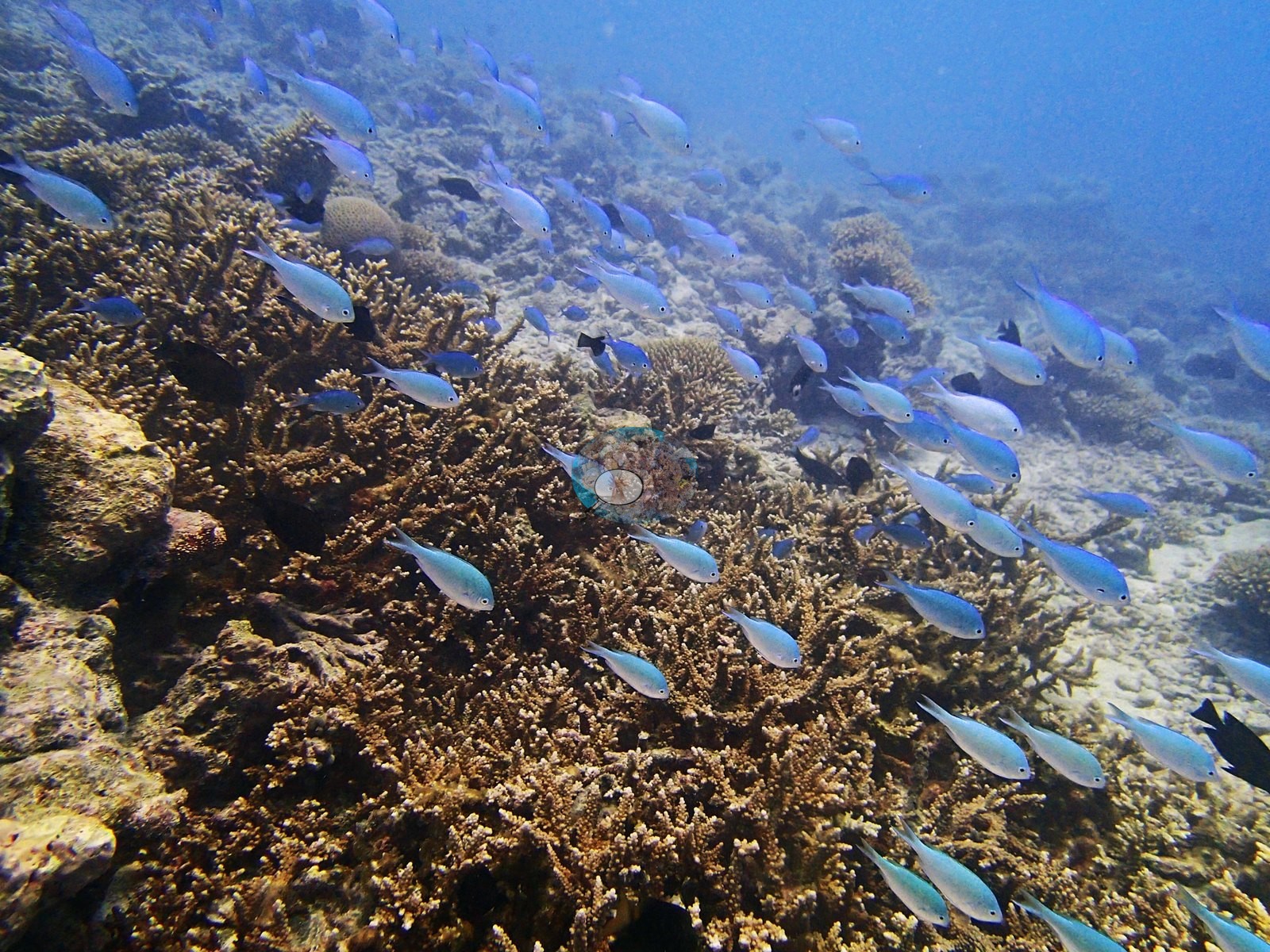
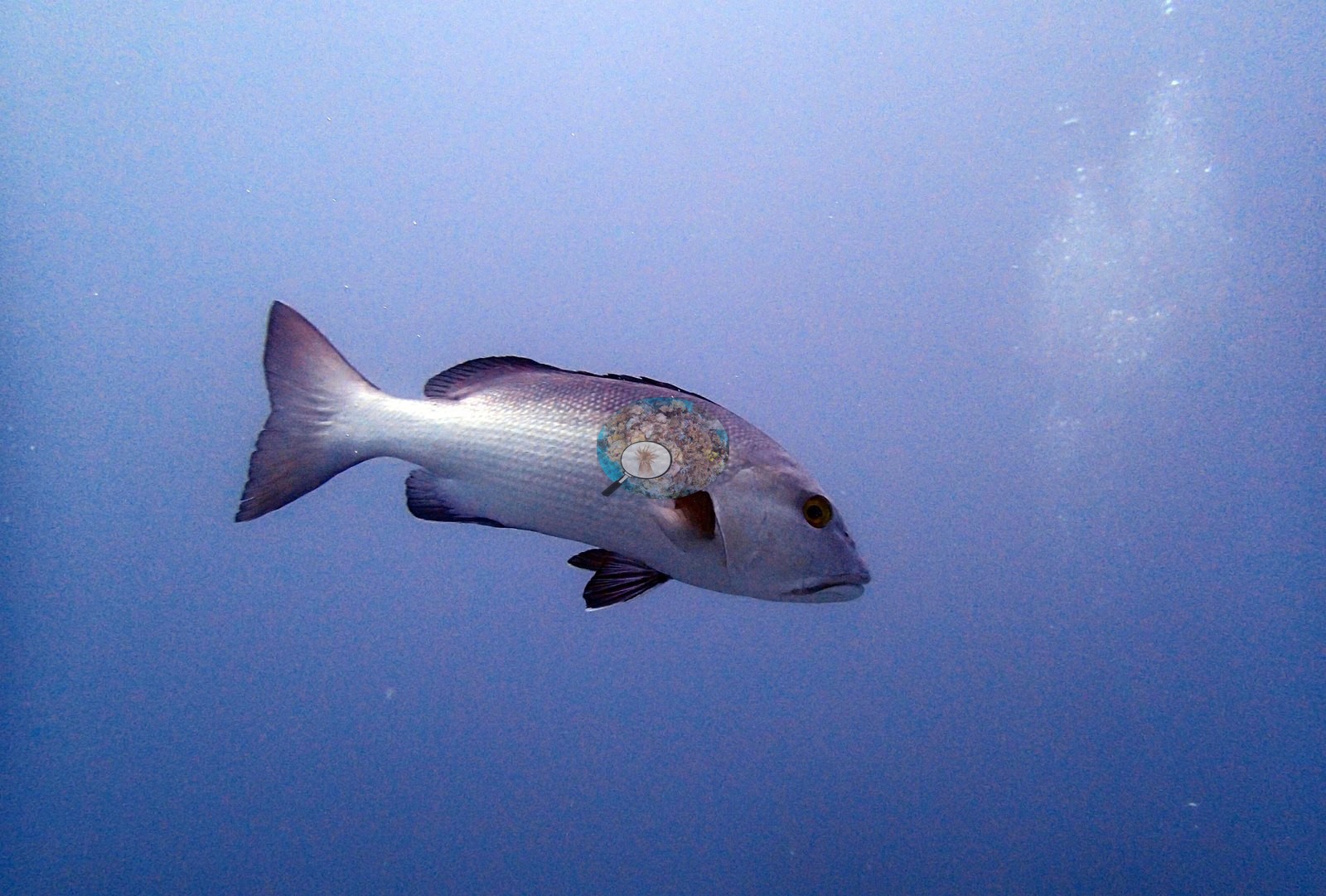
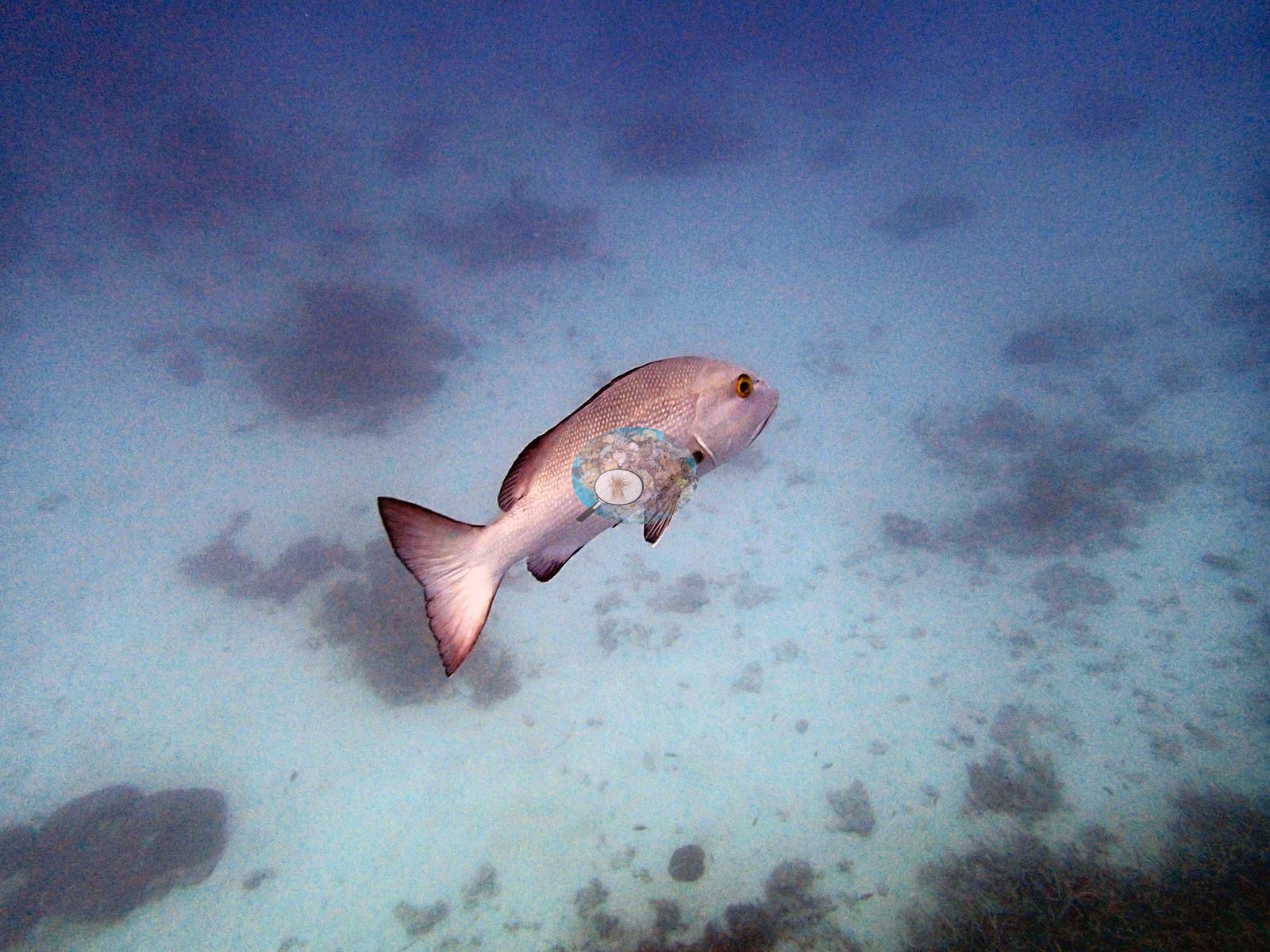
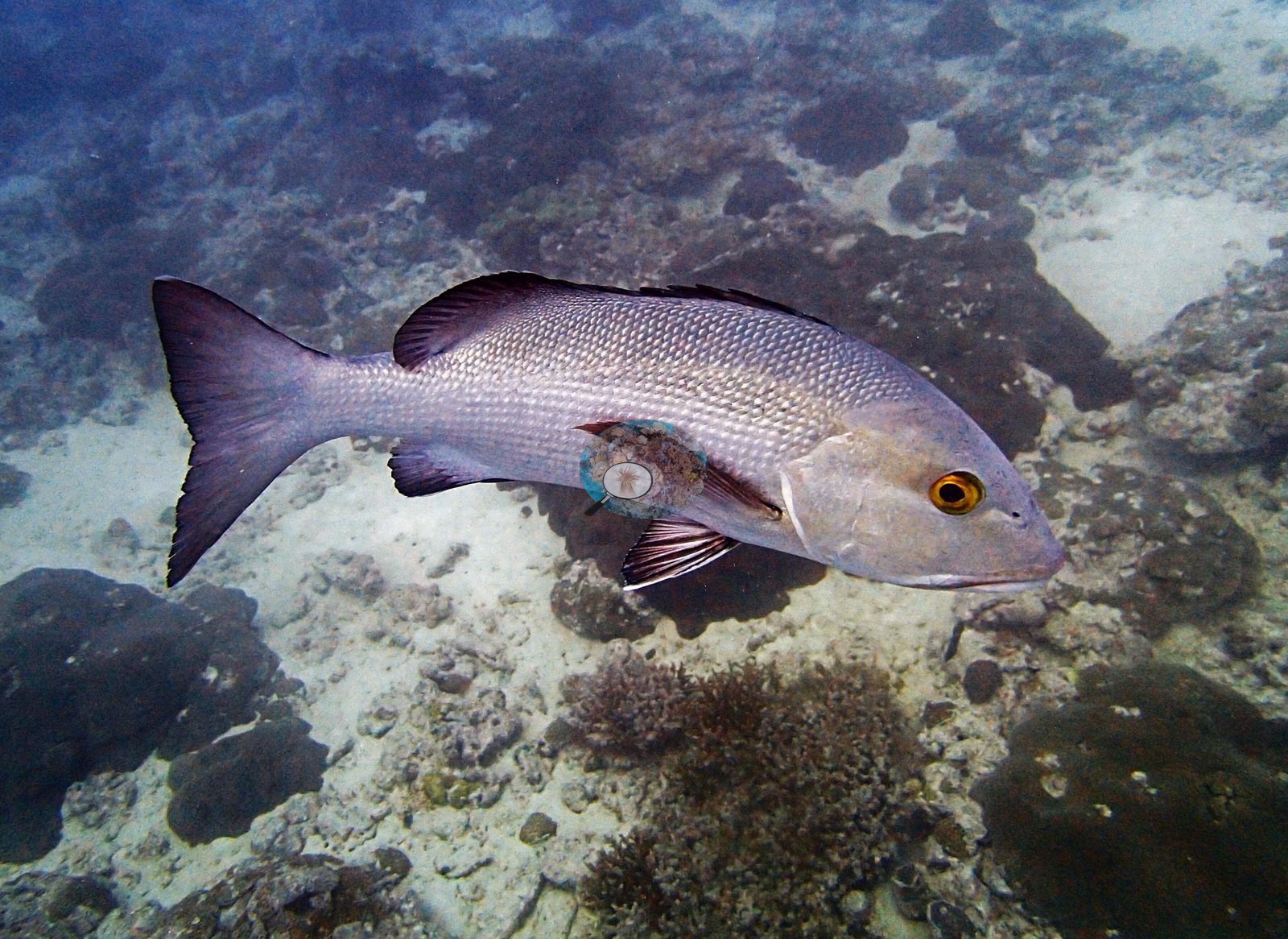
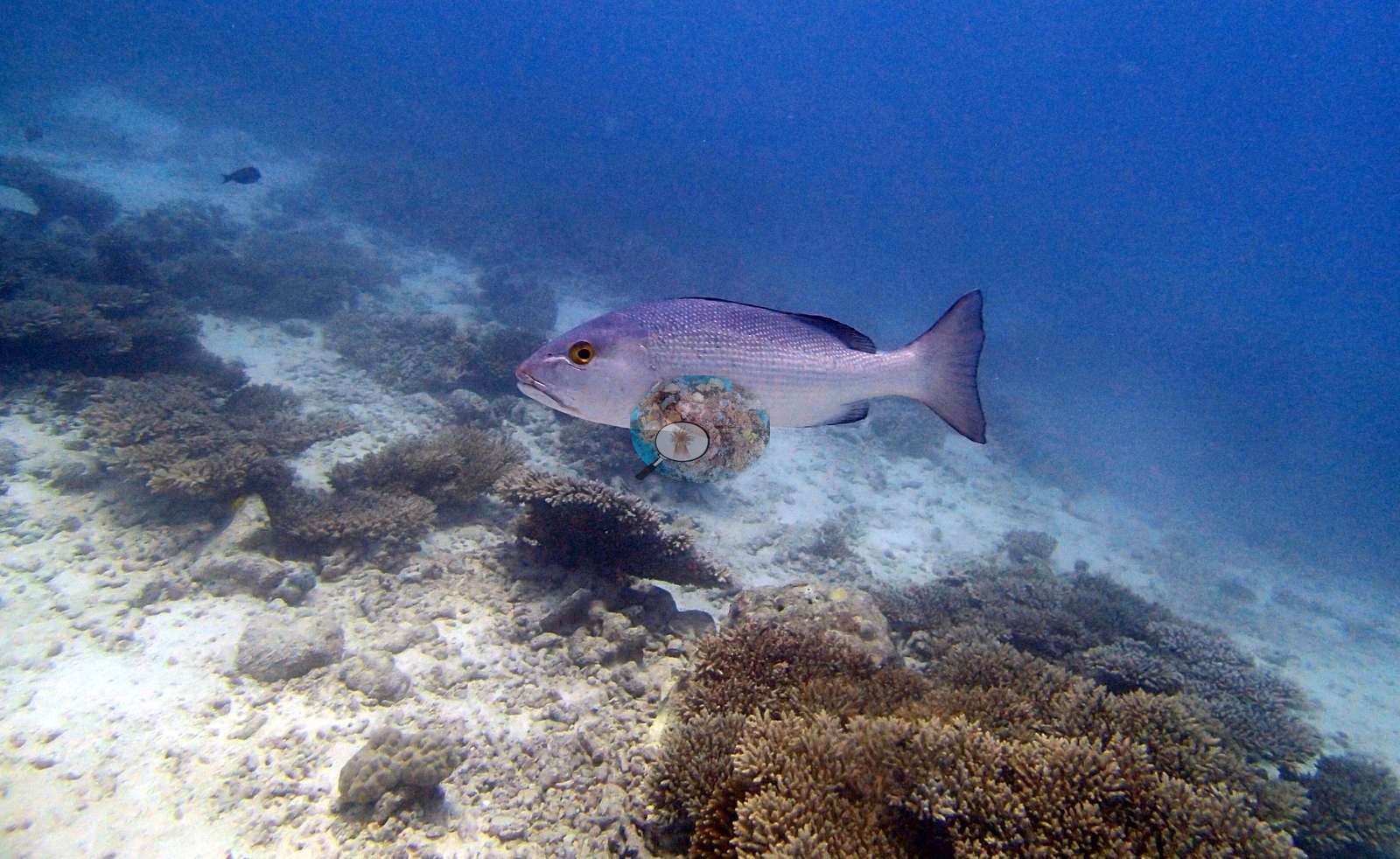
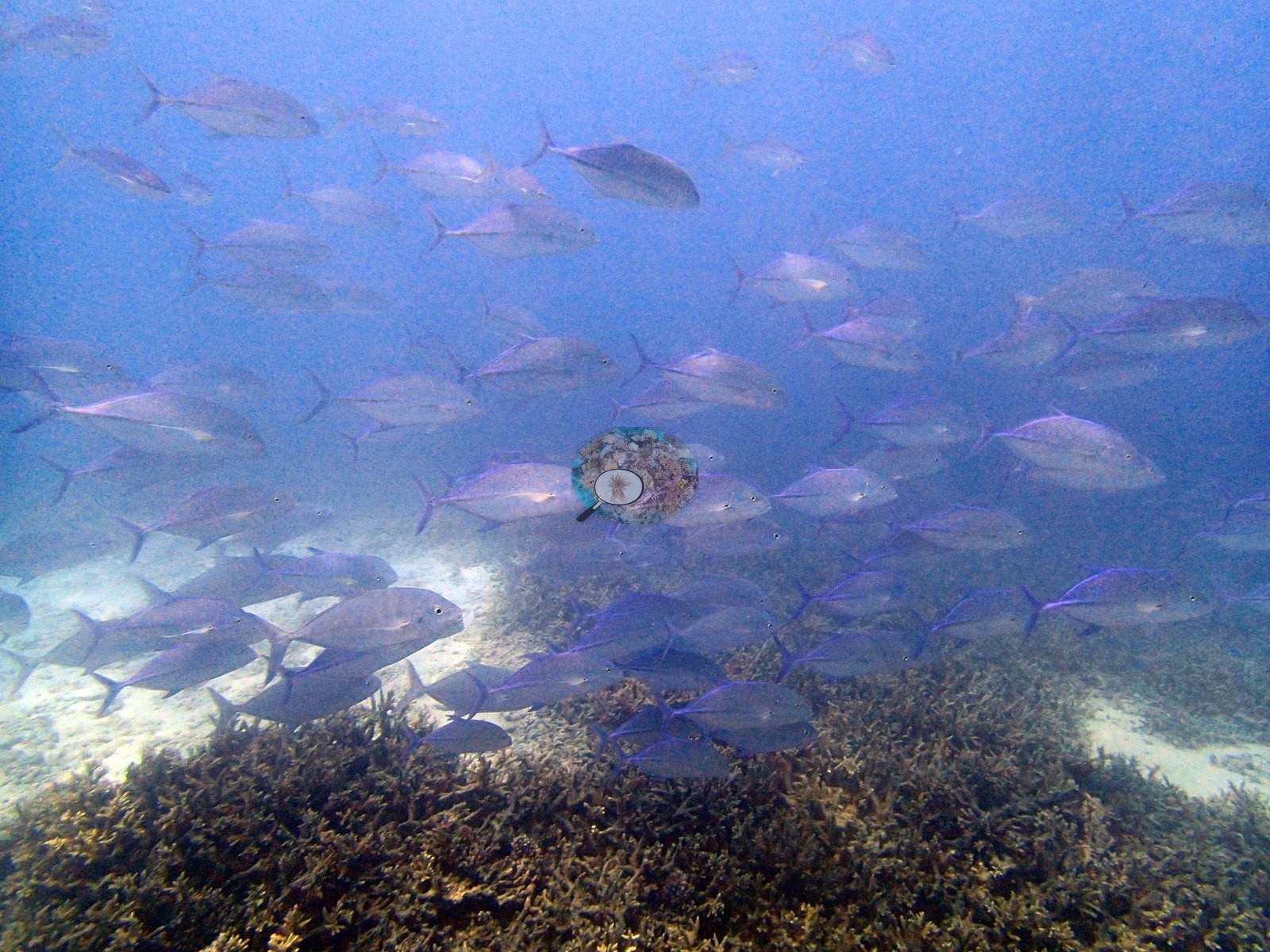
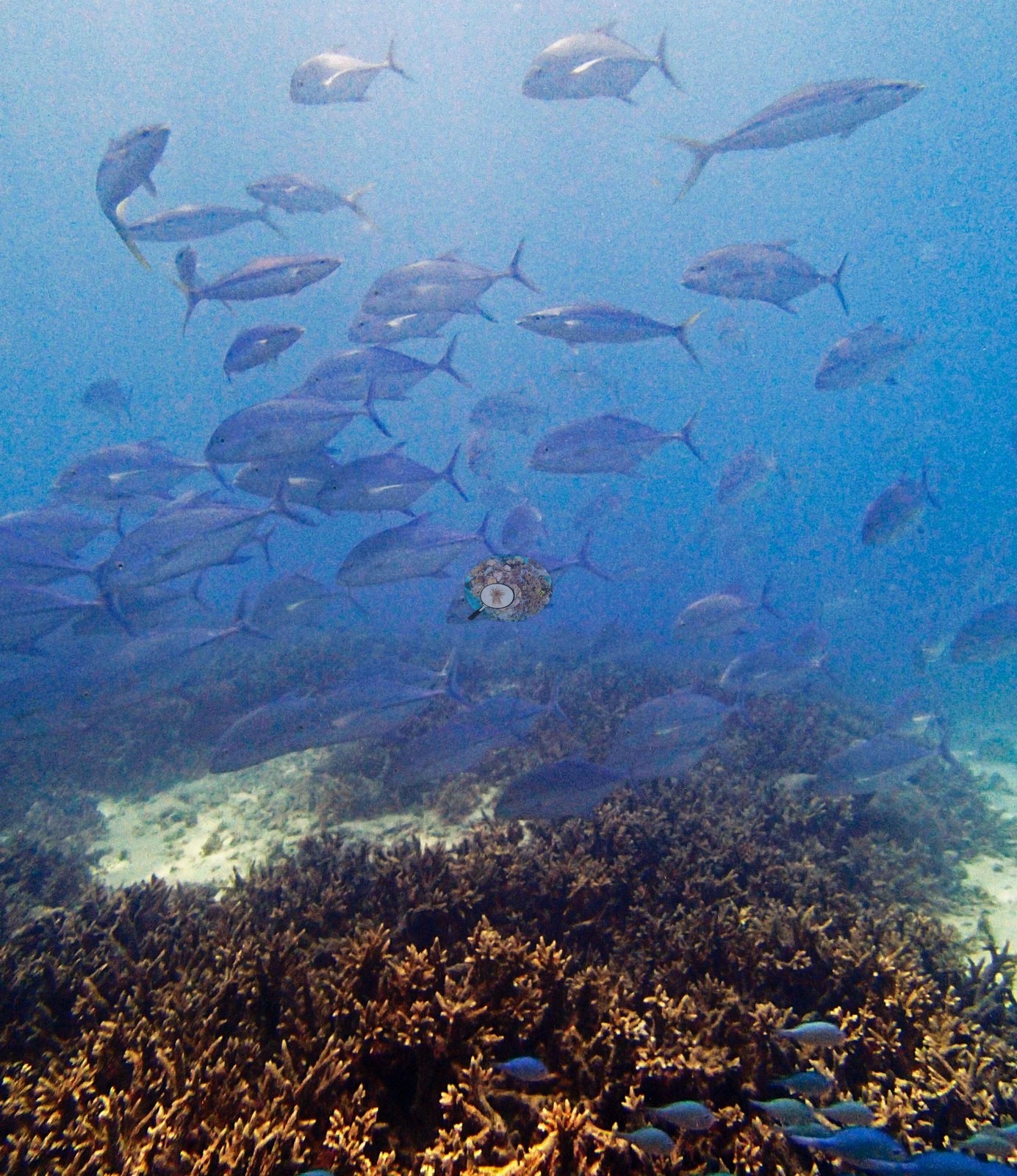
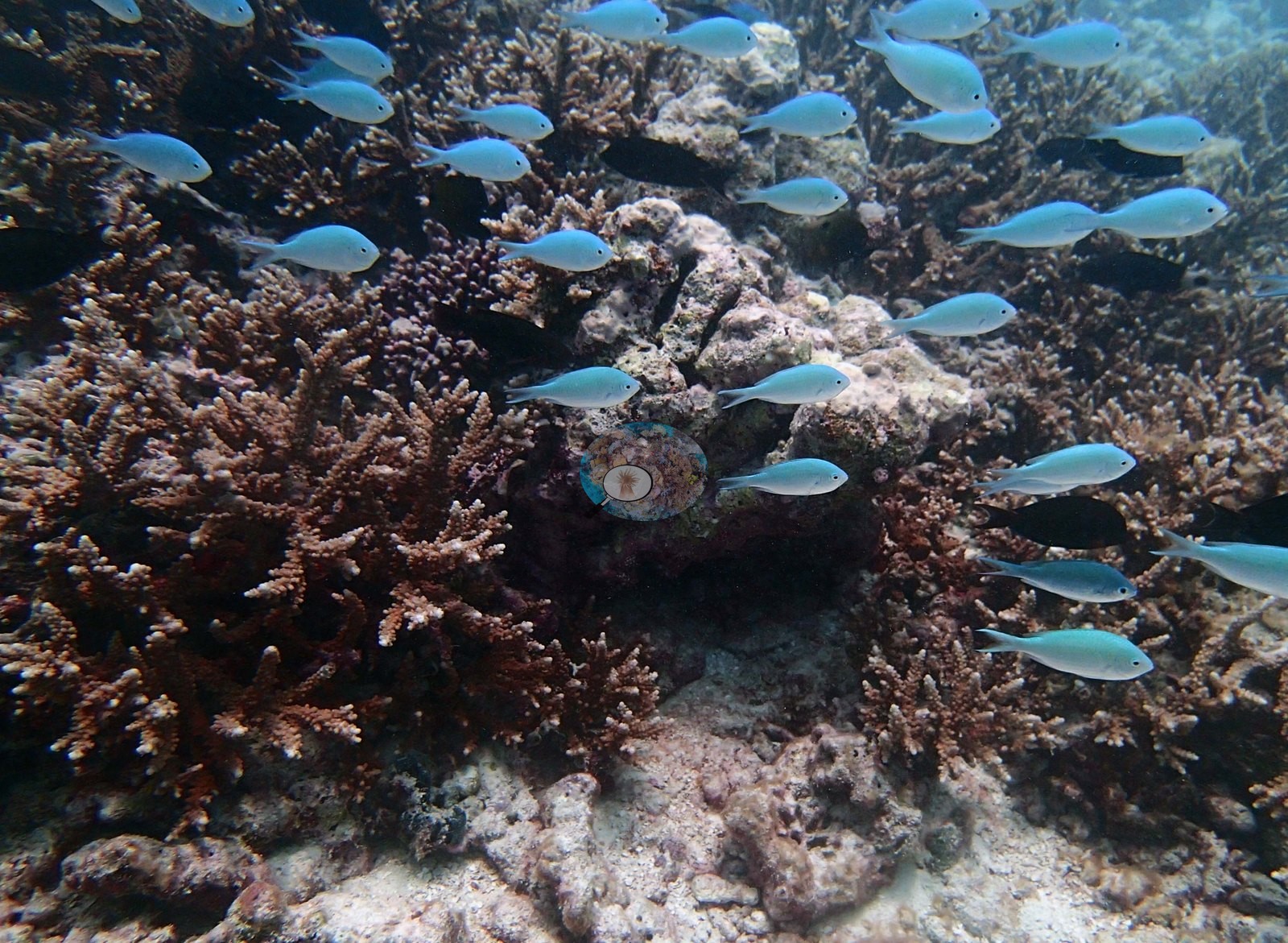
The fish community is dominated by large-bodied predators and grazers, in numbers that make the archipelago's no-take status obvious. Trevally schools compatible with Caranx melampygus and Carangoides fill four consecutive frames — P3110555, P3110556, P3110557, P3110558 — sometimes thirty or more animals in one shot, hanging directly over the staghorn, the largest aggregations reviewed in this Chagos set; a looser aggregation appears in P3110561, which also carries schooling pinkish-silver emperors or breams. Snappers compatible with Lutjanus bohar appear repeatedly and at close range in P3110530, P3110532, P3110533, P3110534, P3110536, and P3110540, and emperors or breams compatible with Monotaxis, Gnathodentex or Lutjanus gibbus school over the coral in P3110538 and P3110560. A gray reef shark compatible with Carcharhinus amblyrhynchos appears in P3110487 and again directly beneath the diver in P3110488. Blue-green chromis compatible with Chromis viridis cloud the staghorn thickets in P3110544 and P3110545, and butterflyfishes work the dead framework in P3110542.
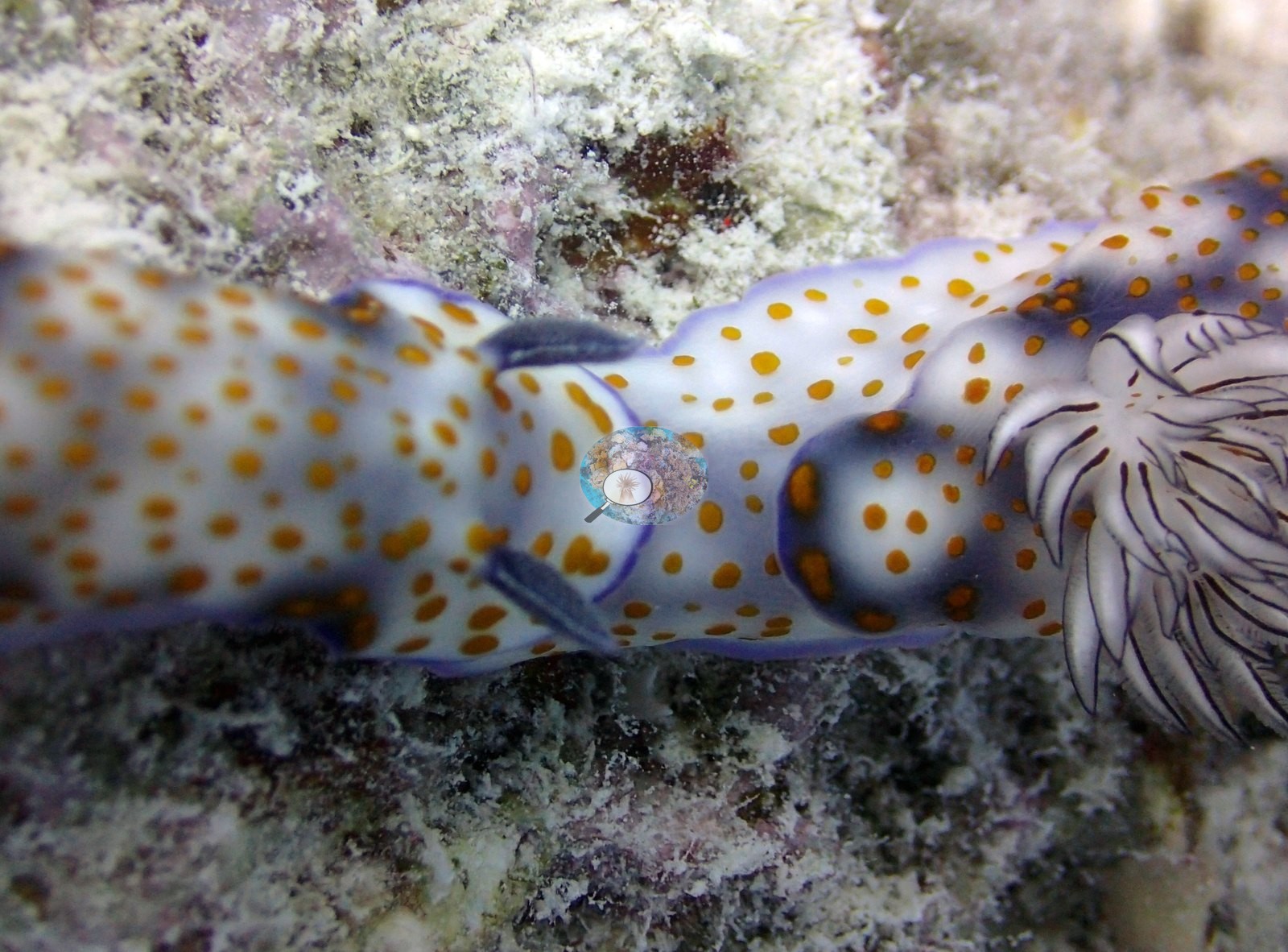
The dive's best single macro subject is P3110526 — a large chromodorid nudibranch, white to lilac with orange-yellow spots, a purple mantle margin and gill plume raised, compatible with Hypselodoris or Chromodoris and not callable to species from a photograph: the only nudibranch found in the Chagos frames reviewed to date.
Comparisons with other data
With the BIEG05 series these form a coherent record of how the survey was done.
Other notes
Image-by-image account. Thirty-three habitat frames exist for BIEG06, all from Anderson's own folder BiEg06-finished, which carries no condition annotation; there are no sampled-colony close-ups.
Methodology frames. P3110532 is the clearest methodology frame at this site — a diver carrying the white PVC quadrat frame, with a large Lutjanus bohar crossing directly in front of the lens as the frame is carried. P3110488 also records the survey in progress, but what the diver there is carrying is a camera rig with twin strobes, not the quadrat.
CV model comparison
More info
Those are point counts on the photographs; this is a diver swimming a transect. The models and the reference never saw the same thing. ⚠ SITE-LEVEL ONLY. The 2,500 frames were not associated with any transect taken within 200 m of them, so transect-vs-image comparisons are site means, never frames. The transect value is already in the pin `cover` field (109 of 112 pins, sourced to the paper's suppl. S1) and is read from there, never re-imported. The transect is THE coral-cover value for this site and stands alone. The rows below it are a methods comparison only: no computer-vision value is averaged with it, feeds the headline, or carries over to the site's cover figure (Anderson, 2026-09-22).| Method | Hard-coral cover (%) |
|---|---|
| Transect (published) | 43.5 |
| CoralNet | 44.2 |
| In-house DINOv3 | 34.0 |
| CoralSCOP edited | 22.6 |
| Claude | 31.6 |
Independent surveys nearby
| Agency / program | Year(s) | Stations / distance | Link |
|---|---|---|---|
| Sheppard et al. (2008) | 2006 | 1 station, 2.15 km | Records ↓ |
| Spalding et al. (2024) | 2024 | 3 stations, 1.16–1.46 km | Records ↓ |
| Spalding et al. 2025 (Chagos 2024 bleaching report) | 2024 | 8 stations, 1.16–3.64 km | Records ↓ |
 Dr. Coral (CRD)Year-average (no detectable trend)
Within 5 km, 12 independent survey stations recorded hard coral cover in 15 surveys between 2006 and 2024. Surveys since 2021 average 39% (range 5.0–70%, n=5); 6 best-patch values above 70% are left out, as they are not site means. This site's own estimate (44%) sits within the recent range (5.0–70%); the methods differ, so the comparison is context, not a like-for-like test.
Collected by other programs using different methods, so these are context for the figures above, not a like-for-like comparison. Where a station was surveyed more than once the range is shown. Station names are not dive-site names. Values marked best patch exceed 70%: surveyors usually chose the richest area, so they are not site means.
Show all 12 independent survey records
| Agency | Site / location | Date | Hard coral cover (%) | Distance | Link |
|---|---|---|---|---|---|
| Sheppard et al. (2008) | Egmont | 2006 | 19% (4 surveys) | 2.15 km | HeatCRD database |
| Spalding et al. 2025 (Chagos 2024 bleaching report) | Egmont, NW Lagoon (lagoon, S aspect, 2-3 m) | 2024 | 70% | 1.16 km | — |
| Spalding et al. 2025 (Chagos 2024 bleaching report) | Egmont Outer reef North (ocean, N aspect, 5-8 m) | 2024 | 80% best patch | 1.46 km | — |
| Spalding et al. 2025 (Chagos 2024 bleaching report) | Egmont Outer reef North (ocean, N aspect, 8-10 m) | 2024 | 80% best patch | 1.46 km | — |
| Spalding et al. 2025 (Chagos 2024 bleaching report) | Egmont West (ocean, W aspect, 7-10 m) | 2024 | 30% | 3.50 km | — |
| Spalding et al. 2025 (Chagos 2024 bleaching report) | Egmont West (ocean, W aspect, 12-15 m) | 2024 | 20% | 3.50 km | — |
| Spalding et al. 2025 (Chagos 2024 bleaching report) | Egmont Manta Alley (ocean, NE aspect, 2-5 m) | 2024 | 5.0% | 3.64 km | — |
| Spalding et al. 2025 (Chagos 2024 bleaching report) | Egmont Manta Alley (ocean, NE aspect, 5-8 m) | 2024 | 80% best patch | 3.64 km | — |
| Spalding et al. 2025 (Chagos 2024 bleaching report) | Egmont Manta Alley (ocean, NE aspect, 8-10 m) | 2024 | 80% best patch | 3.64 km | — |
| Spalding et al. (2024) | Egmont, NW Lagoon (lagoon, S aspect, 2-3 m) | 2024 (Nov-Dec mortality survey; site also described in Annex 3) | 70% | 1.16 km | — |
| Spalding et al. (2024) | Egmont Outer reef North (ocean, N aspect, 5-8 m) | 2024 | 80% best patch | 1.46 km | — |
| Spalding et al. (2024) | Egmont Outer reef North (ocean, N aspect, 8-10 m) | 2024 | 80% best patch | 1.46 km | — |
Data & links
- Read the full site report ↗
- Download benthic survey data (CSV) ↗
- Download all LOF-GRE data (933 sites) ↗
- CoralNet image repository for this region ↗
- HeatCRD database ↗
- (reference) ↗
- Photo portfolio ↗
- Coral Reef Diagnostics page for this area ↗
All images from Coral Reef Diagnostics. Data are from Coral Reef Diagnostics and the organizations named in the data-sources table above.
 © Coral Reef Diagnostics.
References
- Mayfield AB, Dempsey AC (2026). Using tourist diver images to estimate coral cover and bleaching prevalence in a remote Indian Ocean coral reef system. Oceans 7(1):1. PDF
- Sheppard C, Harris A, Sheppard A (2008). Archipelago-wide coral recovery patterns since 1998 in the Chagos Archipelago, central Indian Ocean. Marine Ecology Progress Series 362:109-117. PDF
- Spalding M, Bourasseau M, et al. (2025). Coral bleaching and mortality in the Chagos Archipelago, 2024. British Indian Ocean Territory Administration report (gray literature). PDF