
Chagos Archipelago - Danger Island (BIDI16.5)

Part of the regional summaries: Chagos Archipelago - Egmont / Danger Island / Cauvin Bank and Chagos Archipelago
More info
Chagos (NOAA CRW virtual station)The bleaching site of the Danger Island set: several Pocillopora colonies are strongly mottled, with bone-white branch clusters beside fully pigmented ones, a textbook pattern of patchy partial bleaching. Point counts on the photographs independently confirm it, and pale patches on massive Porites suggest older partial die-off. Surveyed on the Living Oceans Foundation's Global Reef Expedition.
Two other CRD dive sites within 5 km shown in orange — click a marker to open its page.
🗺 Detailed map of the Global Reef Expedition dive sites, Danger Island, Chagos (Khaled bin Sultan Living Oceans Foundation; opens in a new window)
2 of these 4 photographs are shown beside the text that discusses them under "Site description" below.
Site description
General benthic features
The two macro frames are substrate studies rather than colony portraits: pink and mauve crustose coralline algae over consolidated pavement and rubble, blood-red encrusting patches, dark-green algal tufts, a glossy dark-brown ovoid consistent with a mantle-covered cowrie in one of them, and pale-tipped branching colonies at the frame edges. Non-coral cover is dominated by crustose coralline algae 5.9%, turf 28.2% of all points.
Coral cover
Assemblage composition. Across 13 analyzed frames the Coralscapes masks put live hard coral at 23.5% of image area, of which other hard coral is the largest component at 41.3%; the rest breaks down as Acropora (non-tabular) 24.5%, massive and meandroid 15%, Pocillopora 12.7% of live cover. The independent 30-point human annotation of the same frames (390 points) gives live hard coral as 27.4% of all points and apportions it Porites 45.8%, Acropora 31.8%, Pocillopora 16.8%, other hard coral 5.6% of live coral. Coral cover: 46% — from imagery only, with no transect behind it. This is a ".5" site: informal survey images were annotated in CoralNet, but no formal benthic transect was ever run here. The figure describes the frames that were photographed, not a surveyed reef, and it is not comparable with the transect-derived cover quoted at the numbered sites nearby — it must never be pooled or averaged with them.
Stressors
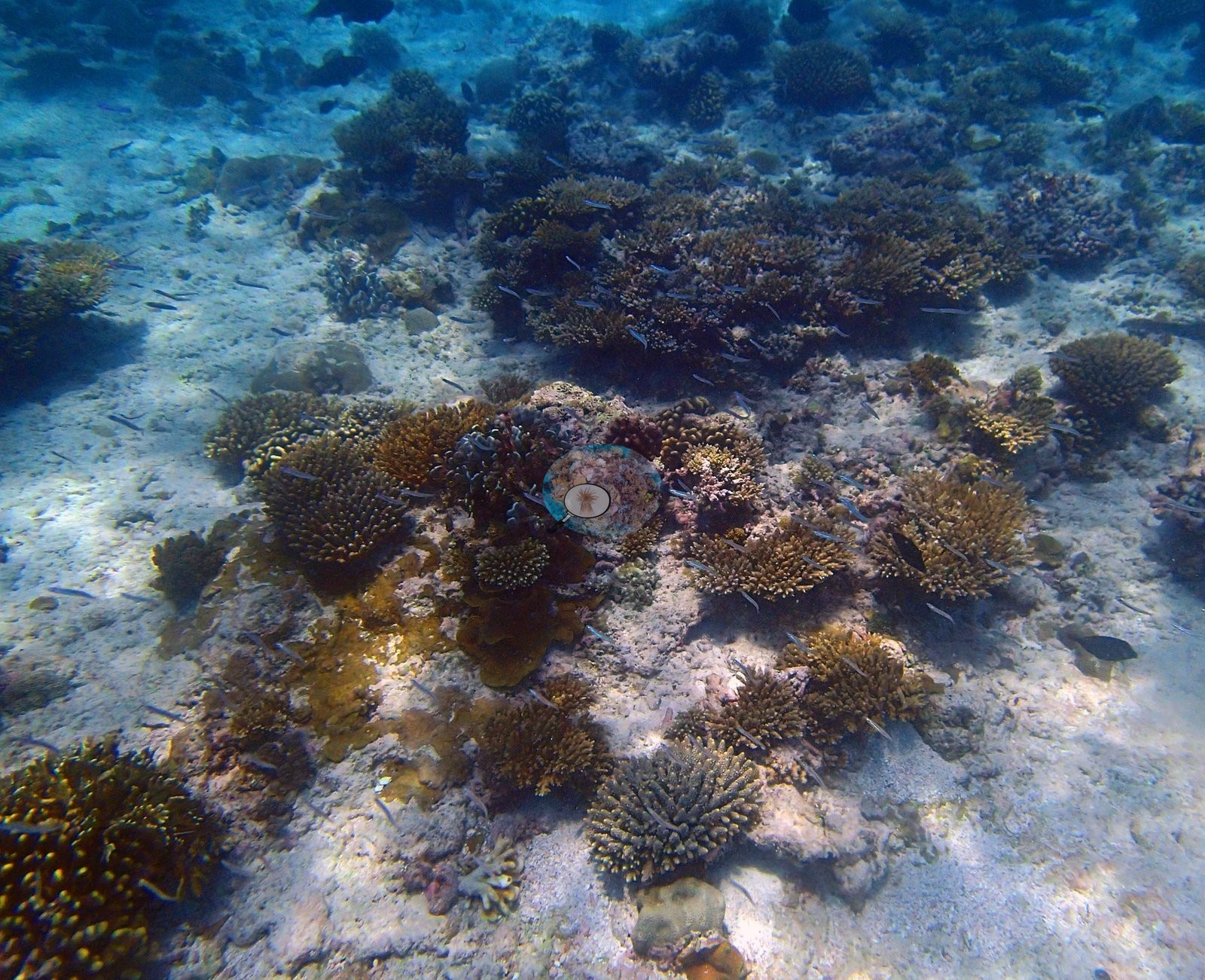
This is the bleaching site of the Danger Island set, and the imagery carries it. The single best frame: one Pocillopora-type colony strongly mottled, bone-white branch clusters interleaved with fully pigmented brown ones across the same colony — textbook patchy partial bleaching, unambiguous. A second frame is its complement, a large verrucose thicket where most of the colony has gone pale pink-cream with brown polyps still visible and one bone-white cluster below (e.g., Image 3).
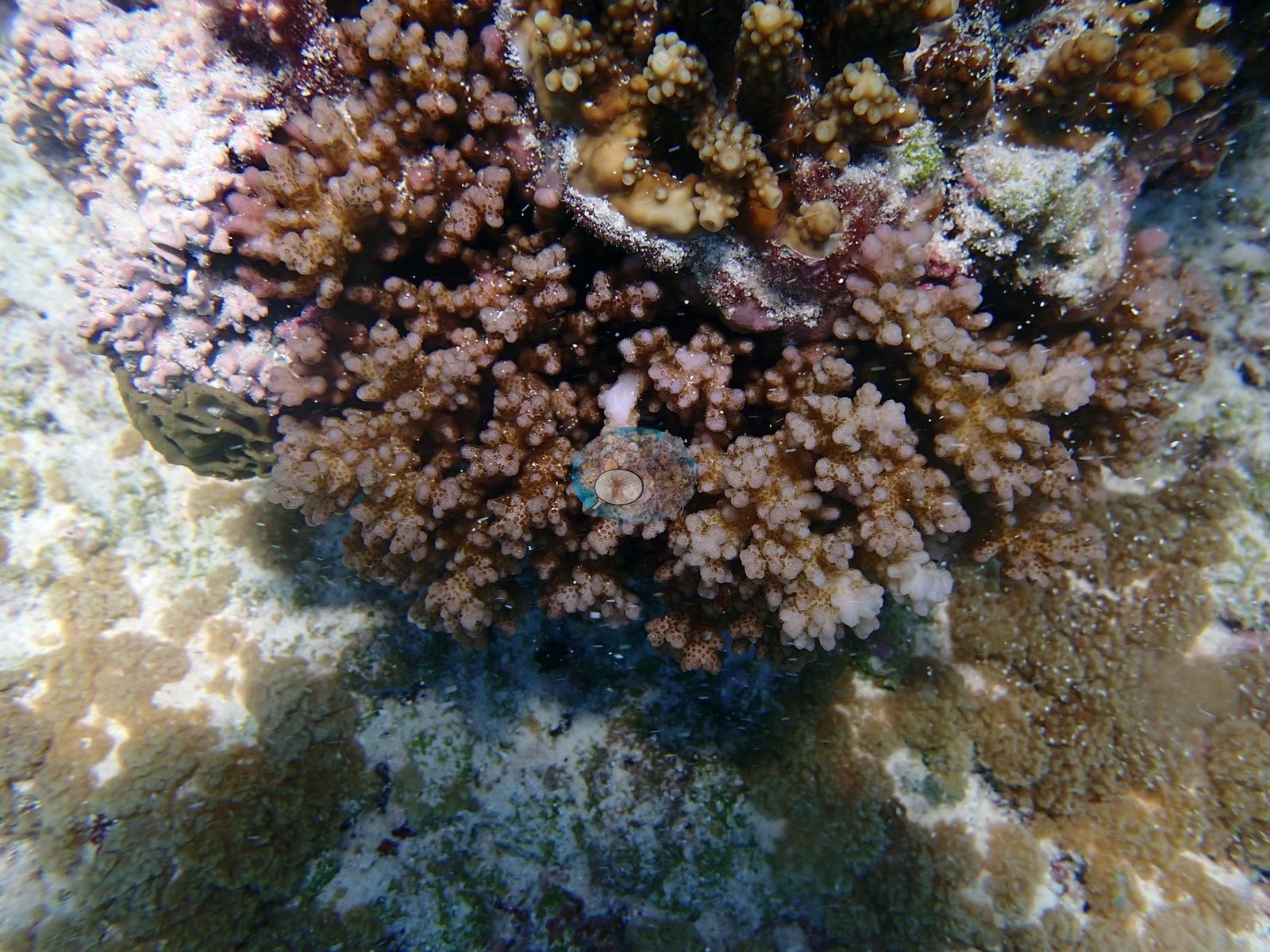
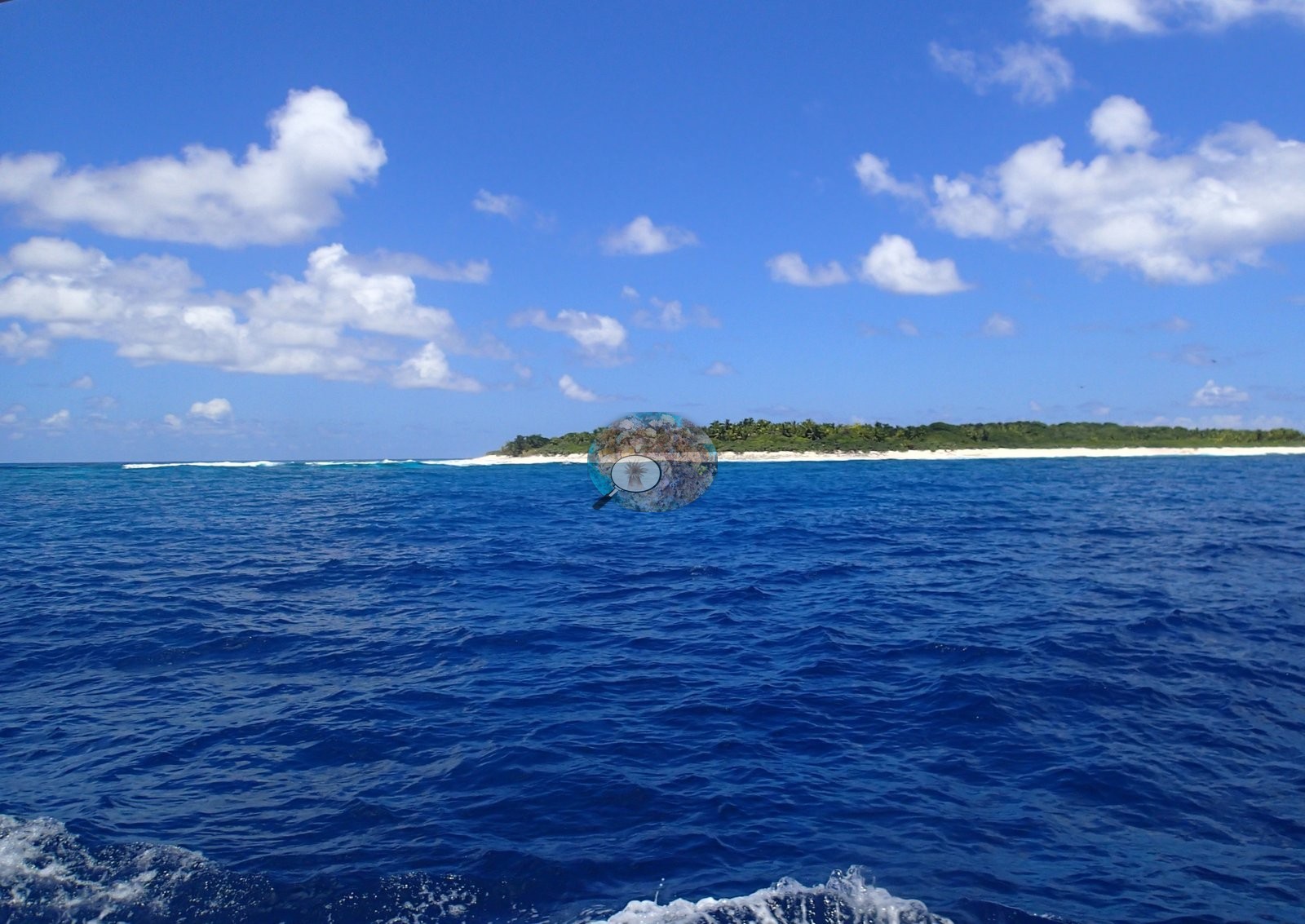
A third shows the tip-first pattern: a Pocillopora whose branch ends are white while the colony interior stays pigmented. In Pocillopora white branch ends are not a normal growth feature, which is what makes these three frames convincing where a pale Acropora tip would not be. Another frame adds a small, wholly bone-white branching colony standing among pigmented neighbors, and two more show pale patches on the upper surfaces of massive Porites that are more likely partial mortality or old lesions than active bleaching. The point annotations independently confirm this read. Of 21 bleached points across the site, 11 (52%) fall in the two frames flagged as the strongest bleaching images before the point annotations were opened, with 2 each in three other frames and 1 each in two more. The Coralscapes model agrees on the single best frame too, reading it as 7.5% bleached and 11.9% dead, its highest for either class at this site. Three methods, one conclusion: the bleaching at BIDI16.5 is real, spatially clustered, and concentrated in pocilloporids. Two annotation errors run in opposite directions, and both matter. First, 2 of the site's 21 bleached points sit on the two surface frames, photographs of the palm-fringed sand cay taken from the boat, 90% open water and sky, containing no coral whatsoever. Each was assigned one "bleached Acropora" point (one also picks up a "Porites"), almost certainly points landing on white breaking surf along the reef crest. That is 10% of the site's bleached signal generated by foam. Second, and pulling the other way, one frame contains a wholly white branching colony yet scores zero bleached points — 30 points simply did not land on it. The same under-detection was flagged at BIDI16. Point counts on this site both over-call bleaching on blue-water frames and miss small whole-colony bleaching; do not treat the 30-point read as ground truth in either direction. One more frame deserves separate mention: a striking deep pink-magenta verrucose colony, compatible with a pink-pigmented Pocillopora, sitting on coralline pavement. Pink and purple chromoprotein pigmentation in pocilloporids is a documented thermal-stress ("colorful bleaching") response, and this frame carries 2 bleached points, so the colony may belong with the bleaching evidence rather than beside it. Caution on those tips — in Acropora actively growing axial corallites are routinely pale, so tip pallor alone is not bleaching; the Pocillopora frames are the defensible evidence. Structural loss registers as dead coral 2.1% of image area and rubble 8.7%. Bleaching stands at 5.4% of annotated points, concentrated in other hard coral 3.3%, Acropora 2% of points. No crown-of-thorns starfish (COTS) or other corallivores evident.
Fish and other fauna
Faunally the site is livelier than BIDI16: one frame has a large loose school of small slender silvery fish (fusilier- or silverside-type) threading the whole frame, another draws wrasses and damselfishes to its isolated bommie, and a sergeant major compatible with Abudefduf sits at the bottom of a third (e.g., Image 2).
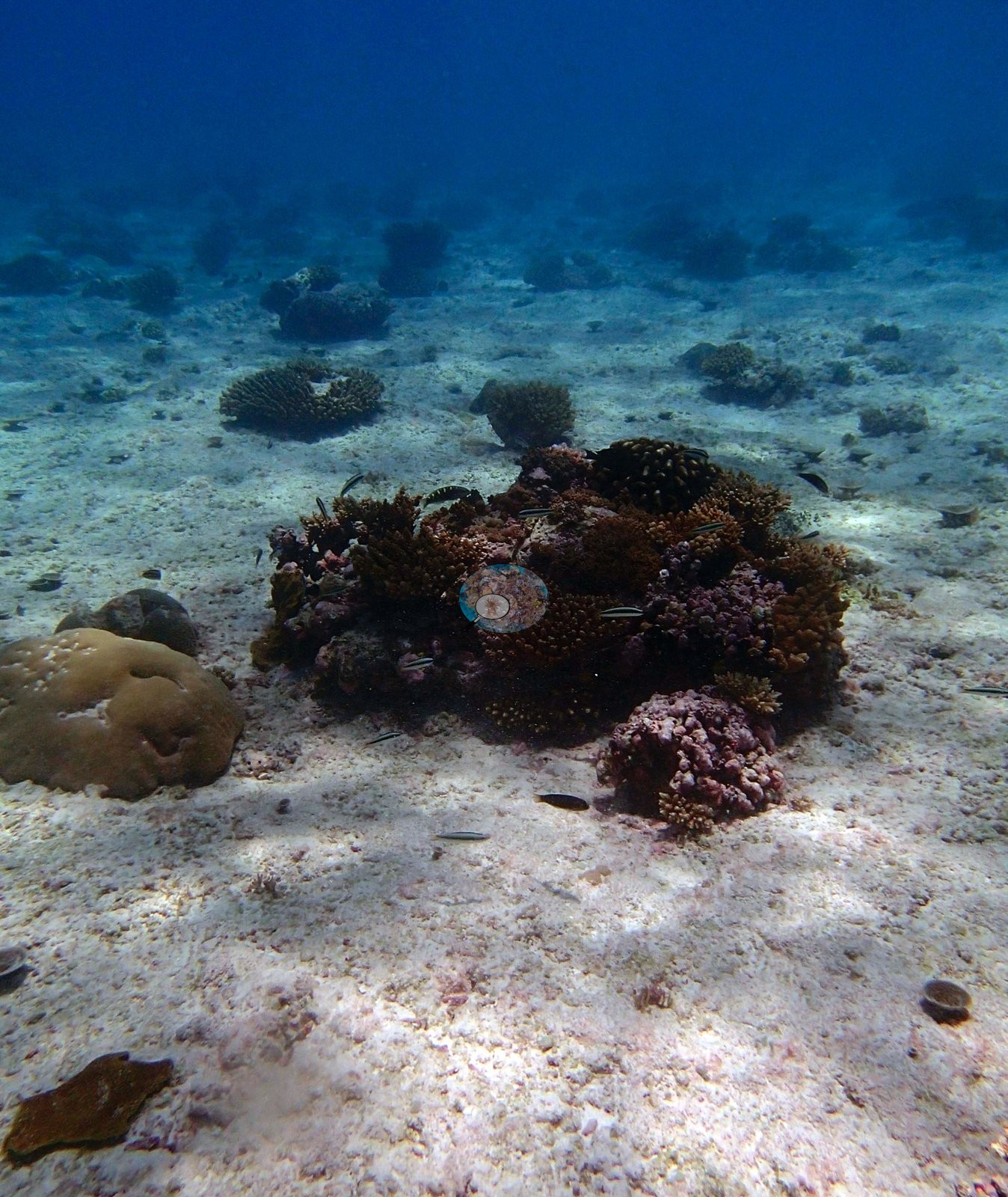
Conspicuous fauna and sessile invertebrates appear as sponges in 8 of the frames reviewed, anemones in 2, giant clams in 1.
Comparisons with other data
No prior survey data from this site. If you would like to share yours, please email us.
Other notes
The existing description called this "a deep-magenta soft-coral colony wedged among the branches" — that appears to be wrong; the corallite structure is stony, not octocorallian. Flagged for Anderson's eye rather than resolved here.
CV model comparison
More info
Every other row is a method run on this site's own photographs (mean ± SD across photos), listed for comparison only; nothing is averaged with the headline. As of September 2026 no computer-vision method estimates coral cover accurately on new images, so treat these as indicative.| Method | Hard-coral cover (%) |
|---|---|
| Manual (published) | 45.6 |
| CoralNet | 38.7 |
| In-house DINOv3 | 41.8 |
| CoralSCOP edited | 29.7 |
| Claude | 26.3 |
Data & links
- Download all LOF-GRE data (933 sites) ↗
- CoralNet image repository for this region ↗
- Photo portfolio ↗
- Coral Reef Diagnostics page for this area ↗
All images from Coral Reef Diagnostics. Data are from Coral Reef Diagnostics.
© Coral Reef Diagnostics.