
Part of the regional summaries: Chagos Archipelago - Egmont / Danger Island / Cauvin Bank and Chagos Archipelago
More info
Chagos (NOAA CRW virtual station)Cauvin Banks has the second-lowest coral cover of the 109 Chagos sites, at 4.6%, with a third of the bottom bare and much of the rest sediment-bound turf and coralline crust. Yet its sparse corals are unusually diverse and evenly mixed, a thin veneer on open ground rather than a collapsed reef, and no bleaching was recorded. Surveyed on the Living Oceans Foundation's Global Reef Expedition.
🗺 Detailed map of the Global Reef Expedition dive sites, Cauvin Bank, Chagos (Khaled bin Sultan Living Oceans Foundation; opens in a new window)
Site description
Setting
Setting: submerged patch reef, lagoonal (inside the lagoon), exposed · 28.9°C · salinity 34 · 6.80368°S, 72.38544°E · marked Training in the supplement · the only site in the Cauvin region · dived 9 March 2015, the expedition's first survey, site #1 of 109.
General benthic features
Assemblage composition from transect data — the reef is nearly bare, and the little coral on it is the most evenly shared in the archipelago. The transect records eleven genera, summing exactly to the 4.6% cover: Porites 1.45%, Montipora 1.30%, Pocillopora 0.55%, Acropora 0.35%, Cyphastrea 0.20%, Favites 0.15%, Goniastrea 0.15%, Leptastrea 0.15%, Stylophora 0.15%, Fungia 0.10% and the hydrocoral Millepora 0.05%. As a share of live coral that is Porites 31.5% and Montipora 28.3% — no genus holds even a third of the assemblage. H′ = 1.886, Simpson (1−D) = 0.794, Pielou's J′ = 0.787.
The pairing of those numbers is the point. BICA01 has the second-lowest coral cover of the 109 sites (4.6% vs a mean of 37.9%; only BIDI12 at 4.18% is lower) and near-lowest richness (11 genera, 103rd, mean 23.3) — yet evenness third-highest in the dataset (J′ 0.787 vs a mean of 0.598, behind only BINI78 and BIEA20) and H′ above the dataset mean of 1.856 on a twentieth of the mean cover. A thin, taxonomically diverse veneer, not a stand — the exact inverse of BIDI11, where four genera and 75% Porites carried 40% cover: abundance without diversity there, diversity without abundance here.
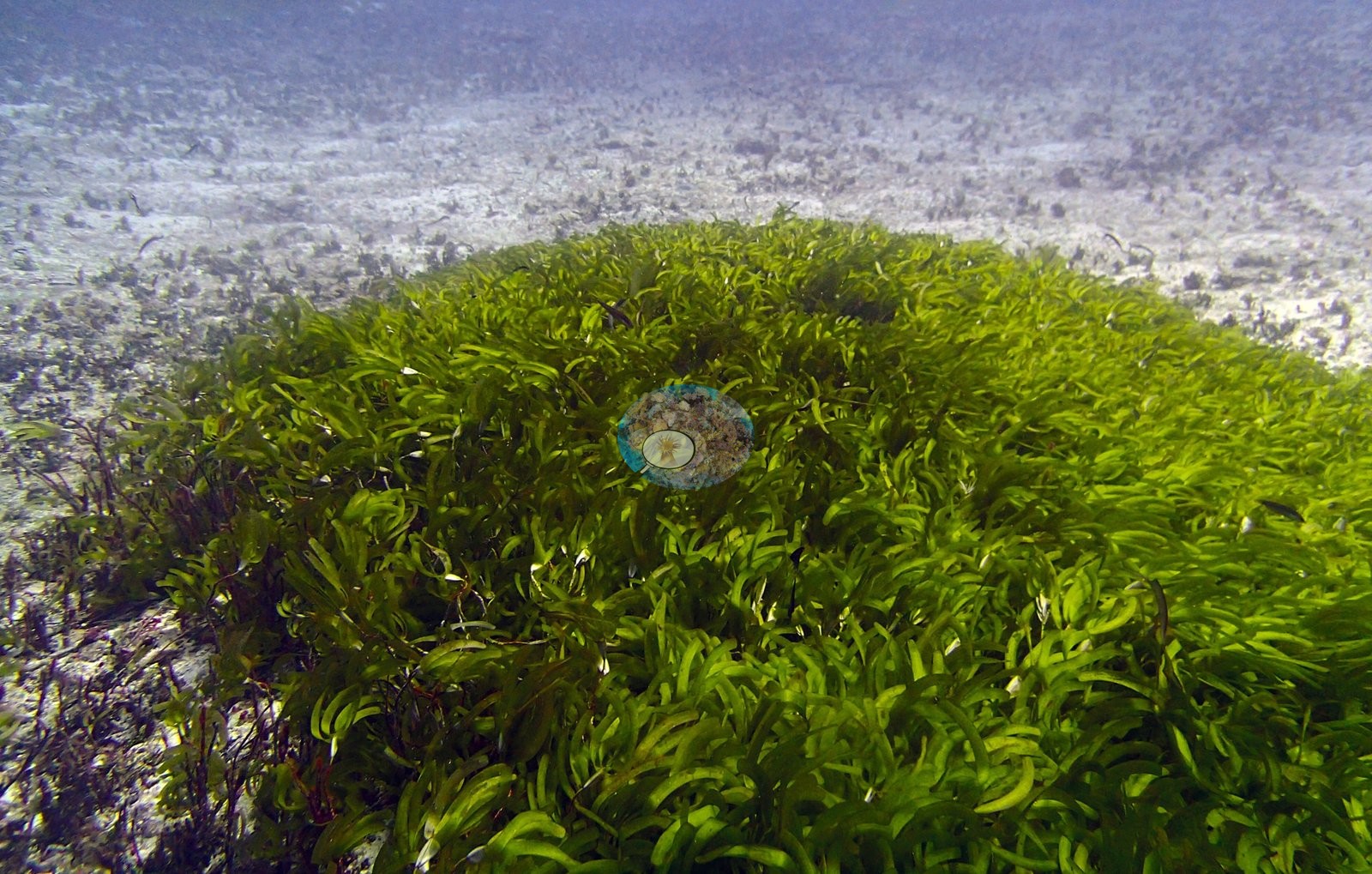
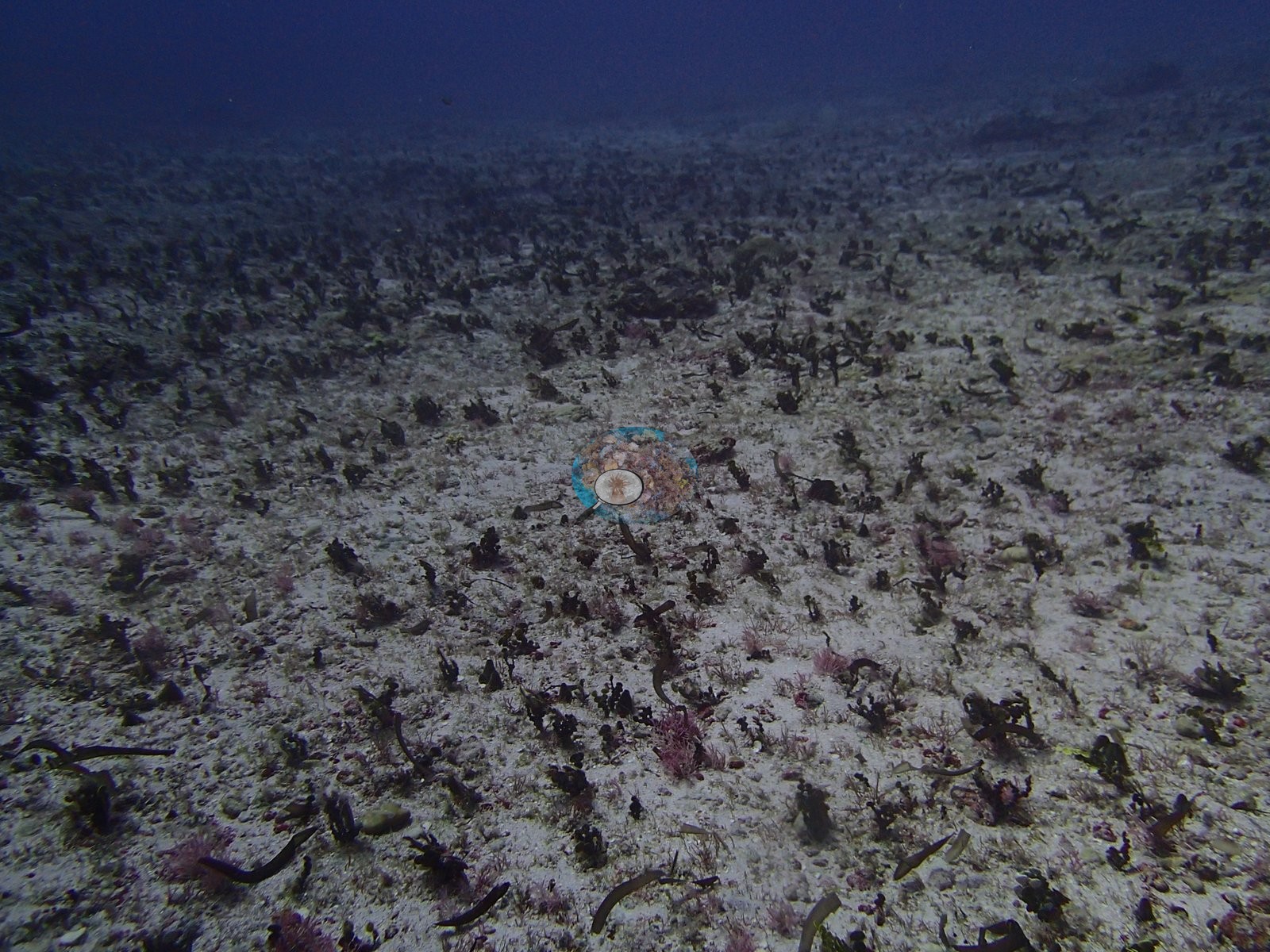
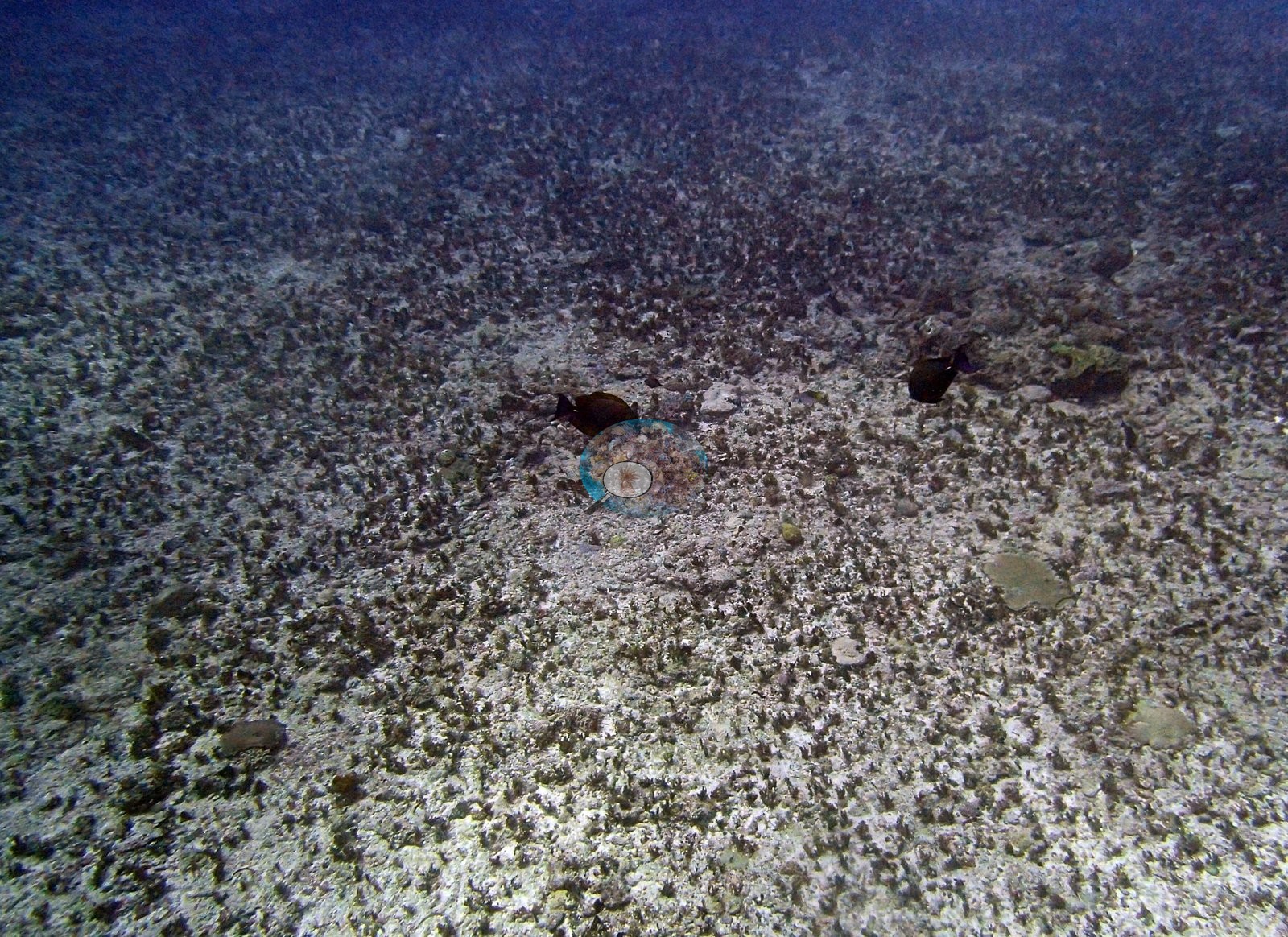
The benthos closes cleanly and is dominated by things that are not coral: coral 4.6 + algae 56.8 + bare substrate 37.45 + invertebrates 1.15 = 100.00%. Algal cover breaks down as sediment-laden turf (PTSTS) 22.3 · CCA (PCCATS) 15.5 · erect algae (PETS) 9.1 · turf (PTTS) 7.4 · macroalgae (PMTS) 2.5 · cyanobacteria (PCYTS) 0.0. Bare substrate (PB) at 37.45% is the dataset maximum (mean 11.2%) and sediment-laden turf at 22.3% is 8th of 109 (mean 7.37%). One-third bare, one-fifth sediment-bound turf, one-sixth CCA — mostly open substrate under a fine algal skin, not a collapsed framework. The 10% comes from three “Acropora” points on P3090257 — a photograph of a green algal mound — whose 30 points are 15 FISH, 6 Unknown, 6 Turf and 3 Acropora, with no macroalgae point at all. P3090257 is a dense low mound of bright-green strap-shaped blades — compatible with a fleshy Caulerpa-type macroalga — on open pale carbonate sand, with dark red-brown erect tufts along its left margin; no coral in frame at all. It is the best-lit of the three. P3090273 is a wide, dim, deep-looking view of exactly the substrate the transect describes: sediment-veneered pale carbonate with scattered dark olive erect tufts, pink-mauve tufts compatible with articulated coralline algae, and no coral framework; it is low-contrast. P3090284 is the best habitat frame — low-relief pavement running away to a dark blue horizon under continuous dark turf stubble, with two dark surgeonfish-type acanthurids grazing over it and a few small smooth olive-gray discs compatible with encrusting or small massive colonies but not callable; it too is dim. What the frames do support, qualitatively, is the character the transect describes: open substrate under a fine algal skin rather than a collapsed coral framework — a reef that is sparse rather than wrecked.
Coral cover
The transect is this site's measurement. Coral cover 4.6%, from LOF BIOT-1 in situ transects (Mayfield & Dempsey 2026, Oceans, suppl. S1). That diver survey — four transects × 500 points = 2,000 points, per-transect 6.2 / 4.0 / 5.6 / 2.6%, SD 1.6 — is the authoritative record of cover and community here, and it describes a uniformly sparse bottom rather than a patchy one. The survey sits in a single depth stratum, D4, at 28 m; there is no depth profile to read. Everything photographic or model-derived below supplements this measurement and never qualifies it.
Computer-vision method comparison — it rests on two frames and is not a method test. The multi-method table gives transect 4.6% · CoralNet 5.0% · Coralscapes 0.4% (deviation −4.2 to +0.4 pp) on n = 2 — P3090284 was never annotated. The 5.0% is the mean of two training rounds that returned 10% and 0%, a 200% formal-vs-informal difference — the largest of the 105 sites carrying it. CoralNet landing within 0.4 pp of the transect is arithmetic coincidence, not agreement. Worth one line: Coralscapes returned essentially nothing (0.4%) where the transect scored 4.6%. Neither product is a check on the transect, and neither may be pooled with the n = 20+ sites.
Stressors
Condition. Anderson's published per-site figure for BICA01 is 0.0% bleached, and that published value is the authority for this site's condition; nothing is estimated from the photographs. Qualitatively, no bleached tissue, crown-of-thorns, disease lesion or predation scar is visible in any of the three frames — an absence in three photographs, not a survey result. The 0.0% belongs with the reading above rather than against it: the reef is not stressed, it is sparse. The figure is real but not unique — five other sites also read 0 on both training rounds (BIDI16, BITB40, BITB43, BIEA52, BIPB69) against a dataset mean of 9.8%.
Comparisons with other data
No prior survey data from this site. If you would like to share yours, please email us.
Other notes
Image-by-image analysis — three frames, and they corroborate the transect and add texture, nothing more. The entire photographic record for BICA01 is three habitat frames in Anderson's folder BiCa01-finished (his processing label for the edited website set); there are no sampled-colony photographs, and three frames cannot characterize a site. Not one of the eleven transect genera can be confirmed photographically. No frame carries a scale object, quadrat or transect line, and none has a depth stamp, so nothing in them is measurable and none can be placed on the depth profile.
CV model comparison
More info
Those are point counts on the photographs; this is a diver swimming a transect. The models and the reference never saw the same thing. ⚠ SITE-LEVEL ONLY. The 2,500 frames were not associated with any transect taken within 200 m of them, so transect-vs-image comparisons are site means, never frames. The transect value is already in the pin `cover` field (109 of 112 pins, sourced to the paper's suppl. S1) and is read from there, never re-imported. The transect is THE coral-cover value for this site and stands alone. The rows below it are a methods comparison only: no computer-vision value is averaged with it, feeds the headline, or carries over to the site's cover figure (Anderson, 2026-09-22).| Method | Hard-coral cover (%) |
|---|---|
| Transect (published) | 4.6 |
| In-house DINOv3 | 3.3 |
| CoralSCOP edited | 0.3 |
| Claude | 0.0 |
Data & links
- Read the full site report ↗
- Download benthic survey data (CSV) ↗
- Download all LOF-GRE data (933 sites) ↗
- CoralNet image repository for this region ↗
- Photo portfolio ↗
- Coral Reef Diagnostics page for this area ↗
All images from Coral Reef Diagnostics. Data are from Coral Reef Diagnostics.
 © Coral Reef Diagnostics.