
Egypt Red Sea - Om Halhala (Marsa Nakari)
Part of the regional summaries: Egypt and Red Sea
More info
Egypt (NOAA CRW virtual station) · Northern and Central Red Sea ecoregion mean=12.2°C-heating weeksOm Halhala is the most structurally substantial of the Marsa Nakari-area sites, a dense coral slope built mainly on broad fields of massive Porites - and a large share of that framework was found bleached chalk-white at field scale, dozens of colonies across in a single frame, while nearby Acropora thickets held full color. Published cover was 24% with 61.2% of coral tissue bleached, the second-highest bleaching figure of the Egypt survey leg.
أم حلحلة هي الأمتن بنيوياً بين مواقع منطقة مرسى نكاري، منحدر مرجاني كثيف مبني أساساً على حقول عريضة من Porites الكتلي — وقد وُجد جزء كبير من ذلك الهيكل مُبيَّضاً إلى بياض طباشيري على نطاق الحقل، عشرات المستعمرات في الصورة الواحدة، بينما احتفظت أجَمات Acropora القريبة بألوانها كاملة.
ترجمة هذا الملخص بالذكاء الاصطناعي؛ النص الإنجليزي هو المعتمد. Translated from the site’s shorter map summary.
Site description
General benthic features
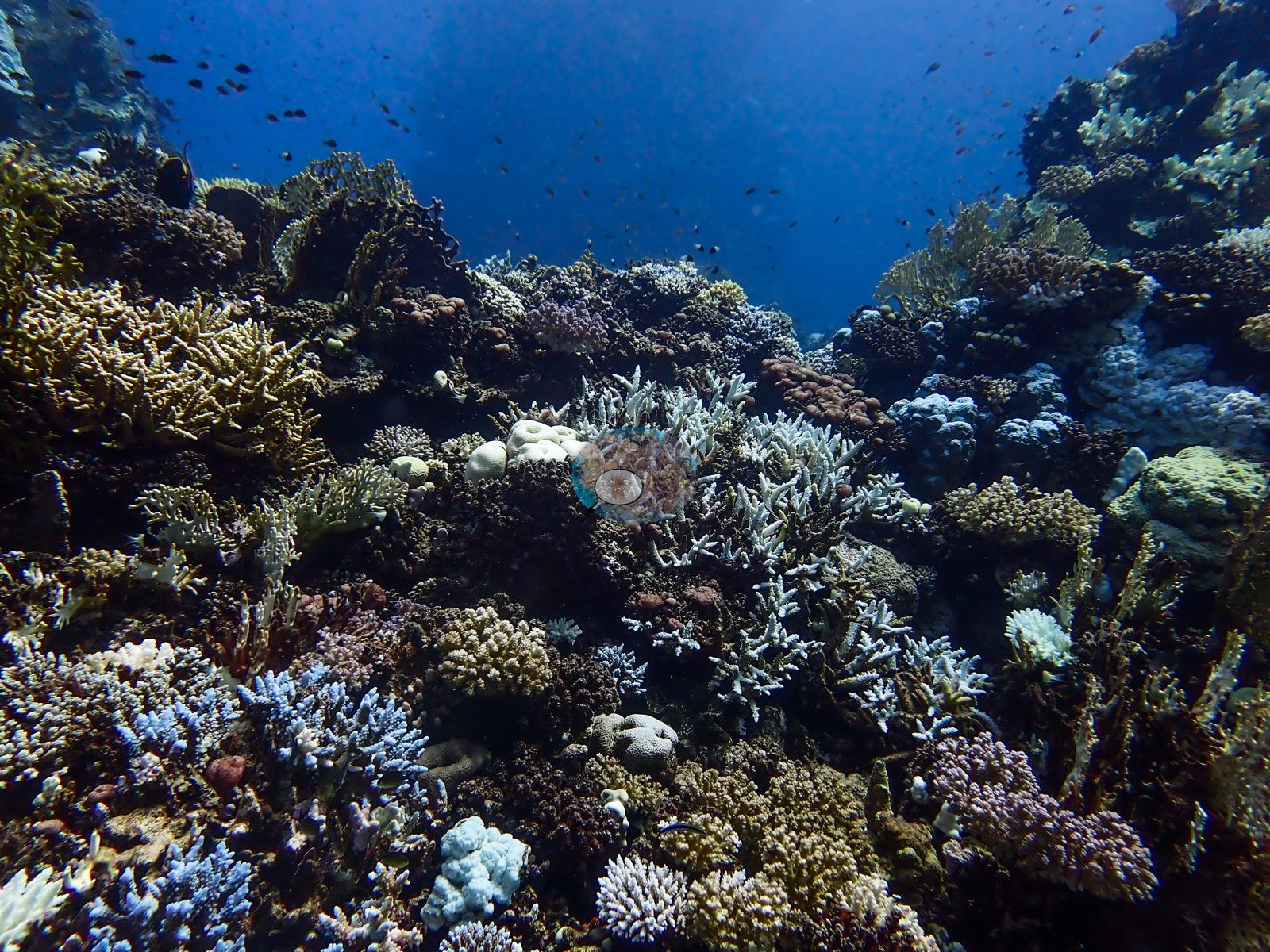
The reef is a well-built coral slope, dense and structurally complex, dropping from shallow water down onto a white sand plain with scattered outlying bommies (e.g., Image 1).
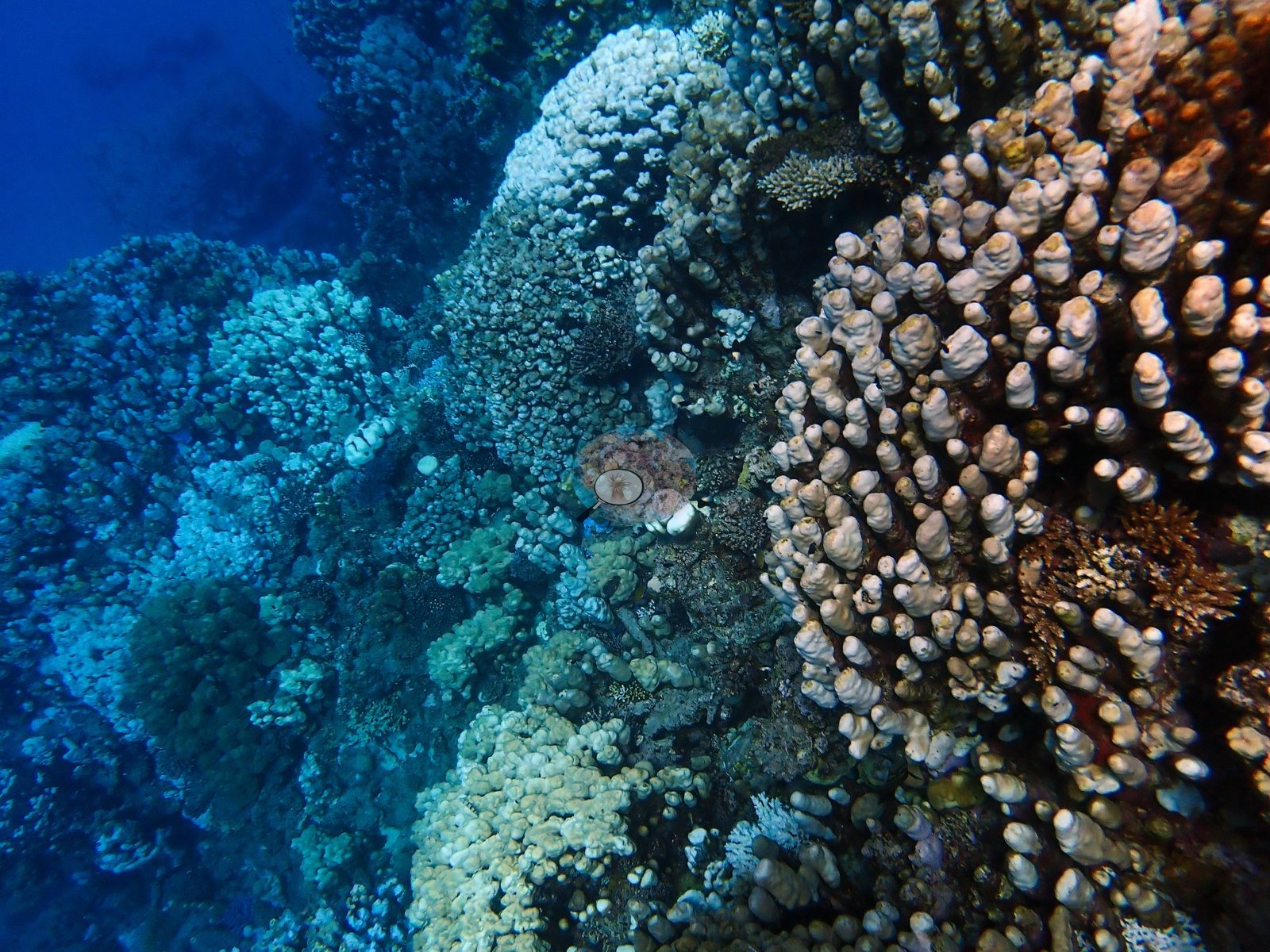
Its dominant element is massive coral: broad fields of lobate and knobby Porites that form the framework, with corymbose and staghorn Acropora, pocilloporids, and encrusting plates layered over and between them (e.g., Image 3).
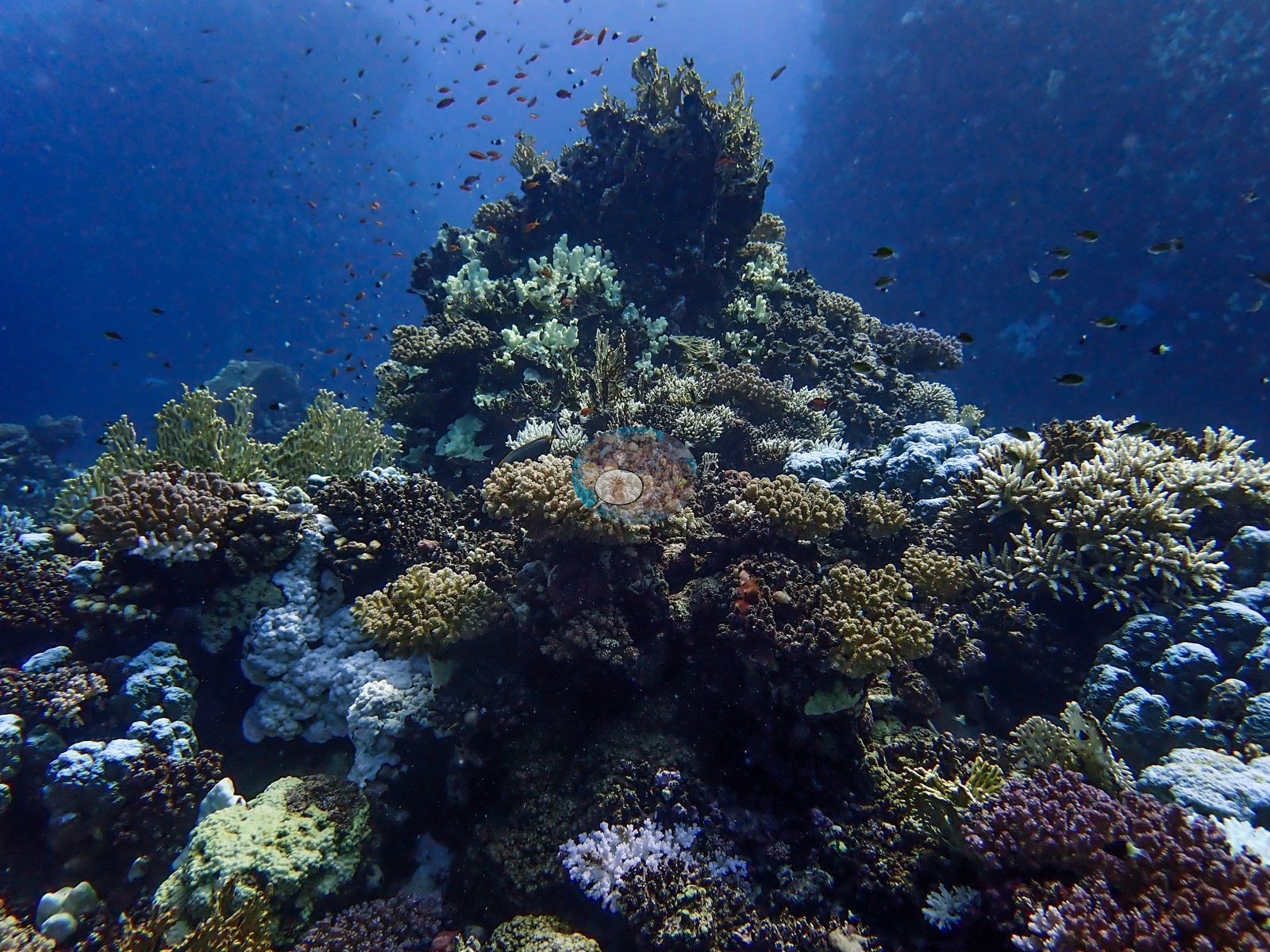
Large columnar bommies rise several meters off the slope (e.g., Image 2).
Coral cover
Coral cover is 24.0% ± 15.2 across 216 photographs, quoted verbatim from Mayfield, A.B. (2025) Environments 12:248 — Red Sea 2023-24 bleaching; CoralNet point annotation, Appendix A — a manual, diver-annotated CoralNet point count from Anderson's own published work, not a computer vision output and not recomputed here.
Stressors
The site record reports 61.2% of coral tissue bleached at about 21.9°C-weeks DHW — the second-highest bleaching figure of the Egypt leg. And a very large proportion of that framework is white (e.g., Image 4).
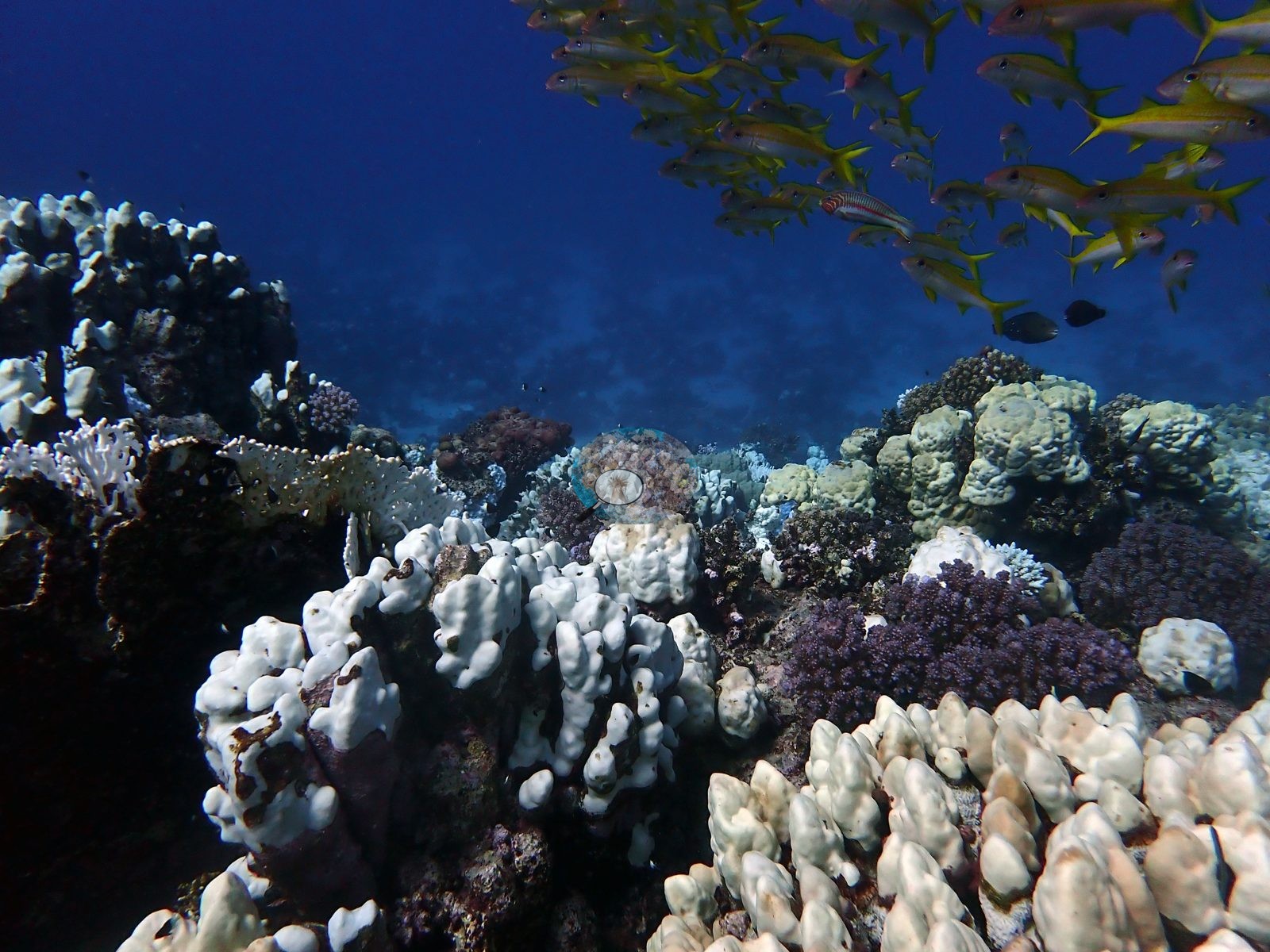
One frame shows a continuous field of lobate Porites, dozens of colonies across, in which effectively every colony is chalk-white, running from the foreground to a bleached bommie in the background — with dark pigmented Acropora thickets holding normal color on the opposite side of the same frame. That contrast within a single image is what makes the call here unambiguous.
Comparisons with other data
No prior survey data from this site. If you would like to share yours, please email us.
Dive record
The second dive of 21 September 2024 with Red Sea Diving Safari, and structurally the most substantial of the Marsa Nakari-area sites.
Other notes
See flags.
CV model comparison
More info
The reference row is this dive site's own published value (Mayfield 2025, Appendix A, 216 photos); the other rows are AREA-level (Marsa Nakari) comparisons, not run on this site's frames. ⚠ The comparison rows are REGIONS, not dive sites: the paper's main tables report cover by region, and this site's own value comes from its Appendix A. ⚠ The manual column and the CV columns are on DIFFERENT FRAME SETS: the published cover spans 674–1,180 frames, the CV arms ran on the 30- and 129-frame hand-scored reference subsets. CoralNet is n/a by design: the reference set IS the hand-scored set. DINOv3 is restricted to frames it never saw. CoralNet automated point classifier: n/a — the reference set IS the hand-scored set; these frames carry no independent CoralNet robot label to compare against CoralSCOP (SAM-based mask-sum), unedited photos: pending — CoralSCOP run: 370/747 images scored at build time CoralSCOP (SAM-based mask-sum), edited photos: pending — CoralSCOP run: 370/747 images scored at build time| Method | Hard-coral cover (%) |
|---|---|
| Manual (published) | 24.0 |
| In-house DINOv3 | 41.8 |
| Claude | 27.7 |
Data & links
All images from Coral Reef Diagnostics. Data are from Coral Reef Diagnostics.
© Coral Reef Diagnostics.