
Egypt Red Sea - Nakari House Reef-South (Marsa Nakari)

Part of the regional summaries: Egypt and Red Sea
More info
Egypt (NOAA CRW virtual station) · Northern and Central Red Sea ecoregion mean=12.2°C-heating weeksNakari House Reef-South, the first stop of the September 2024 Egypt survey leg, captured a graded sequence on a single dive - Anderson's own captions run from 'live corals' and 'survivors' through 'dying Acropora' to 'dead Seriatopora hystrix' and 'dead corals,' documenting bleaching mid-collapse on one reef in one day. Published cover was 25% with 50.4% of coral tissue bleached; a nearby Reef Check station at essentially the same spot has averaged 36.0% hard coral across seven surveys since 2010.
شعبة نزل نكاري الجنوبية، وهي المحطة الأولى في مسح مصر في سبتمبر 2024، وثّقت تسلسلاً متدرجاً في غطسة واحدة: تنتقل تعليقات أندرسون نفسه من "مرجانيات حية" و"ناجية" إلى "Acropora يحتضر" ثم "Seriatopora hystrix ميت" و"مرجانيات ميتة"، فتوثّق الابيضاض في منتصف انهياره على شعبة واحدة وفي يوم واحد.
ترجمة هذا الملخص بالذكاء الاصطناعي؛ النص الإنجليزي هو المعتمد. Translated from the site’s shorter map summary.
Nine independent survey stations shown with the program’s logo — click one to see how far it is from this site.
One other CRD dive site within 5 km shown in orange — click a marker to open its page.
Site description
Setting
The southern arm of the Marsa Nakari house reef, and the first dive of the September 2024 Egypt leg with Red Sea Diving Safari.
General benthic features
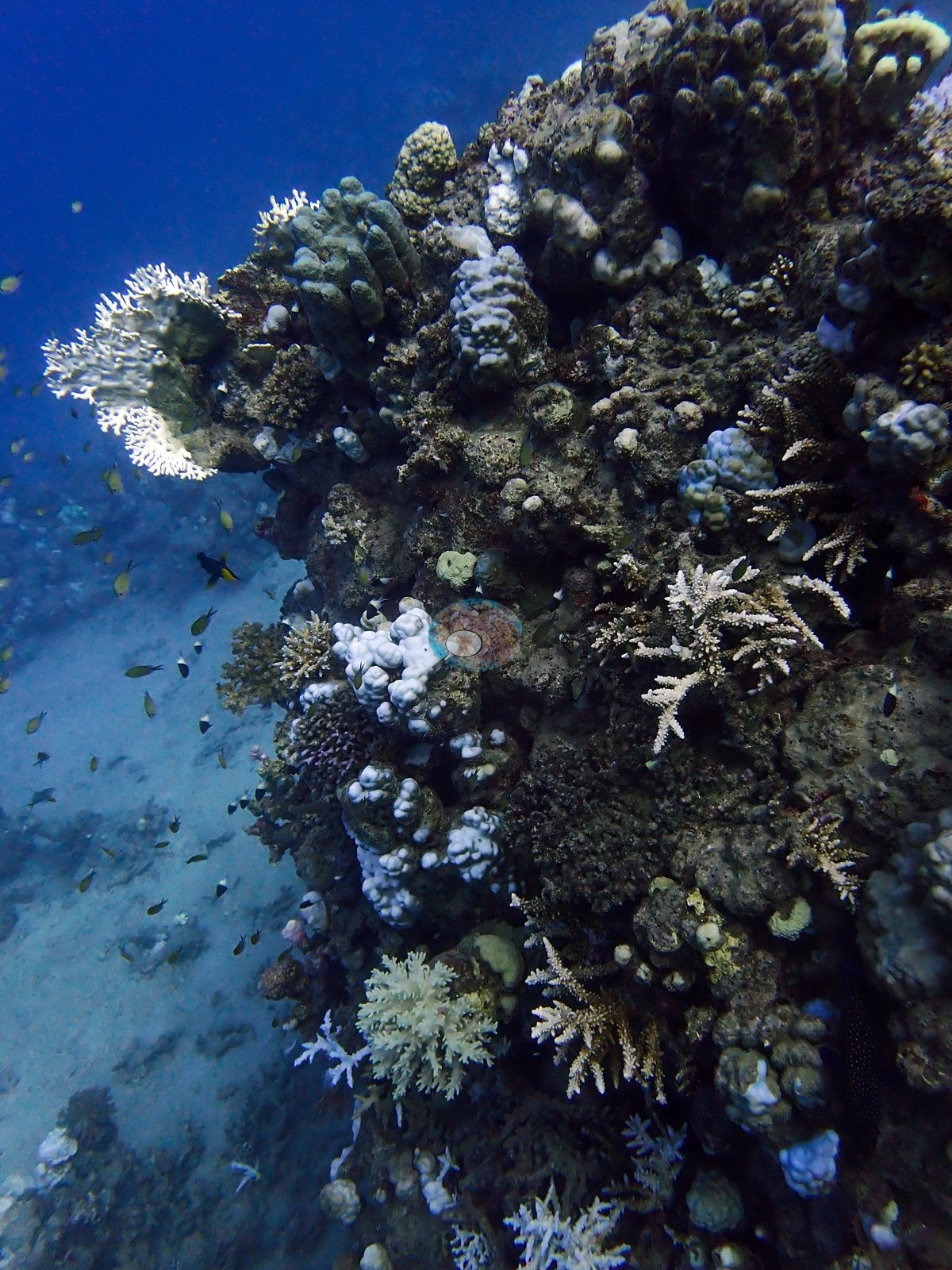
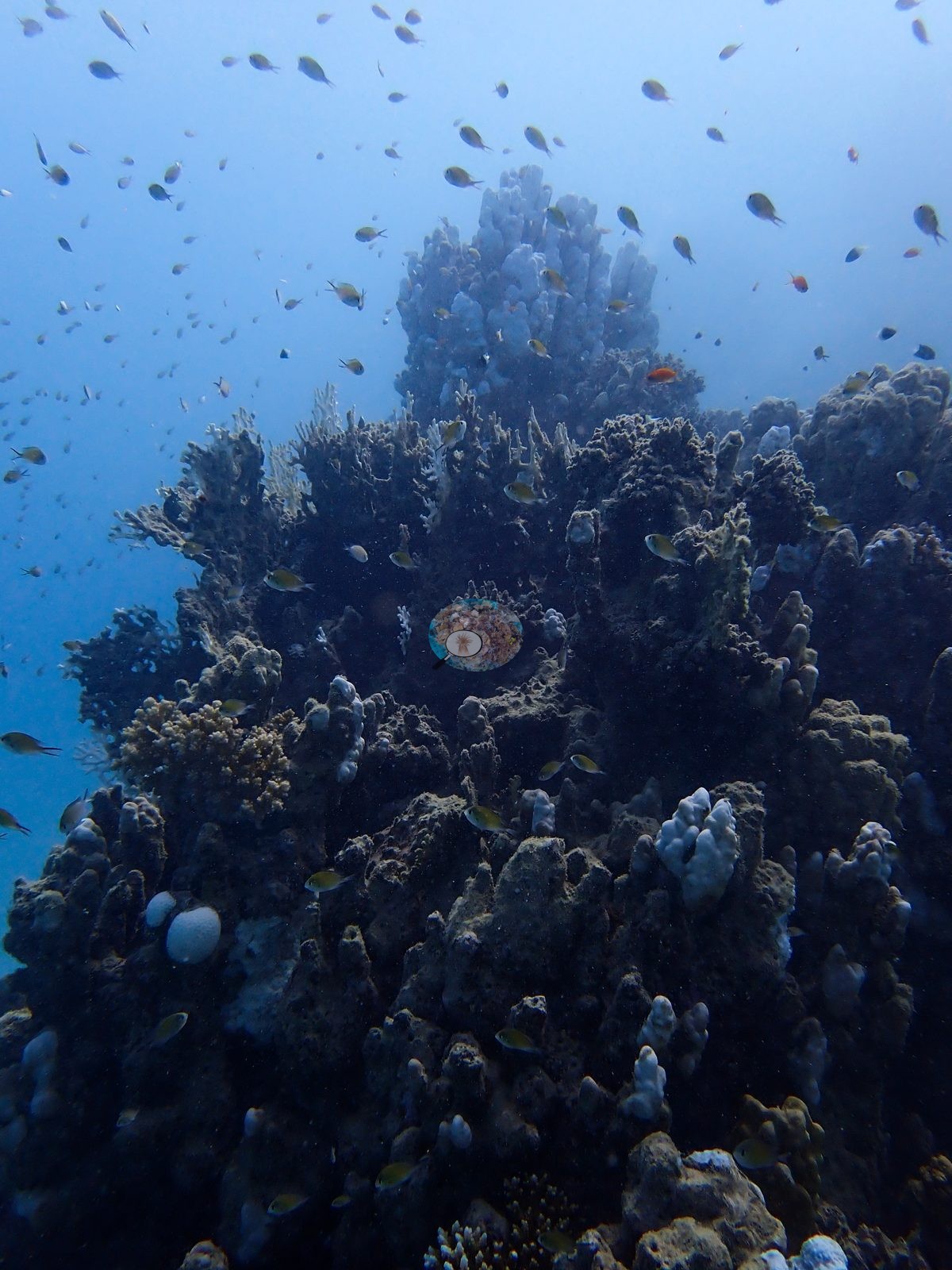
The reef runs down from a shallow flat over a broad sand-and-pavement apron (e.g., Image 2).
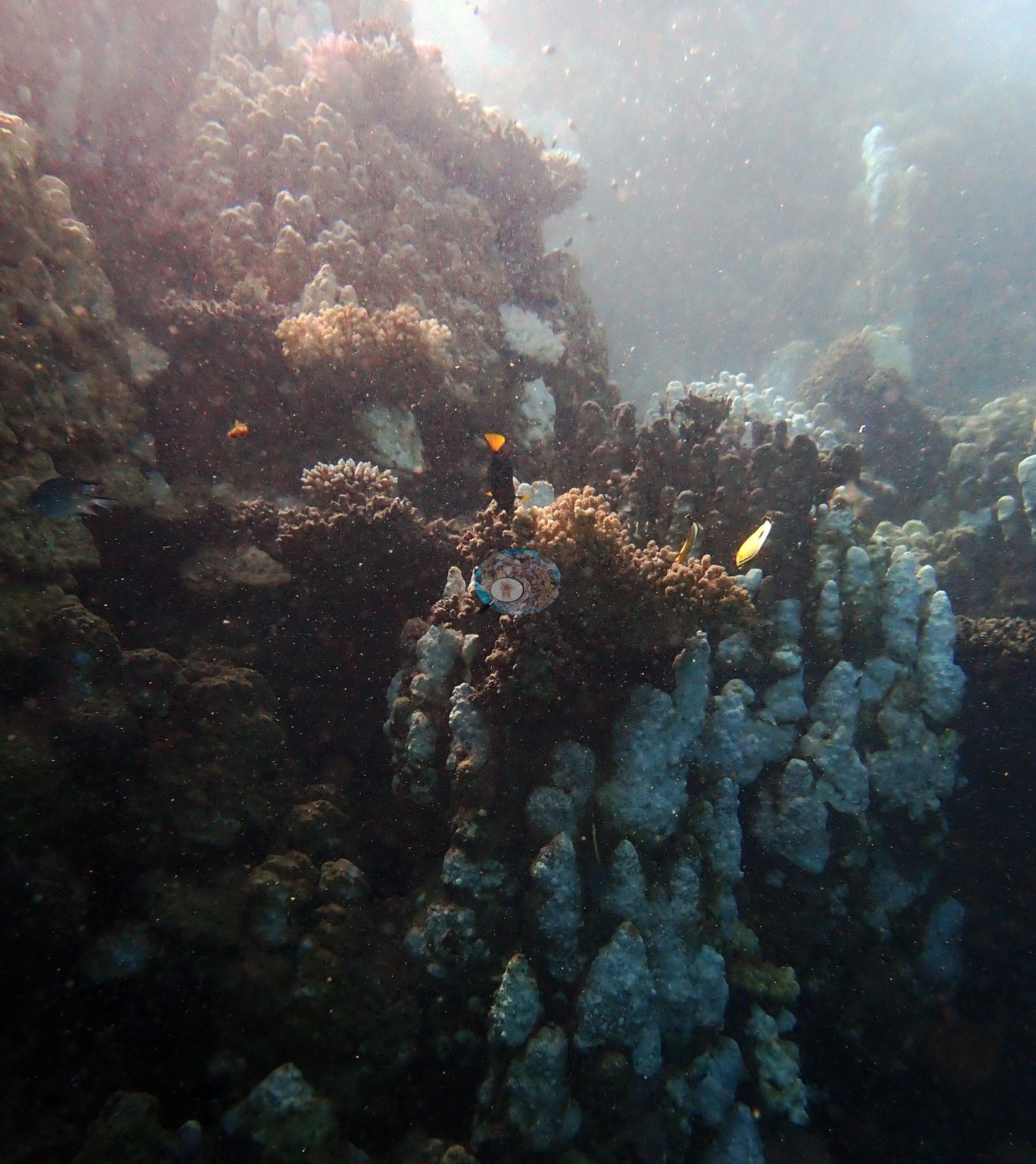
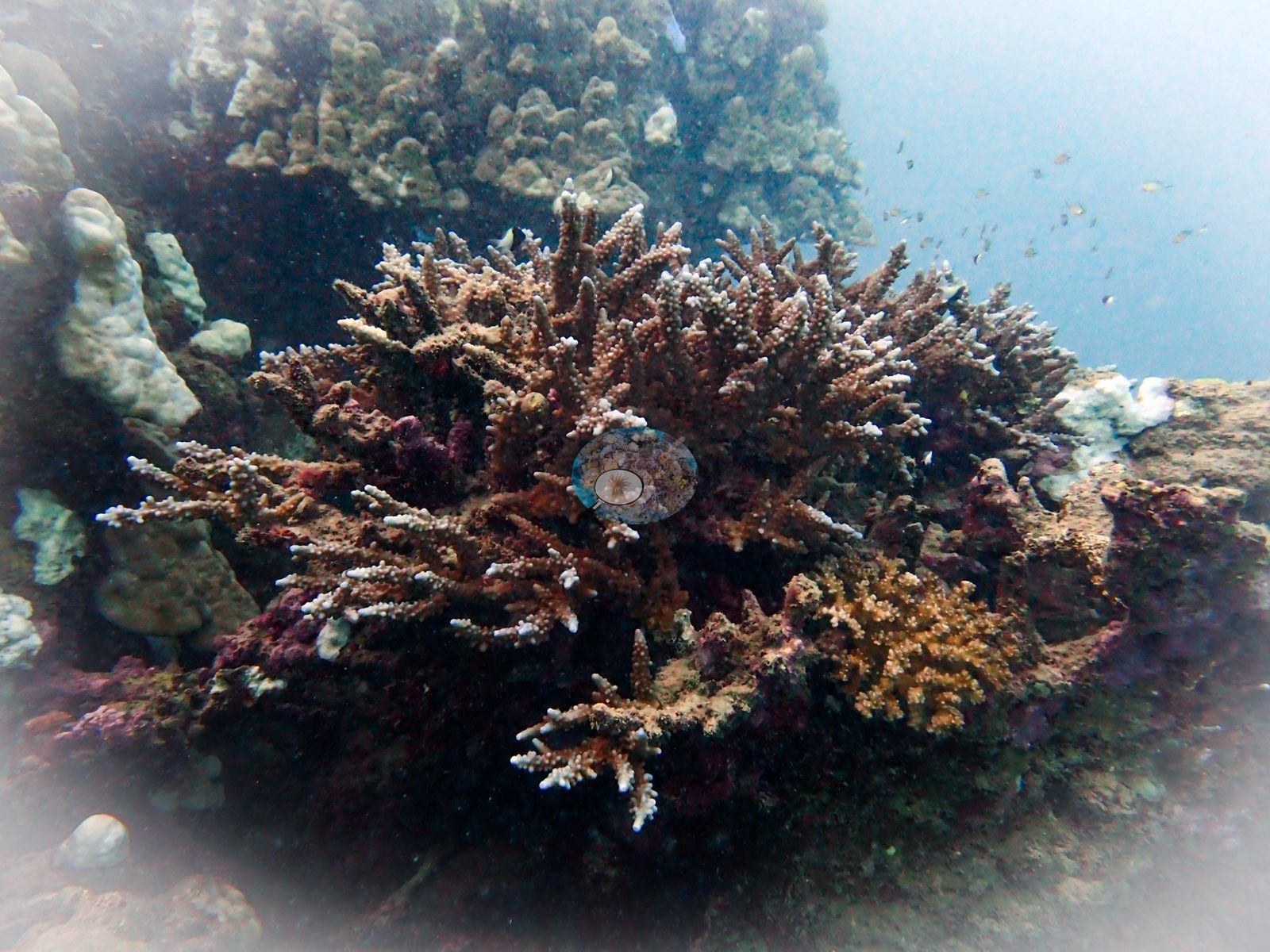
Structure is low: knobby and encrusting Porites, olive and yellow-green Goniastrea/Favites heads, corymbose and staghorn Acropora stands, fine-branched Seriatopora hystrix, Pocillopora, and a good deal of open sand between them (e.g., Image 1, Image 3, Image 4).
Coral cover
Coral cover is 25.1% ± 16.9 across 102 photographs, quoted verbatim from Mayfield, A.B. (2025) Environments 12:248 — Red Sea 2023-24 bleaching; CoralNet point annotation, Appendix A — a manual, diver-annotated CoralNet point count from Anderson's own published work, not a computer vision output and not recomputed here.
Stressors
The site record reports 50.4% of coral tissue bleached at about 21.9°C-weeks DHW, and adds a standing note for the Egypt leg: nearly all corals at these sites showed some degree of bleaching. What makes this dive worth reading closely is not the reef but the sequence Anderson photographed on it. He captioned frames "live corals", "survivors", "resilient Acropora sp.", "dying Acropora sp.", "dying Pocillopora", "dying Porites", "mostly dead Acropora", "dead Acropora", "dead Seriatopora hystrix", and "dead corals" — a graded series from healthy through dying to dead, on one reef on one day.
Comparisons with other data
The site record also carries an external cross-reference: Reef Check's Marsa Nakari South station sits 0.10 km away and reports a mean of 36.0% hard coral over seven surveys (2010–2025). The two are reported side by side and deliberately not averaged — different methods (CRD photographic point count vs Reef Check point-intercept transect), and at 0.10 km they are almost certainly the same reef. Different station, different observers: a near-concurrent cross-check, not a repeat of this site.
Other notes
See flags.
CV model comparison
More info
The reference row is this dive site's own published value (Mayfield 2025, Appendix A, 102 photos); the other rows are AREA-level (Marsa Nakari) comparisons, not run on this site's frames. ⚠ The comparison rows are REGIONS, not dive sites: the paper's main tables report cover by region, and this site's own value comes from its Appendix A. ⚠ The manual column and the CV columns are on DIFFERENT FRAME SETS: the published cover spans 674–1,180 frames, the CV arms ran on the 30- and 129-frame hand-scored reference subsets. CoralNet is n/a by design: the reference set IS the hand-scored set. DINOv3 is restricted to frames it never saw. CoralNet automated point classifier: n/a — the reference set IS the hand-scored set; these frames carry no independent CoralNet robot label to compare against CoralSCOP (SAM-based mask-sum), unedited photos: pending — CoralSCOP run: 370/747 images scored at build time CoralSCOP (SAM-based mask-sum), edited photos: pending — CoralSCOP run: 370/747 images scored at build time| Method | Hard-coral cover (%) |
|---|---|
| Manual (published) | 25.1 |
| In-house DINOv3 | 41.8 |
| Claude | 27.7 |
| Reef Check 2024 (same site) | 43.1 |
Independent surveys nearby
 Dr. Coral (CRD)
Within 5 km, 9 independent survey stations recorded hard coral cover in 50 surveys between 2003 and 2025. Of the 8 stations surveyed in more than one year, 5 declined, 1 increased, and 2 changed by less than 5 percentage points between their first and latest surveys. The longest record, Marsa Nakari South (Reef Check, 0.10 km away), went from 37% in 2010 to 29% in 2025. Surveys since 2021 average 43% (range 27–58%, n=7). This site's own estimate (25%) is indistinguishable from the recent range (27–58%): the 1.8-point gap is inside the ±7 percentage-point noise between methods; the methods differ, so the comparison is context, not a like-for-like test.
Collected by other programs using different methods (Reef Check uses point-intercept transects), so these are context for the figures above, not a like-for-like comparison. Where a station was surveyed more than once the range is shown. Station names are not dive-site names.
| Agency | Site / location | Date | Hard coral cover (%) | Distance | Link |
|---|---|---|---|---|---|
| Reef Check | Samaka Mogeha (North Marsa Nakari) | 2003–2005 | 43–49% (3 surveys) | 1.18 km | — |
| Reef Check | Checkpoint | 2003–2013 | 22–43% (3 surveys) | 3.63 km | — |
| Reef Check | Marsa Tondoba/3 Sisters | 2005–2012 | 39–61% (3 surveys) | 2.29 km | — |
| Reef Check | Gotta Nakari | 2005–2006 | 9.4–23% (3 surveys) | 2.70 km | — |
| Reef Check | Marsa Nakari South | 2010–2025 | 29–40% (14 surveys) | 0.10 km | — |
| Reef Check | Marsa Nakari North | 2010–2025 | 27–47% (13 surveys) | 0.22 km | — |
| Reef Check | Marsa Um Tondoba- 3 Sisters | 2014 | 52% | 4.61 km | — |
| Reef Check | Shaab Nakari, north-east side | 2017–2024 | 51–59% (6 surveys) | 2.88 km | — |
| Reef Check | Dream Lagoon Marsa Alam | 2022–2024 | 53–58% (4 surveys) | 1.55 km | — |
Data & links
All images from Coral Reef Diagnostics. Data are from Coral Reef Diagnostics and the organizations named in the data-sources table above.
© Coral Reef Diagnostics.