
Egypt Red Sea - Habili El Ghadeer (Marsa Nakari)
Part of the regional summaries: Egypt and Red Sea
More info
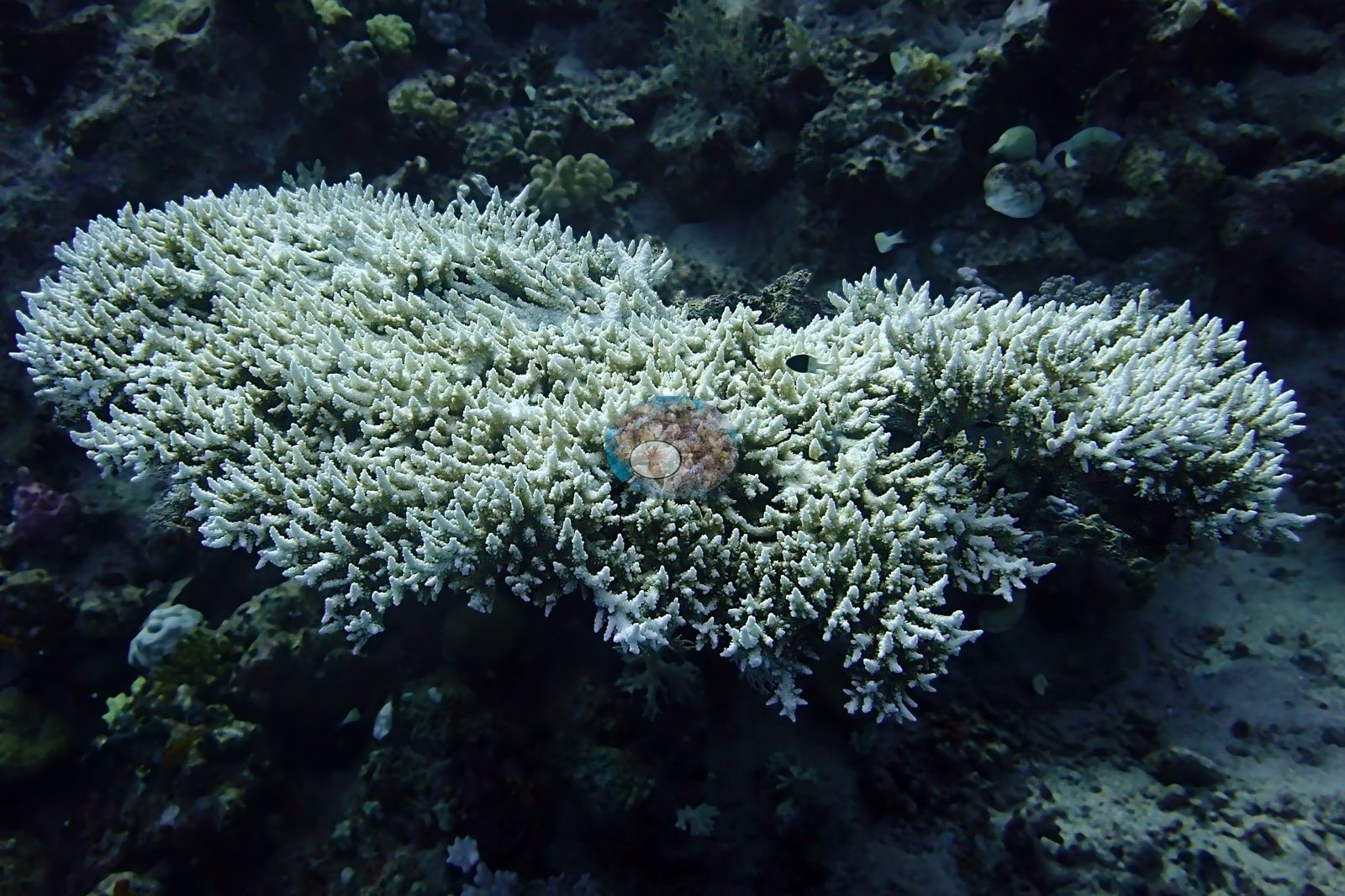
Egypt (NOAA CRW virtual station) · Northern and Central Red Sea ecoregion mean=12.2°C-heating weeksHabili El Ghadeer is a submerged pinnacle whose upper plateau is dominated by bioeroded rock and coralline algae rather than living coral - the lowest published cover of any Egyptian pin in this set at 13.2%, likely reflecting structure as much as the bleaching event itself. What coral is there was hit hard: a large table Acropora more than a meter across was photographed bleached uniformly white from center to every branch tip, consistent with the site's 57.2% tissue-bleaching figure.
حبيلي الغدير قمة مغمورة يسيطر على هضبتها العليا صخر متآكل حيوياً وطحالب مرجانية بدلاً من المرجان الحي — وهو أدنى غطاء منشور بين المواقع المصرية في هذه المجموعة عند 13.2%، وهو ما يعكس على الأرجح البنية بقدر ما يعكس حدث الابيضاض نفسه.
ترجمة هذا الملخص بالذكاء الاصطناعي؛ النص الإنجليزي هو المعتمد. Translated from the site’s shorter map summary.
Site description
Setting
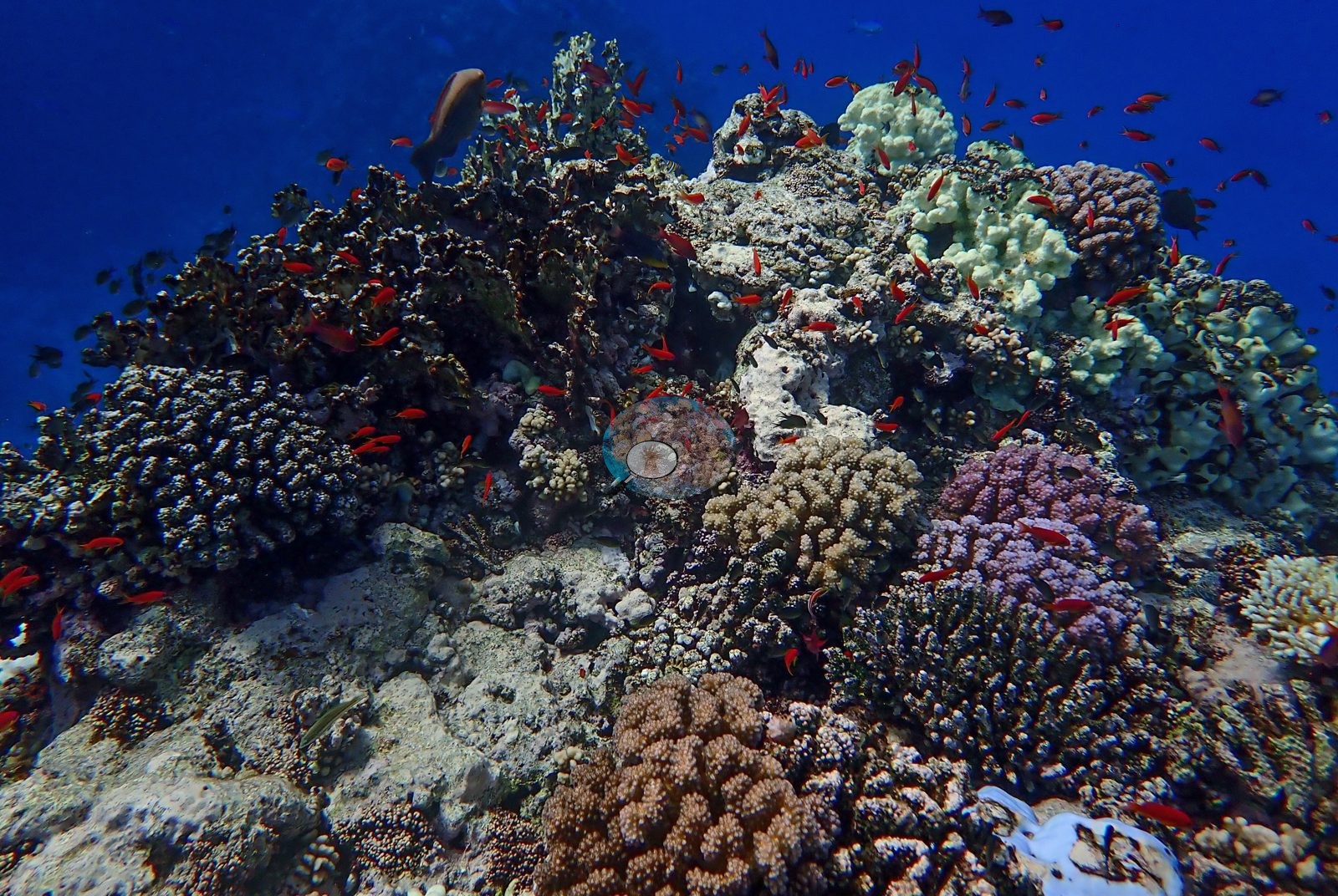
An offshore habili — a submerged pinnacle that does not break the surface — dived on the morning of 21 September 2024 with Red Sea Diving Safari. The structure is a steep-sided tower rising from deeper water, its flanks dropping away into blue on every side (e.g., Image 1).
General benthic features
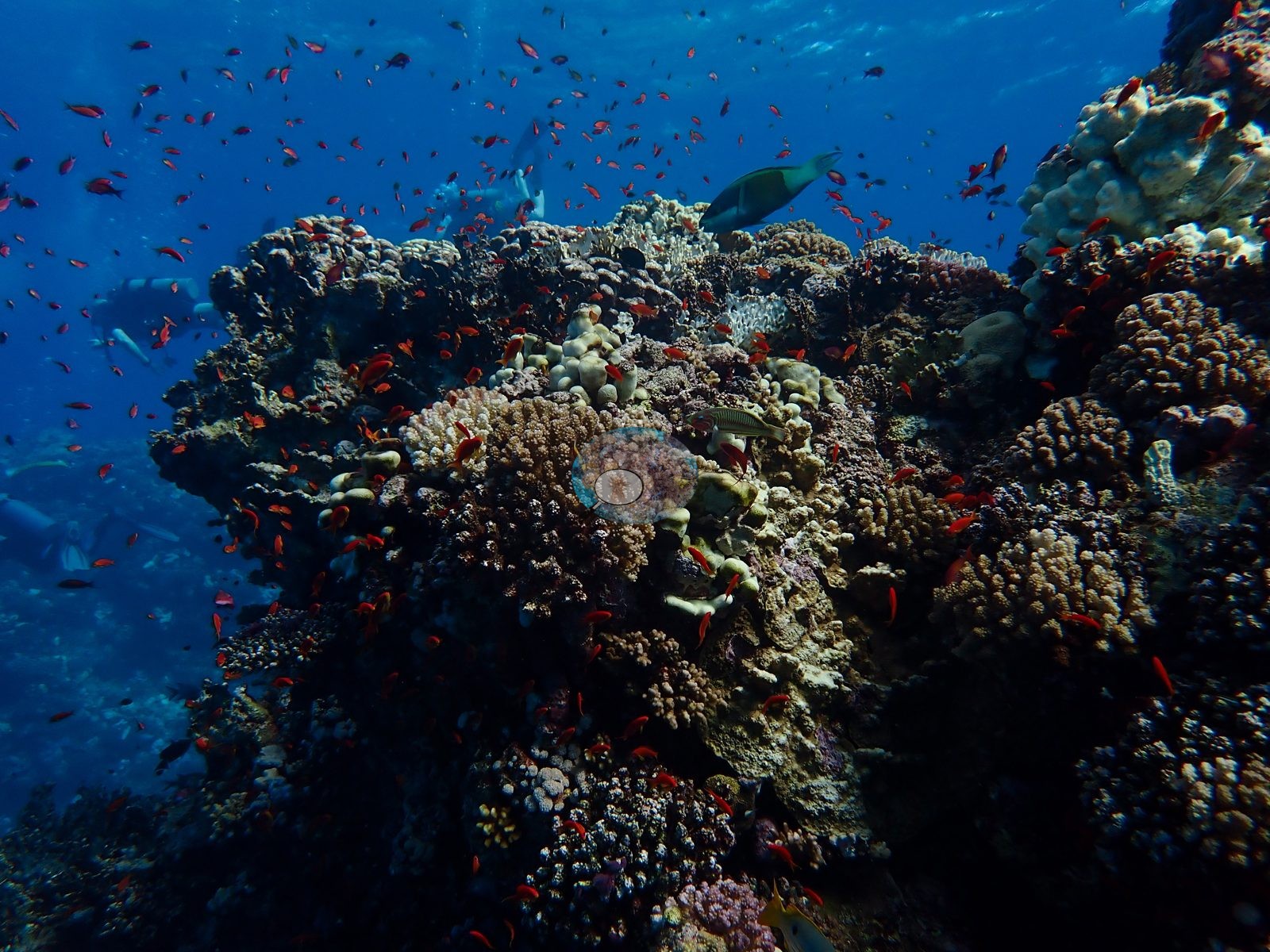
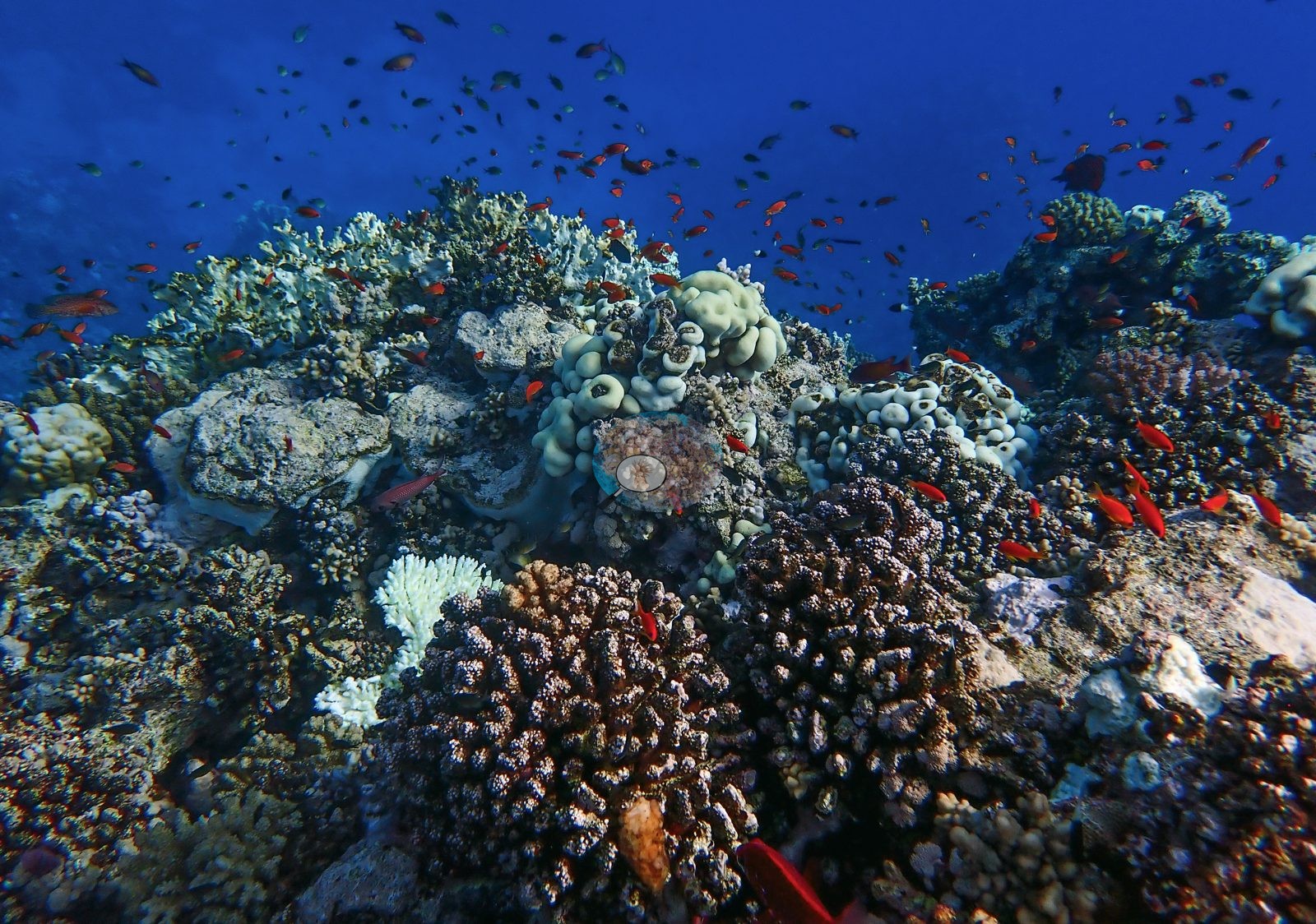
The upper surface is a dark, rugged, heavily bioeroded plateau — largely maroon and purple encrusting coralline algae, turf, and old framework, with coral occupying a minority of the surface. What coral there is sits in tight clusters: cauliflower and knobby pocilloporids, small corymbose Acropora, foliose, and encrusting plates in olive and mustard, and a few large table Acropora cantilevered off the rim into open water (e.g., Image 2, Image 3).
Coral cover
Coral cover is 13.2% ± 11.6 across 161 photographs, the lowest of the Egyptian sites in this set, quoted verbatim from Mayfield, A.B. (2025) Environments 12:248 — Red Sea 2023-24 bleaching; CoralNet point annotation, Appendix A — a manual, diver-annotated CoralNet point count from Anderson's own published work, not a computer vision output and not recomputed here.
Stressors
The site record reports 57.2% of coral tissue bleached at about 21.9°C-weeks DHW. The single frame Anderson captioned by hand is the site's headline: a very large elongate table Acropora, more than a meter across, bleached uniformly white from its center to every branch tip (e.g., Image 4).
Fish and other fauna
Red anthias hang in curtains along the flanks, and a well-camouflaged scorpionfish sits motionless on the encrusting rock in one frame.
Comparisons with other data
No prior survey data from this site. If you would like to share yours, please email us.
Other notes
See flags.
CV model comparison
More info
The reference row is this dive site's own published value (Mayfield 2025, Appendix A, 161 photos); the other rows are AREA-level (Marsa Nakari) comparisons, not run on this site's frames. ⚠ The comparison rows are REGIONS, not dive sites: the paper's main tables report cover by region, and this site's own value comes from its Appendix A. ⚠ The manual column and the CV columns are on DIFFERENT FRAME SETS: the published cover spans 674–1,180 frames, the CV arms ran on the 30- and 129-frame hand-scored reference subsets. CoralNet is n/a by design: the reference set IS the hand-scored set. DINOv3 is restricted to frames it never saw. CoralNet automated point classifier: n/a — the reference set IS the hand-scored set; these frames carry no independent CoralNet robot label to compare against CoralSCOP (SAM-based mask-sum), unedited photos: pending — CoralSCOP run: 370/747 images scored at build time CoralSCOP (SAM-based mask-sum), edited photos: pending — CoralSCOP run: 370/747 images scored at build time| Method | Hard-coral cover (%) |
|---|---|
| Manual (published) | 13.2 |
| In-house DINOv3 | 41.8 |
| Claude | 27.7 |
Data & links
All images from Coral Reef Diagnostics. Data are from Coral Reef Diagnostics.
© Coral Reef Diagnostics.