
Alor - Lobang

Part of the regional summary: Indonesia - Alor
More info
East Nusa Tenggara (NOAA CRW virtual station) · Lesser Sunda ecoregion mean=6.9°C-heating weeks Alor and the Pantar Strait sit in a zone of exceptionally strong upwelling, which holds these reefs several degrees cooler than NOAA’s satellite-derived figures imply. Read the heat-stress numbers here as a regional-scale indication, not as this reef’s own temperature history.A night muck dive off Alor over dark volcanic sand and shell hash with almost no coral framework, where the life is the draw: feeding yellow cup corals, a banded boxer shrimp under a crinoid, a gold-edged black flatworm, and a camouflaged scorpionfish. A few hammer- or anchor-type corals also stood out.
Penyelaman muck malam hari di lepas Alor di atas pasir vulkanik gelap dan serpihan cangkang yang nyaris tanpa kerangka karang, tempat daya tariknya adalah kehidupannya: karang cangkir kuning yang sedang makan, udang petinju belang di bawah lili laut, cacing pipih hitam bertepi emas, dan ikan lepu batu yang menyamar. Beberapa karang bertipe palu atau jangkar juga menonjol.
Terjemahan ringkasan ini oleh AI; versi bahasa Inggris yang berlaku.
Site description
Setting
Lobang is a night dive off Alor in the Lesser Sundas, made 2 August 2026 to about 20.9 m, and it is a muck site rather than a reef: the substrate in every frame is dark volcanic sand and grit mixed with shell hash and scattered rubble, with the strobe beam falling off into black at the edges.
General benthic features
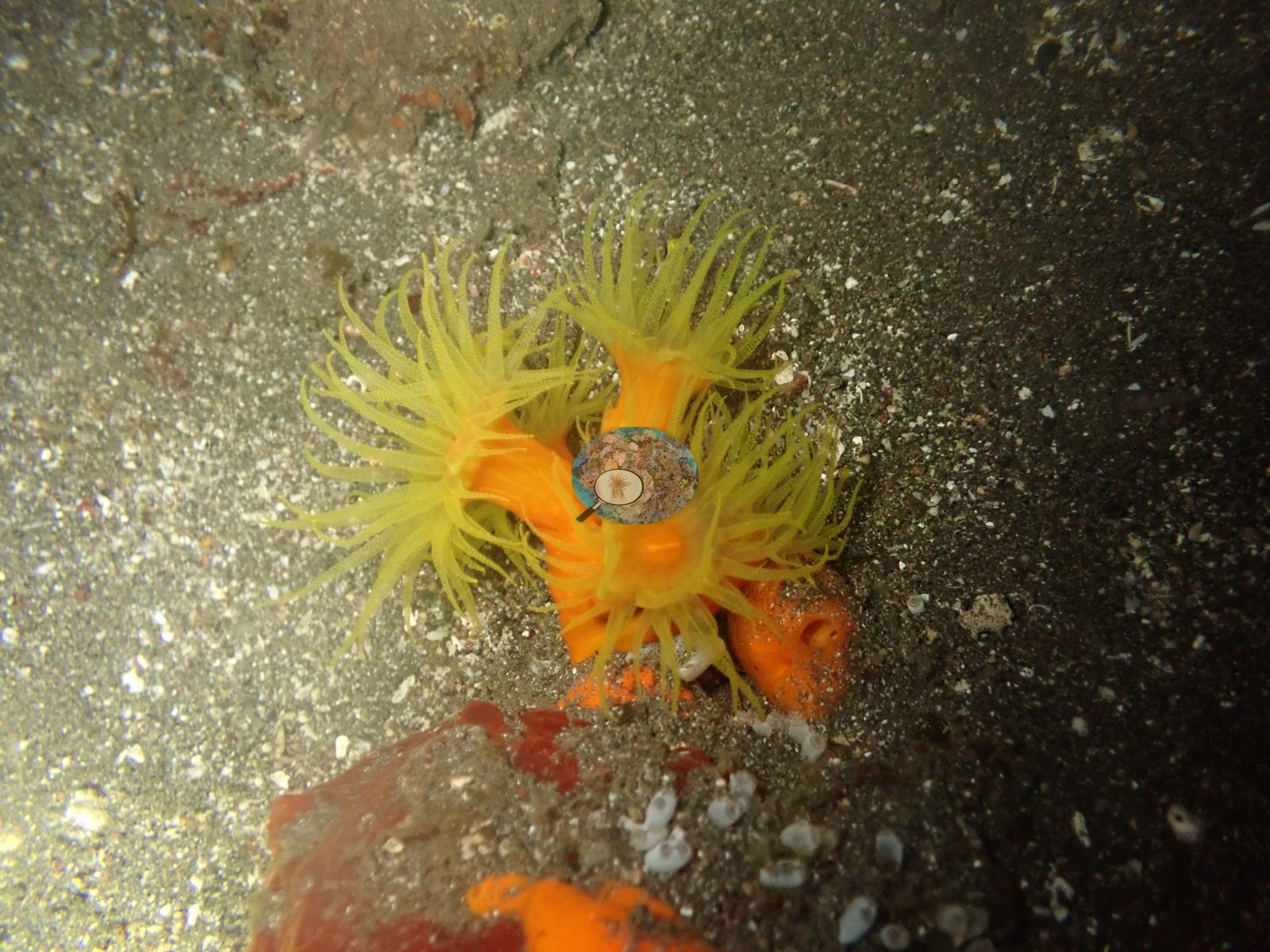
A cluster of bright yellow cup-coral polyps (Tubastraea-type) sits fully expanded on an orange encrusting sponge, feeding in the dark (e.g., Image 1).
There is almost no hard coral framework in these frames.
Coral cover
No coral cover figure is published, and rightly so - strobe-lit macro shots on a non-coral-dominated muck bottom are not planar benthic quadrats and a point count would not mean anything here.
Stressors
No crown-of-thorns starfish (COTS) or other corallivores evident.
Fish and other fauna
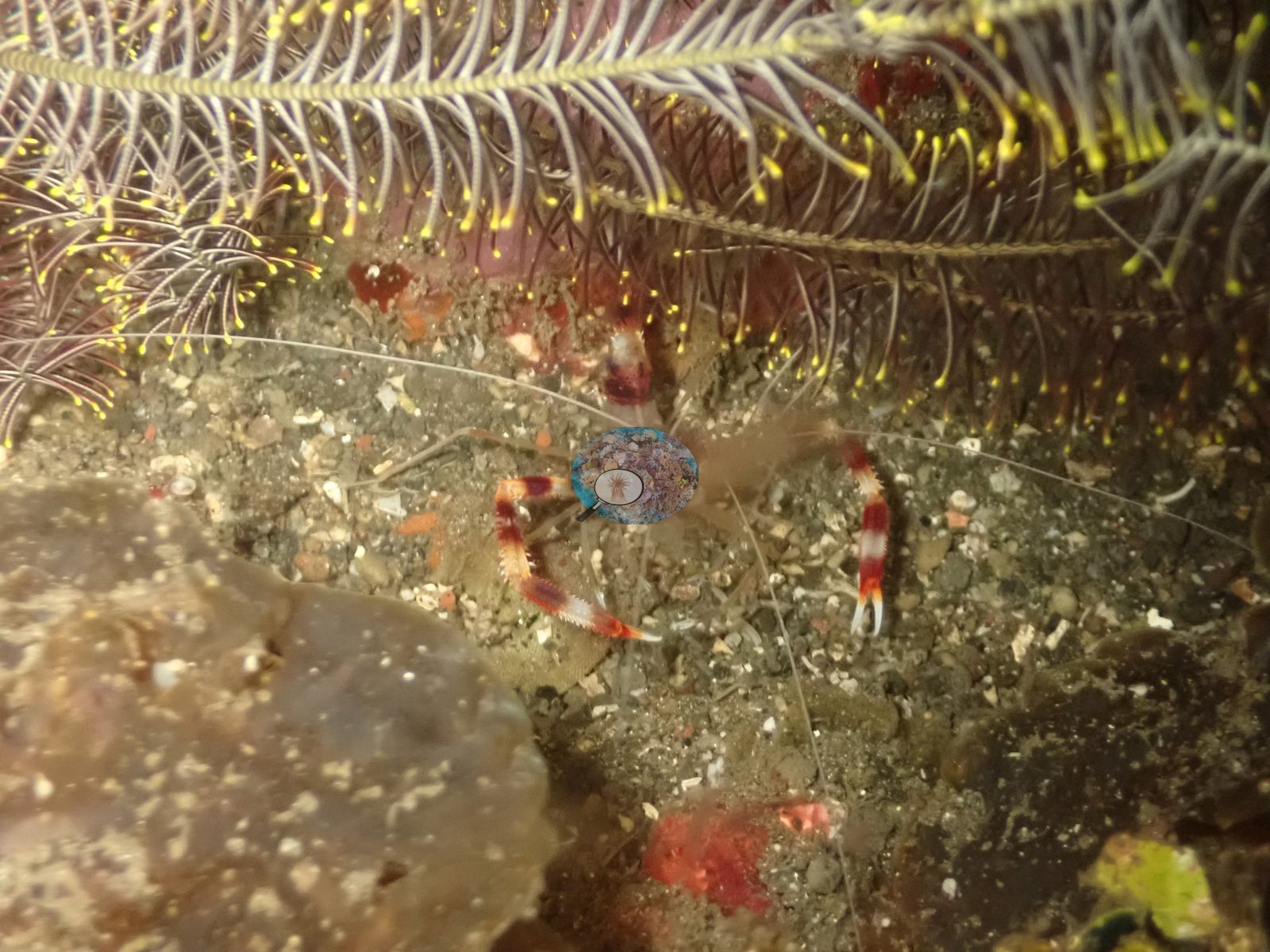
What lives there is what makes the dive. A banded boxer shrimp with long white antennae shelters under the arms of a crinoid, its white-and-red barred legs unmistakable against the sediment (e.g., Image 2).
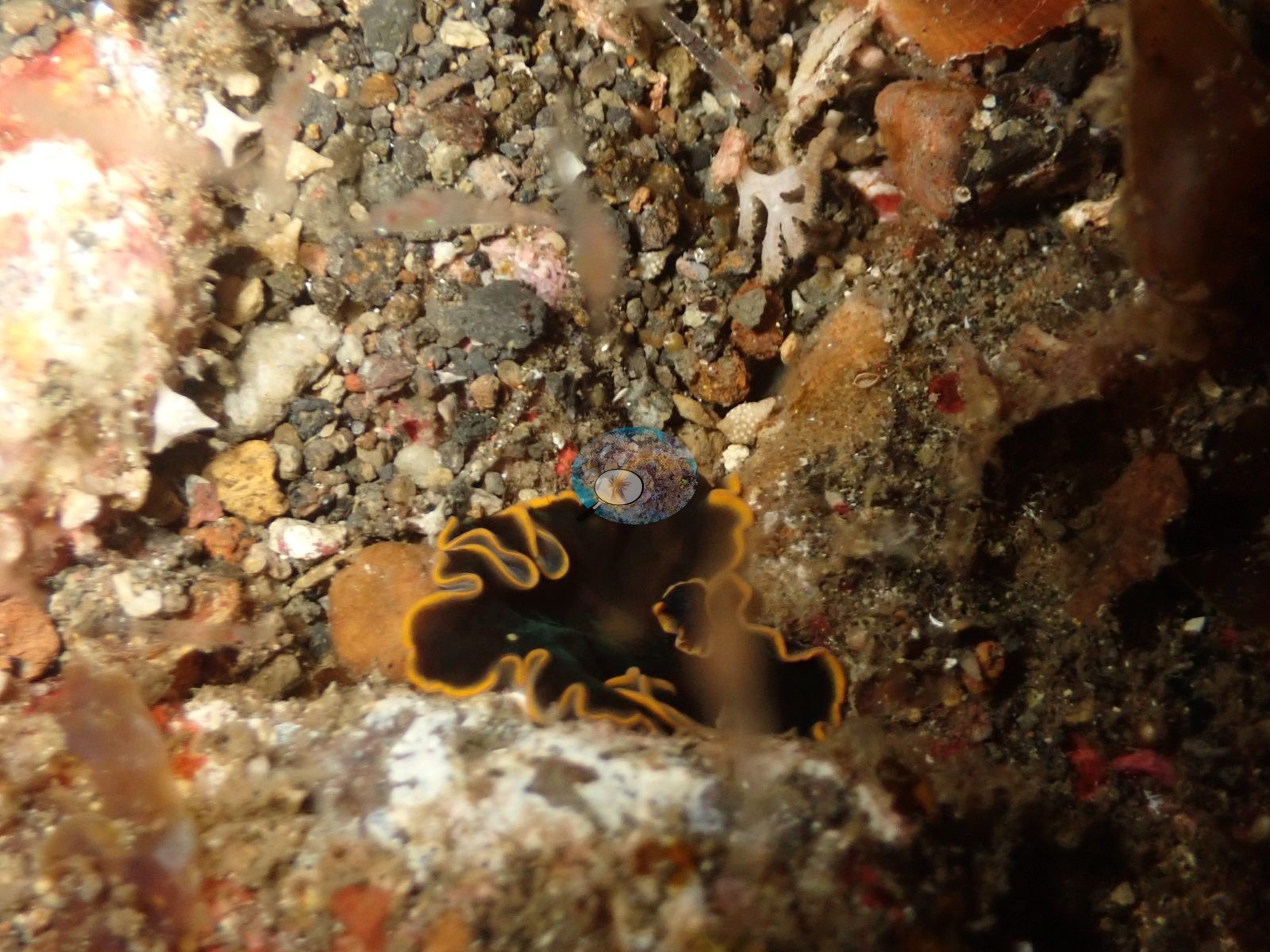
A black polyclad flatworm with a rippling gold-margined edge glides across coarse black gravel (e.g., Image 3).
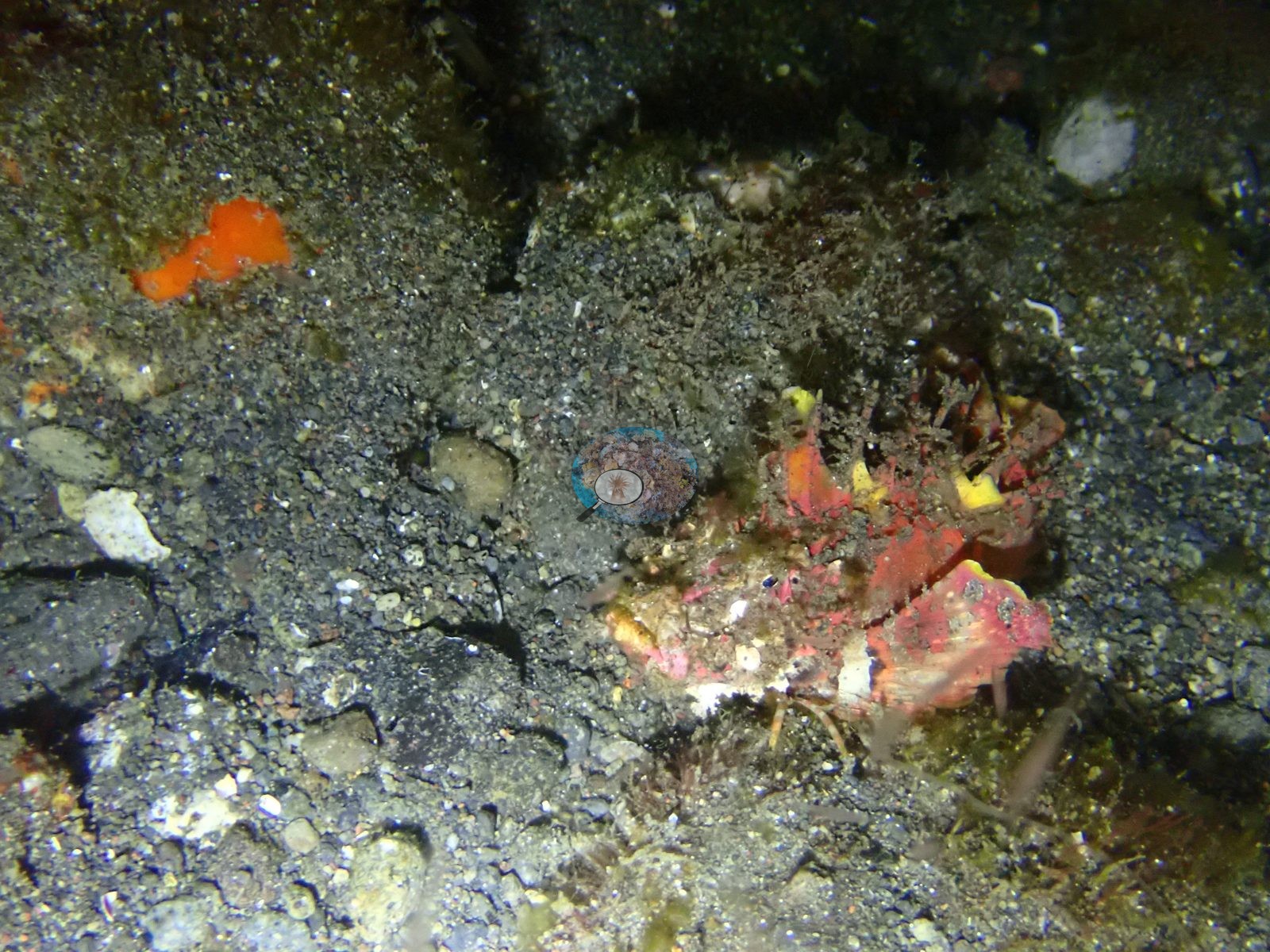
And a small scorpionfish, mottled pink, red, and yellow and fringed with skin filaments, sits invisible until the light hits it, buried to the eye in silt (e.g., Image 4).
Comparisons with other data
Also on record for this site: A night dive over rock, rubble, and sand with sparse coral cover but several distinctive large-polyp corals, including anchor- or hammer-coral forms compatible with Euphyllia/Fimbriaphyllia. Macro subjects include an electric-flame-scallop-type file clam (Ctenoides sp.) with a mantle rim bearing long tentacles, a phyllidiid dorid nudibranch (Phyllidia-type), a large orange-red snapping or pistol shrimp (Alpheidae), and a well-camouflaged scorpionfish. Sponges, anemones, and additional small benthic fishes and crustaceans were also photographed. The close-up emphasis limits wider habitat interpretation; this is a nocturnal muck site defined by its macro fauna.
Data & links
All images from Coral Reef Diagnostics.
© Coral Reef Diagnostics.