
Kenya — art-led conservation site selection
Tap any score to see why. Scores 0–5, weighted. Anderson Mayfield · 3 Nov 2026 · Indonesia version
The goal. Coral reefs are being lost faster than conservation can replace them, and almost everything tried so far ends when the funding does. This is an attempt at the alternative: a reef economy that pays for itself and reverses coral decline at the same time — not another project sunk into a place, but something a community owns, earns from, and keeps. Legally sink an inspiring piece of art, then build a community around it, complete with jobs. Art is the catalyst, not the product.
The approach. Seven candidate areas along the Kenyan coast, from Shimoni near the Tanzanian border to Pate Island in the Lamu archipelago, were scored on 13 weighted dimensions with the same instrument used for Indonesia. The evidence: Anderson’s own 21 Kenyan dive sites (photos; March–April 2024, during the 2024 bleaching event), historical cover from HeatCRD, WCS Kenya surveys via MERMAID, Reef Check, REEFolution’s Shimoni surveys, 36 Kenyan locations on Anderson’s interventions map, and his Global Coralition site scoring. Six dimensions are measured; seven are judgment calls, flagged as such in every box. Unlike the Indonesia page, all seven candidates stay in the table, so any of them can win if the weights favor it.
Where they are
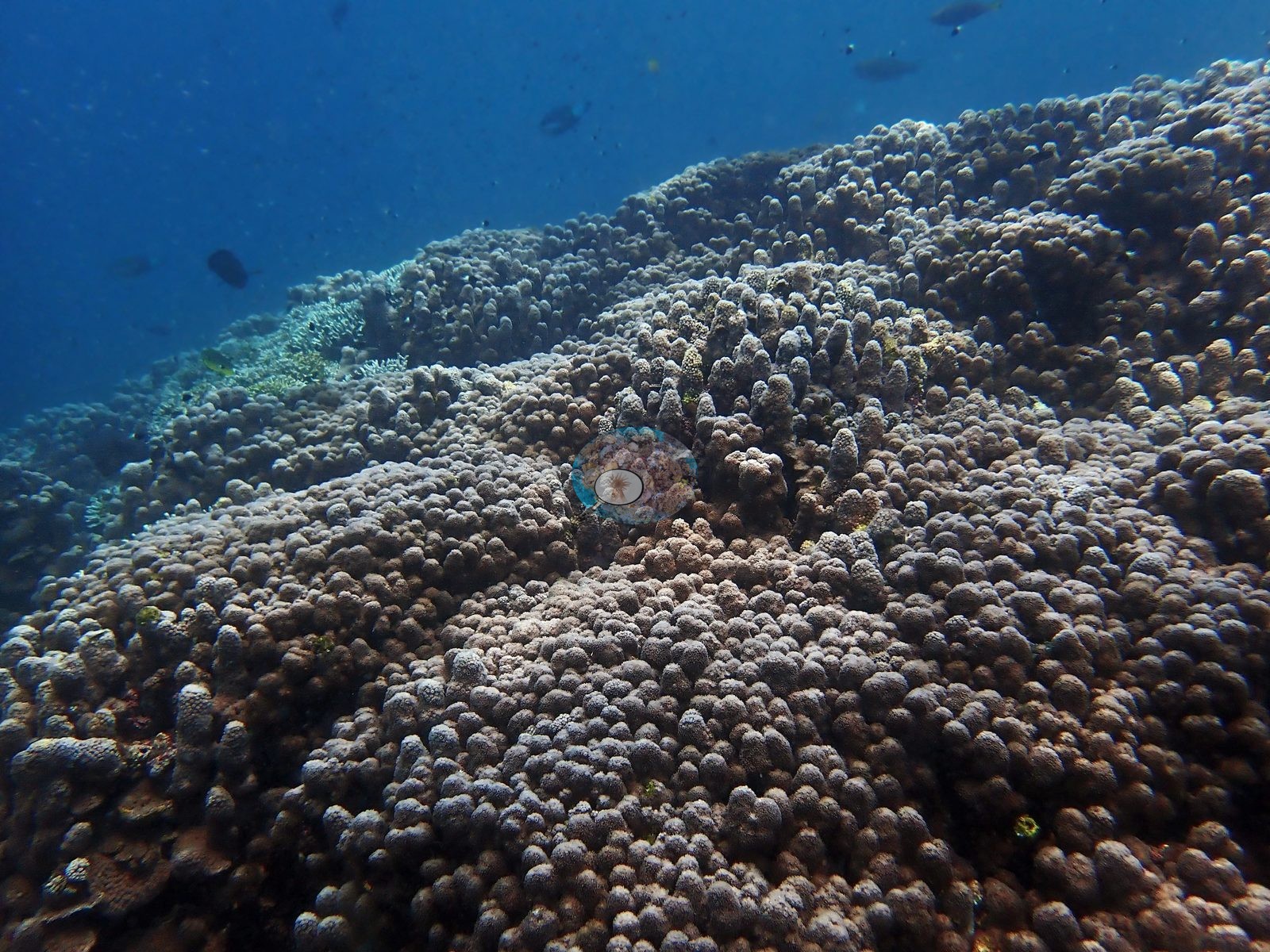
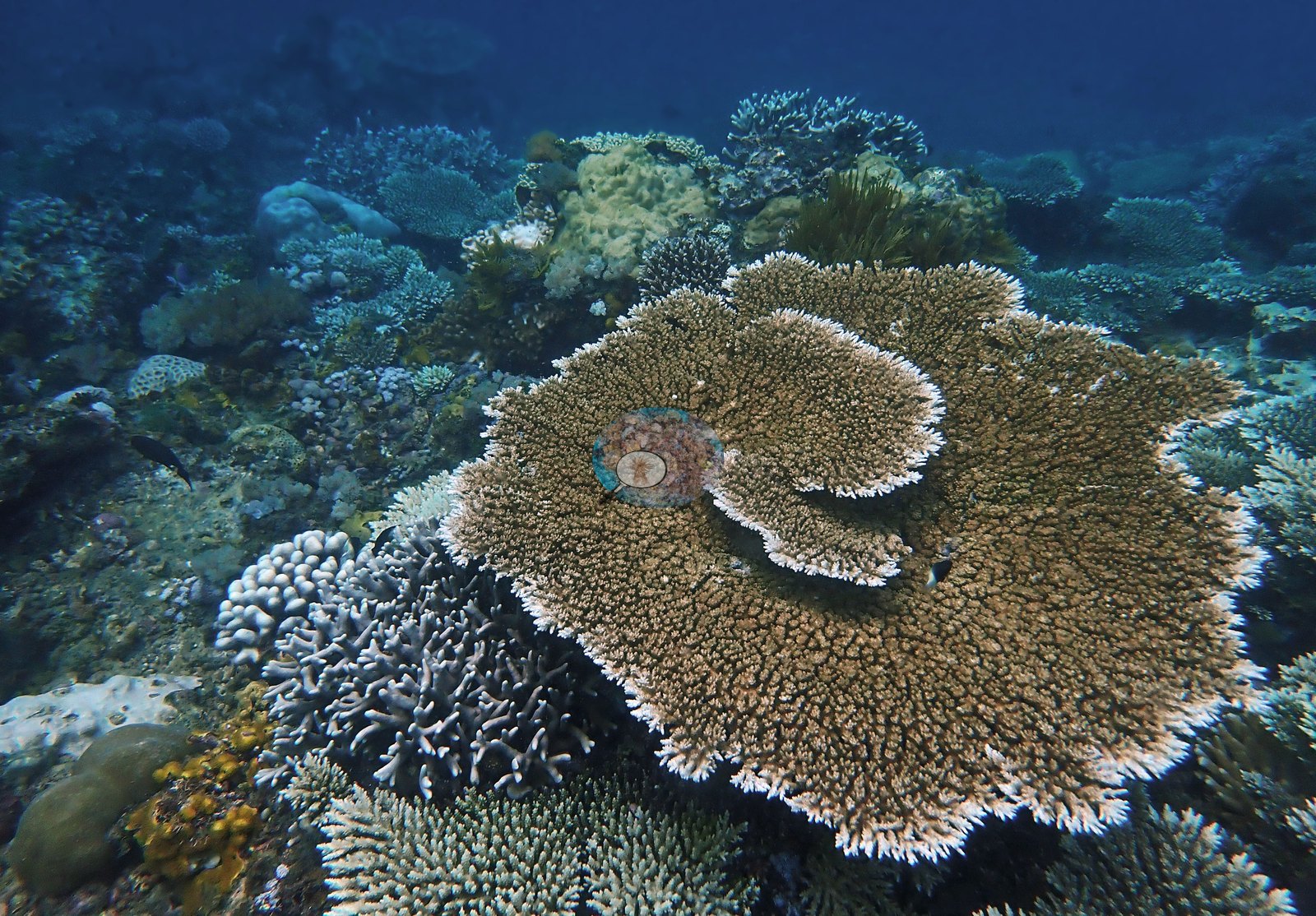
Large circles are the seven candidates, colored on the same 1–5 scale as the table and sized by rank; they update as you move the weights. Small white dots are Anderson’s own 2024 dive sites: click one for its coral cover and photos.
Who won: Shimoni–Wasini / Kisite, clearly. At the default weights it scores 3.71, ahead of N Mombasa 3.44, Mombasa south 3.26, Diani 3.25, Watamu 3.11, Kilifi 2.58 and Lamu 1.79. Unlike Indonesia’s near-tie, the lead survives every robustness test (below).
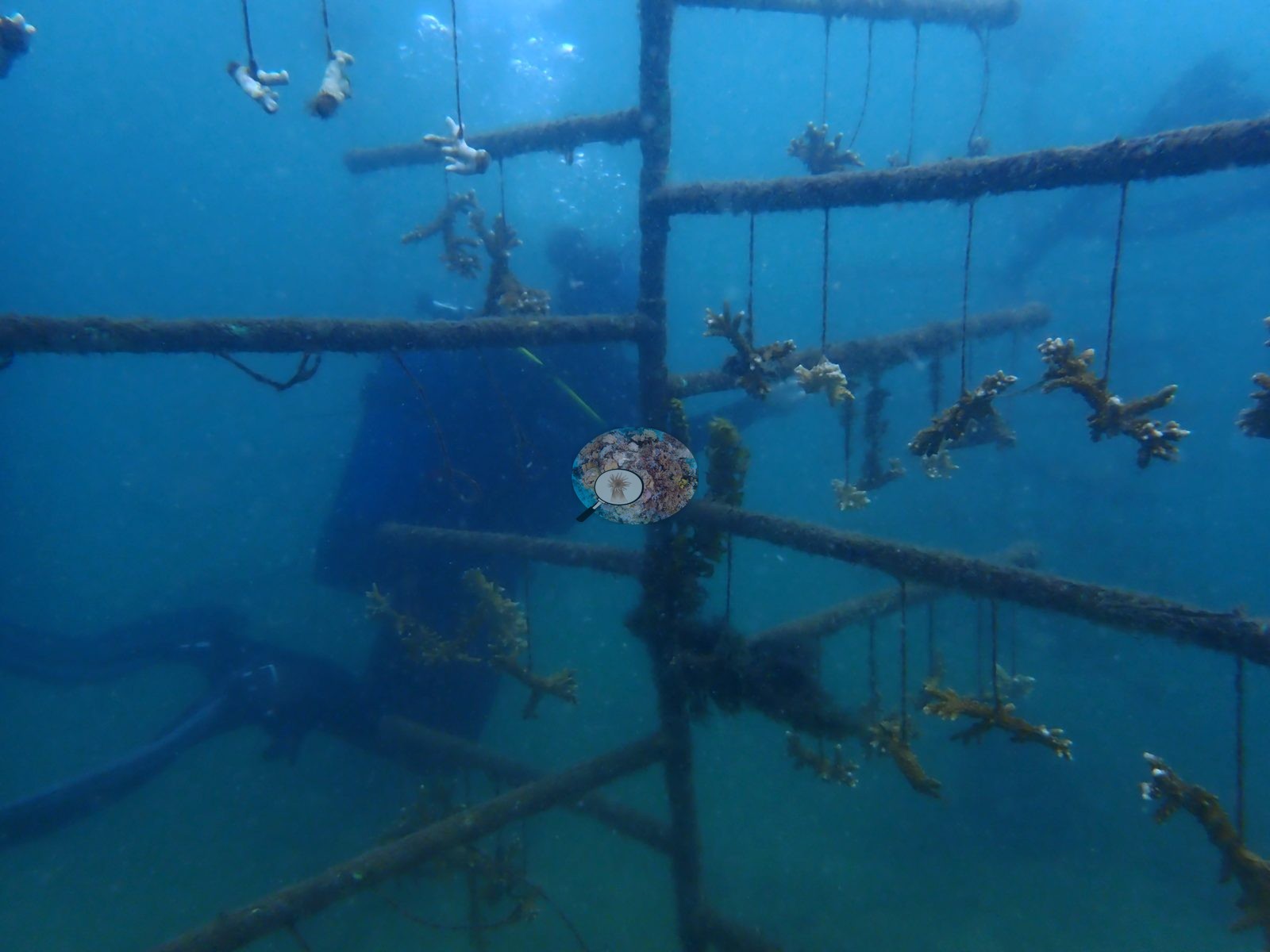
- Shimoni–Wasini / Kisite has the highest coral cover in Kenya (38.5% across 7 of Anderson’s sites), a +14.1-point recovery since 1996, a named partner already in the water (REEFolution’s nursery is one of his dive sites), the protection of a national park, and small, coherent communities to mobilize. It is also the only Kenyan site in his Global Coralition scoring. Its weakness is revenue: visitors come on day trips rather than staying.
- N Mombasa (Nyali–Bamburi) is the only site that ever overtakes Shimoni in simulation. Its corals bleached least in 2024 (60.6% against 73–88% elsewhere), it has the biggest audience and the best local capacity, and KMFRI is on the doorstep — but a city is hard to mobilize, and urban stress is the worst in the set.
- Diani earns the most in principle and shows the largest recovery on paper (+18.9 points), but that rests on a single site, and no partner is named.
Three starting assumptions, tested against the data. “Diani’s reefs are possibly too far gone”: not supported; it read 34.9% in 2024, though on one shallow site. “Mombasa is too big a city”: the size is real, the disqualification is not, given its low bleaching and capacity. “Lamu will almost surely be too difficult”: supported on every measured row before access or security is even scored.
What would change the answer. A second Diani survey (one site currently carries the whole area); whether Mombasa’s low bleaching holds beyond his three sites; and whether Kenyan law and KWS allow an artwork to be sunk at all — the heaviest open question, scored as judgment throughout because nothing in the material settles it.
Swipe the table sideways to see all seven sites.
How much confidence do these scores carry?
A judgment matrix has no confidence interval in the statistical sense, but robustness can be tested: how often does the ranking survive being perturbed? 20,000 simulations per row. 7 of the 13 dimensions are judgment calls (61% of the weight); the other six come from data. In a seven-way race the null is 14.3%.
| Only the 7 judgment rows wrong by ±1 weights as published | Shimoni 93.0% N Mombasa 6.0% Mombasa south 0.6% Diani 0.3% | The realistic case. Shimoni beats N Mombasa at about 15 : 1; no other site is a real contender. |
| Judgment rows ±1 and weights ±40% | Shimoni 88.7% N Mombasa 9.0% Mombasa south 1.1% Diani 1.1% Watamu 0.1% | Every slider moved as far as is defensible and every subjective call allowed to move a notch: Shimoni still leads at about 10 : 1. |
| Worst case: all 91 cells wrong by ±1, weights ±40% | Shimoni 82.1% N Mombasa 12.9% Mombasa south 2.6% Diani 2.1% Watamu 0.3% | Deliberately unfair: it treats measured cover and bleaching as if they were opinions. Shimoni stays first at nearly 6× the null. |
What this licenses you to say. Shimoni is first under every error model tested. Only N Mombasa ever threatens it, and only when everything is allowed to be wrong at once. Lamu’s missing trend value is held fixed at “no data” in every simulation, so the gap cannot flatter it.
Data cautions
- HeatCRD includes Reef Check. The six Malindi/Watamu records (21.2, 23.8, 18.1, 21.9, 6.9 and 1.9%) are identical in both, so they are one source, not two. Do not cite them as corroboration.
- Reef Check barely covers Kenya: 6 sites, all near Malindi. It contributes nothing to five of the seven candidates.
- Mombasa south borrows its measured values. Anderson’s three Mombasa sites are all on the north side, so cover and bleaching for the south column are the north side’s. The one south-side survey (WCS, 2023, 32.5%) agrees on cover.
- Intervention counts overlap. At 25 km the Diani, Mombasa and Kilifi areas still share papers, so their counts are not independent.
- The 1994–2004 baselines straddle the 1998 mass die-off. Kilifi’s 2004 values (1.1%, 2.2%) are post-crash readings, so “recovery since 2004” flatters any site measured then. Different methods, sites and depths: indicative, not a controlled series.
- Lamu’s baseline. Scored as “no data”; one WCS site from 2008 (28.5%) has turned up since. Using it leaves Lamu’s trend score at 0.
- Single-site readings. Diani’s cover, bleaching and trend all rest on one site at about 2 m.
- Partner corrections (21 Sep 2026, Anderson): A Rocha Kenya is in Watamu, not Lamu; CORDIO East Africa is the correct name; the Lamu partner’s name is still unconfirmed. Re-run after the fixes, Shimoni still wins at 93.0 / 88.7 / 82.1%.
References & data sources
- Anderson’s dive sites — 21 Kenyan sites surveyed March–April 2024, with coral cover, bleaching, water temperature, coral health index and photos. Labeled [CRD] in the boxes.
- HeatCRD — van Woesik & Kratochwill (2024) heat-stress coral reef database; the source of the historical baselines. It ingests Reef Check, so it is not independent of it. [HeatCRD]
- MERMAID — WCS Kenya / WCS Tanzania benthic and bleaching surveys, 2005–2024, and the 2024 survey submitted by Kosgei J and Musembi P. [MERMAID]
- Reef Check — six Malindi/Watamu sites, 2003–2004.
- REEFolution Foundation — Shimoni reef surveys, 2017–2023, 6–9 sites a year.
- NOAA Coral Reef Watch — 2024 degree heating weeks for each area. [NOAA]
- Anderson’s interventions map — 36 Kenyan locations; papers within 25 km and their reported outcomes. [INTV]
- Global Coralition site scoring — Shimoni–Wasini 0.366, the only Kenyan site. [GC]
- Scoring engine —
score_sites.py, checked by reproducing a known matrix’s published totals before it was run on Kenya. Judgments are Anderson’s [AM] or Claude’s, the latter being the weakest evidence.
Legal status and permitting are not verified with any Kenyan authority. Statements marked “general knowledge” did not come from Anderson’s data and need confirming.